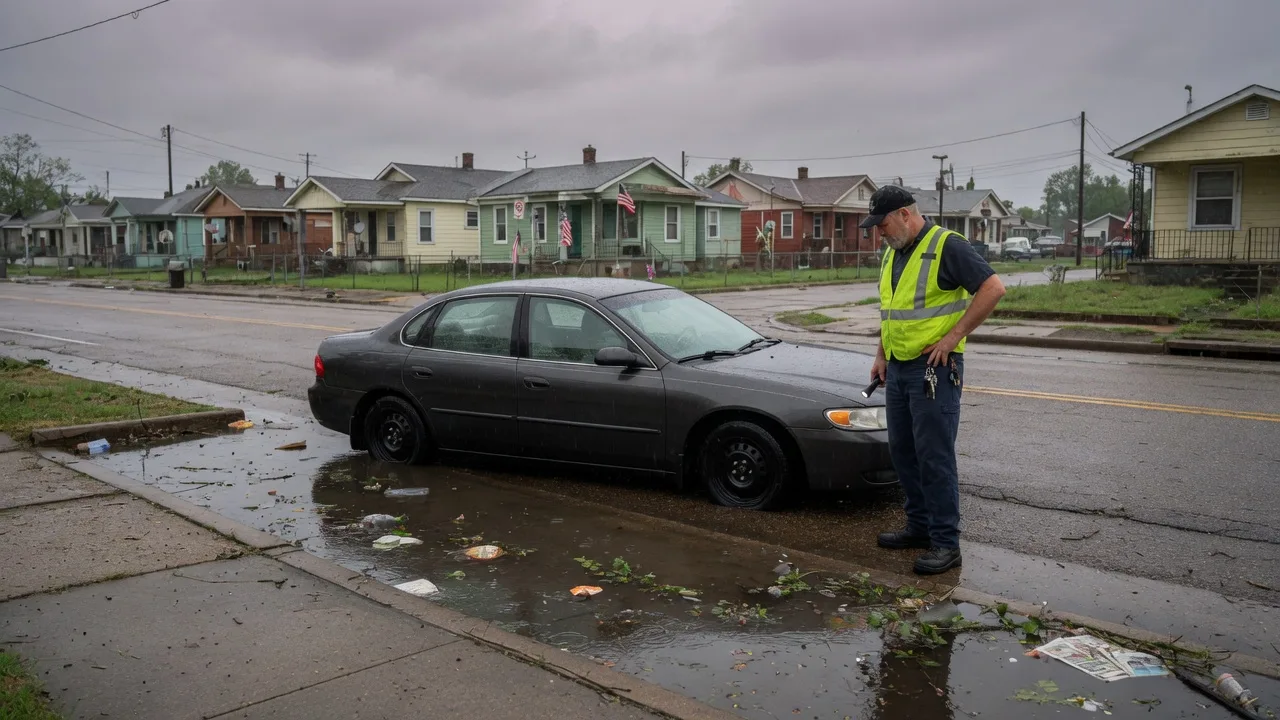
If the car stalled in standing water, leave it off. Do not crank it to “see if it will clear.” Water in the intake or the electrical system turns a wet stall into an engine job. The next move is a controlled pull onto dry pavement, then a tow to a shop if it will not run. Tell the operator the water is still around the car, or that it has receded and the car is sitting wet.
This is not the same job as a ditch winch-out. A soft shoulder is dirt and grass. Standing water is depth, current, and hidden curbs. The operator decides whether a winch from dry ground is enough, or whether the car has to ride a flatbed out.
Low streets pond. Say which one.
Memphis is largely flat. A small low area holds water after a hard rain. Frayser sits with the Wolf River, the Mississippi, and the Loosahatchie on three sides, so low streets there pond. Beale’s low blocks near the river collect water after summer storms. The airport-side flats around Winchester pond too. Name the street, the nearest cross, and whether the water is at the rocker panel, the hub, or over the floor.
Do not walk into moving water to “check the depth” for the operator. Describe what you can see from dry ground or from inside the car. Say whether other cars are still driving the lane. Say whether a curb, a median, or a drowned parking lot is the stall.
If you are on I-40, I-55, I-240, or SR-385 / Bill Morris during HELP hours, 511 may clear a blocking vehicle. TDOT HELP runs Monday through Sunday, 6:00 a.m. to 8:30 p.m. on those listed routes. HELP’s services are flat changes, fuel delivery, minor mechanical help, and clearing blocking vehicles. Jump starts are not on the list. HELP will not tow a drowned car to a shop. Lane clearance is the public job. Transport is private.
Winch from dry ground, then decide on a tow
A winch-out pulls the car back onto stable ground. A tow carries it somewhere else. After a water stall, assume you may need both. Ask the matched operator how a winch-plus-tow is billed before anyone hooks up.
Give year, make, model, and drivetrain. An electric car or a hybrid has high-voltage components. Do not open packs or pull orange cables. Our electric car towing and Tesla flatbed guides cover transport posture, not a water-rescue procedure. The operator still has to see the car.
Do not try to drag it with a strap from another passenger vehicle. That snaps equipment and yanks the drowned car into the next stall. The operators we dispatch do the recovery.
If the car is on private property, you can authorize your own pickup. A manager calling about someone else’s drowned car needs express written authorization. See can a tow truck come on private property.
What the title will say later
Tennessee requires a passenger vehicle’s title to disclose in writing if state records ever show it titled salvage, unrebuildable, parts-only, scrap, junk, nonrepairable, reconstructed, rebuilt, or flood-damaged. That disclosure rule has applied to transfers on or after October 1, 1996. A restart that hydrolocks the engine does not save you from a later flood brand. It can only add a repair bill.
We do not appraise flood cars and we do not promise insurance outcomes. Tennessee does not require auto policies to cover towing. Whether a bill is covered turns on your own endorsements. Read does car insurance cover towing in Tennessee.
If the car is already at a yard because police moved it as a hazard, call the MPD Vehicle Storage Lot at (901) 636-8200, 465 Klinke Avenue, before you drive there.
Quote the recovery, not a guess
Our standard light-duty hookup starts at $95. Winch work, standing water, vehicle size, time of day, truck type, distance, and hookup difficulty can move the total. Ask for the full amount with mileage included, in writing, before you agree. Ask whether the quote assumes a winch only, or a winch plus a tow to a named address.
Quick Tow Memphis matches you with a local operator. The operator does the recovery and contracts with you. Call (901) 557-8700. The line takes calls 24/7.