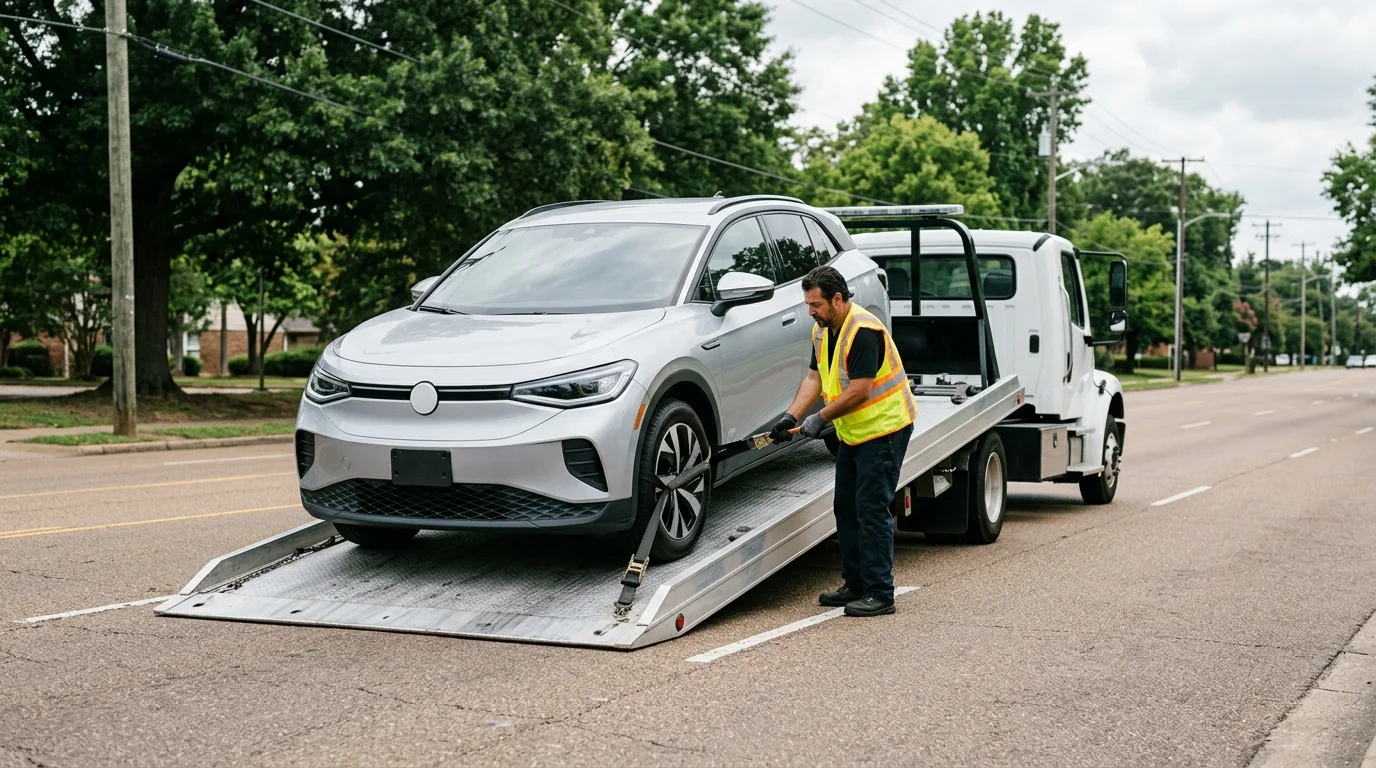
A disabled electric car needs a careful transport plan. For a Tesla or other EV in Memphis, give the recorded line the exact year, make, model, and what you can observe. The matched operator uses that vehicle’s current manufacturer instructions. Do not treat every EV as the same loading plan. The Tesla and EV towing service is the service page for that match.
Flatbed handling keeps the vehicle from being towed with its wheels down. It doesn’t establish one universal procedure for every electric car. Tow settings, approved attachment areas, and power-loss steps can differ by model and year.
Tell the recorded line the exact make and model
Start with the manufacturer, model, year, and trim if known. “Electric SUV” isn’t enough for the operator to prepare a loading plan. A Tesla Model Y may not share procedures with another Tesla, much less a different EV brand.
Say what happened in plain terms. Tell the recorded line whether the problem is a flat tire, collision damage, lost power, or another failure. If a wheel is bent, locked, missing, or pointed at an angle, mention that too. The difference can change how the vehicle reaches the deck.
Give the displayed battery level if you can see it. If the screen is dark, say that instead of guessing. Also report whether the doors open, the steering wheel turns, and the vehicle can select a drive setting. These observations help the towing operator assess the situation without treating an uncertain detail as fact.
Location matters just as much. Share the exact pickup point, not only the neighborhood. A driveway in May Creek is different from a shoulder along I-40 or a busy entrance near North Germantown Parkway. Include the direction of travel, nearby entrance, parking level, and closest visible landmark.
Our flatbed towing service page explains how we connect callers with operators for this kind of transport. Quick Tow Memphis refers the request. The towing operator performs the work and contracts with you directly.
Check current manufacturer instructions before loading
The vehicle’s current manual should guide the loading procedure. Look for a section labeled emergency towing, vehicle transport, or roadside assistance. Use the manual for the exact model year and trim.
Don’t rely on a procedure remembered from another EV. A setting with a similar name may work differently. Attachment locations and steps for keeping the vehicle ready to load may also vary. If you can’t retrieve the manual, tell the recorded line. The operator can account for that gap before moving the vehicle.
For a Tesla, our Tesla flatbed towing guide provides more context about preparing for transport. The separate Tesla transport mode guide explains where that feature may enter the conversation. Neither guide replaces the current instructions displayed by Tesla for your exact vehicle.
Have the app, key card, key fob, or other available access method ready. Tell the recorded line if any access method is missing or unresponsive. Don’t assume the operator can activate a vehicle setting without it.
Wait for the operator and the correct instructions before changing settings. Don’t copy a sequence from a different model or an old social media post. If the manufacturer’s current directions conflict with something you remember, stop and show the operator what you found.
The goal isn’t to memorize every EV procedure. It’s to give the responding operator accurate information and a reliable source for the next step.
What changes when the vehicle has lost power
“Lost power” can describe several different conditions. The battery display may show no usable charge. The cabin screen may be dark. Doors may not respond, or the car may remain in a parking position.
Describe only what you can observe. Tell the recorded line which screens, locks, lights, and controls respond. Say whether the wheels appear straight and whether the parking brake releases. If you don’t know, say so. Clear uncertainty is more useful than a confident guess.
Don’t force a control or try to drag the car into position. Leave movement, attachment, and loading decisions to the towing operator. The correct procedure must come from the vehicle’s current instructions and the condition found on scene.
A powerless EV inside a driveway may still have usable access around it. The same vehicle nose-first inside a garage presents a different problem. A car stopped near Lamar Avenue also brings traffic and positioning concerns that don’t exist in a residential parking space.
For a breakdown in active traffic, use the emergency towing service request and describe the lane, shoulder, and travel direction. On I-40, specify whether you’re near the Hernando de Soto Bridge. On I-55, identify the Memphis & Arkansas Bridge instead. You can also check TDOT SmartWay for current incident and traffic information.
Don’t attempt an EV drivetrain move from a highway shoulder. Give the recorded line the facts, follow official roadside directions, and let the operator plan the recovery.
How garages and parking access affect the setup
A flatbed request doesn’t settle every access question. The operator must still determine whether the truck can reach and align with the vehicle. Garages, gates, tight turns, low ceilings, and parked cars can limit the available setup.
If the EV is in a garage or gated structure, posted height, turning room, and whether the property will let a truck in live on can a tow truck reach a Memphis parking garage. This page stays on the vehicle: exact model, observed power, wheels, and destination.
Position inside the space matters too. Say whether the vehicle faces a wall, sits between other cars, or blocks a gate. Include which wheels can roll and whether collision damage affects one side. Photos of the vehicle and its surrounding space can help the operator understand the access limits.
Don’t move neighboring vehicles unless you control them. If a property manager must open a gate or approve truck access, contact that person before the operator arrives. Give the recorded line any entry instructions that won’t compromise building security.
An open roadside location has different constraints. Share whether the EV is on pavement, grass, a slope, or a narrow shoulder. Don’t describe the pickup only as “near Cordova” or “off the interstate.” A precise pin and travel direction prevent confusion between nearby entrances and ramps.
The operator may need to adjust the loading plan after seeing the site. That isn’t the same as applying one method to every EV. Vehicle instructions and physical access both shape the final approach.
What to confirm before the operator arrives
Keep the recorded-line details together so they’re easy to repeat. Confirm the exact vehicle, its condition, and the pickup environment. A short, accurate summary is better than a long theory about the failure.
Before the operator arrives, confirm:
- The make, model, model year, and trim, if known
- The visible battery level, or that the display is dark
- Whether the doors, steering, controls, and parking brake respond
- The condition and direction of all four wheels
- Any collision damage, fluid, debris, or blocked access
- The exact pickup pin and requested destination
- Garage clearance, gate access, ramps, and parking level
- Which key, card, fob, or app access is available
- Where to find the current manufacturer transport instructions
Tell the recorded line if any detail changes. A tire that loses its remaining air or a garage gate that won’t open can affect the operator’s plan.
Distance, vehicle size, time of day, truck type, and hookup difficulty can move the amount. Ask what circumstances could change it. Ask for the full total with mileage included, in writing, before you agree. The operator sets the total and contracts with you directly.
If the destination is a service center, repair shop, home, or storage location, confirm that the receiving location can accept the vehicle. Don’t assume a named destination has room or access at the time of the tow. Give the operator the correct entrance when the property has several driveways.
Good preparation won’t replace professional handling. It gives the operator the information needed to approach your EV without treating another model’s instructions as interchangeable.
When to call us
Call when your Tesla or other EV needs transport, can’t roll normally, or needs a loading plan based on that vehicle’s instructions. The recorded line takes calls 24/7 and matches you with a local operator who contracts with you directly. Call (901) 557-8700.