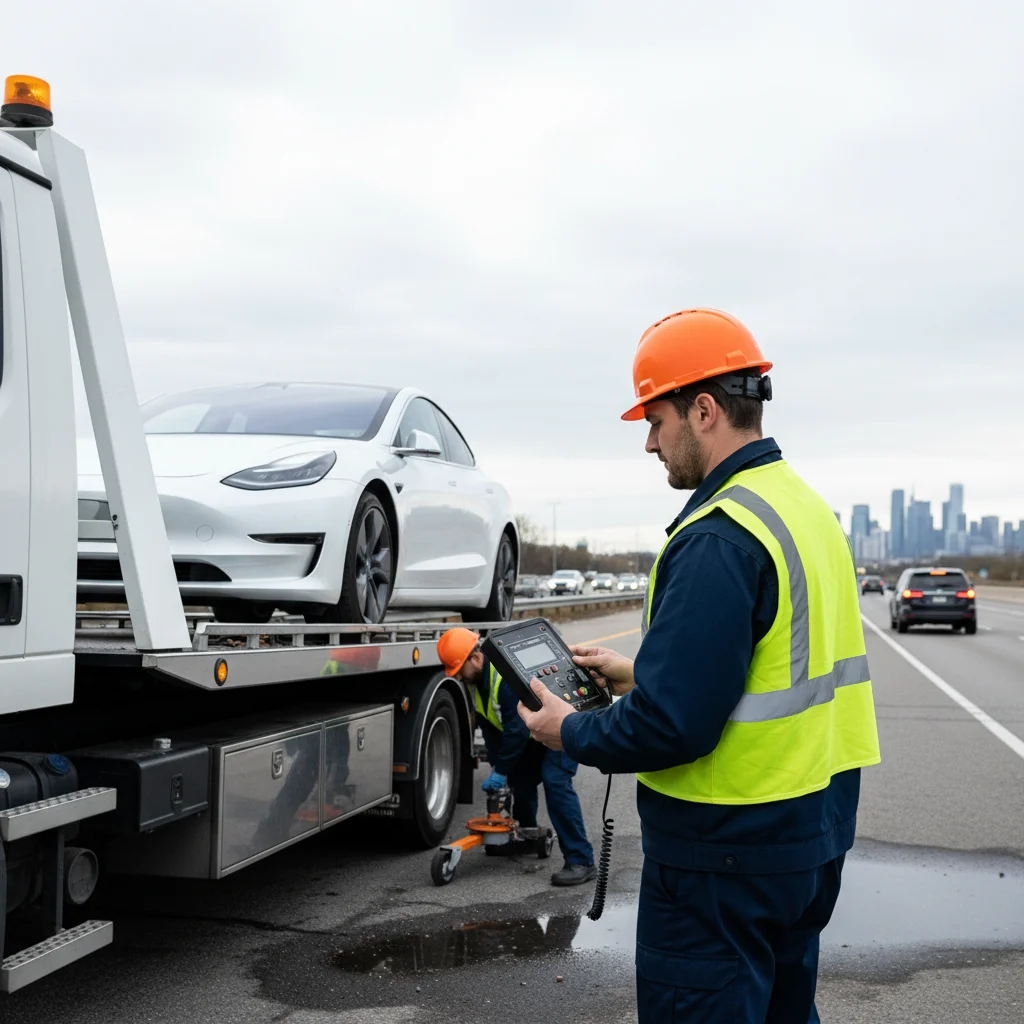
A Tesla shouldn’t be treated as a routine roll-and-go tow. There isn’t one confirmed loading method for every model, model year, battery condition, and wheel condition. Request a flatbed, then have the operator follow the current Tesla instructions for your exact vehicle.
That distinction matters. “It’s a Tesla” isn’t enough information for a safe match.
Start with the instructions for your exact model
Begin with the current owner’s manual for the exact Tesla. Match the model, model year, and configuration shown on the vehicle. Don’t rely on instructions remembered from another Tesla or an older manual.
We couldn’t confirm one manufacturer procedure that applies to every Tesla in every condition. That means a broad rule from a forum, video, or roadside conversation shouldn’t replace the current manual. The matched operator should review the applicable loading instructions before moving the car.
If you can safely access the manual, look for the roadside assistance, transport, or towing section. Share that information with the operator. If you can’t access it, explain exactly what you can observe. The operator can then confirm the next step before loading begins.
Start with these details:
- The exact model and model year
- Whether the car has electrical power
- Whether the screen, lights, or doors respond
- Whether every wheel appears intact
- Whether any wheel is turned, blocked, or damaged
- Whether the car is in a parking space, driveway, garage, or traffic lane
- Whether charging equipment is connected
- Whether collision damage is visible
Our flatbed towing service connects drivers with local operators for this type of move. Requesting a flatbed identifies the service you’re seeking. The exact loading setup still depends on the car’s current instructions and physical condition.
Don’t try to force the car to roll. Let the operator inspect it first.
Why the driven wheels and loading method matter
Drivers often focus on which wheels receive power. That detail can be useful, but it doesn’t confirm the full loading method. The current manual must still match the exact Tesla and its condition.
A wheel-lift, dolly setup, and flatbed are different towing arrangements. Don’t choose between them from memory. Tell the recorded line what happened and request a flatbed. The operator can compare the vehicle’s condition with the manufacturer’s current guidance.
Pay close attention to all four wheels before the car moves. A flat tire, bent wheel, collision-damaged suspension, or wheel that won’t turn changes the information the operator needs. Report what you see without trying to diagnose the cause.
The same applies after a crash. Don’t assume that an undamaged-looking wheel can roll normally. Don’t crawl underneath the vehicle or reach near damaged components. Give the operator room to inspect the loading path.
Parking position matters too. A Tesla facing into a tight garage presents a different setup from one parked in an open lot. Low clearance, a steep driveway, a curb, and limited access can affect the loading plan. Send clear photos if the matched operator requests them and you can take them safely.
The practical answer is simple: identify the exact car, request a flatbed, and avoid improvising. The operator should confirm the approved procedure before applying pulling force or moving a wheel.
What to tell the matched operator
Good details prevent guessing after the operator reaches you. Start with the model and approximate model year. Then describe the battery condition, wheel condition, damage, and location.
Be specific about what “dead” means. Say whether the display turns on, the doors respond, or any lights appear. If nothing responds, say that plainly. Don’t attempt repairs or movement on an active traffic shoulder.
Describe the car’s position in ordinary words. For example, say that it’s nose-in against a garage wall, parallel to a curb, or stopped beside a concrete barrier. Mention clearance above the car if it’s inside a parking structure. Report any sharp turn, slope, soft ground, or blocked access.
Also tell the recorded line whether:
- The vehicle was involved in a collision
- A tire is flat or separated from the wheel
- A wheel appears out of position
- The steering position is unknown
- The key card or phone key is available
- The cabin and storage areas are accessible
- The vehicle is connected to charging equipment
- Traffic is passing beside the car
The operator performs the tow and contracts with you directly. Before agreeing, ask for the complete total with mileage included. Distance, vehicle size, time of day, truck type, and hookup difficulty can affect the amount. Ask what circumstances could change it.
Our guide to tow costs in Memphis explains those cost drivers in more detail. Ask the matched operator for the quoted total in writing before you agree.
What changes when the battery is fully discharged
A fully discharged battery shouldn’t be treated as a routine starting problem. Tell the recorded line that the vehicle has no apparent power and describe exactly which controls still respond.
Avoid guessing about how to unlock, release, or move the vehicle. We couldn’t confirm a single approved process covering every Tesla model and battery condition. The current manufacturer instructions and the operator’s inspection must guide the move.
Don’t conceal access problems because you’re worried they’ll complicate the tow. If a door won’t open, the charging connector is attached, or the vehicle is inside a tight garage, say so during the first call. Those details help the operator assess the loading area before attempting movement.
The wheel condition remains important. Look from a safe standing position. Report flat tires, visible wheel damage, curb contact, or collision damage. Don’t place your hands near a wheel while anyone is preparing to move the car.
If the vehicle stopped while charging, leave the towing and electrical setup to the operator and the current manufacturer guidance. Don’t pull the car against attached equipment. Don’t attempt to drag it into a more convenient position.
A powerless vehicle may also limit what you can confirm from inside the cabin. That’s fine. Report observations instead of conclusions. “The screen stays dark” is more useful than guessing which component failed.
How a Memphis road location changes the safety plan
A Tesla stopped in a Cordova parking lot presents a different problem from one stopped beside I-40. Your first task on a highway is protecting people, not preparing the car for loading.
Tell the recorded line the road, direction of travel, nearest exit, and lane position. On the Hernando de Soto Bridge, specify that you’re on I-40. The Memphis & Arkansas Bridge carries I-55. Those details prevent confusion between the two Mississippi River crossings.
The same precision helps along the I-240 loop and SR-385, also known as Bill Morris Parkway. On Lamar Avenue, identify US-78 if it appears on nearby signs. Say whether the car is completely on the shoulder or still blocking traffic.
Use TDOT SmartWay to check current traffic, cameras, and incidents when you can do so safely. Don’t stand beside moving traffic to inspect a tire or take photos. Stay behind a barrier when one is safely reachable.
The TDOT HELP program patrols covered Tennessee interstates around Memphis during published urban hours that vary by day. Rural HELP also covers I-269 from the Mississippi state line to Exit 19 from 6:00 a.m. to 10:30 p.m. daily, with on-call overnight support for major incidents. During service hours, dial 511 and follow the Motorist Assistance prompts. Assistance is not guaranteed. HELP may clear a blocking vehicle, but it does not tow a car to your chosen shop, home, or storage lot. A private operator handles that move.
Location also affects cost. Distance, access, truck type, time of day, and hookup difficulty can change the total. Ask for mileage to be included before you agree.
When to call us
Call when your Tesla can’t be moved using a clearly confirmed manufacturer procedure, has a discharged battery, shows wheel damage, or is stranded beside Memphis traffic. We’ll take the details and match you with a local towing operator. Call us at (901) 557-8700.