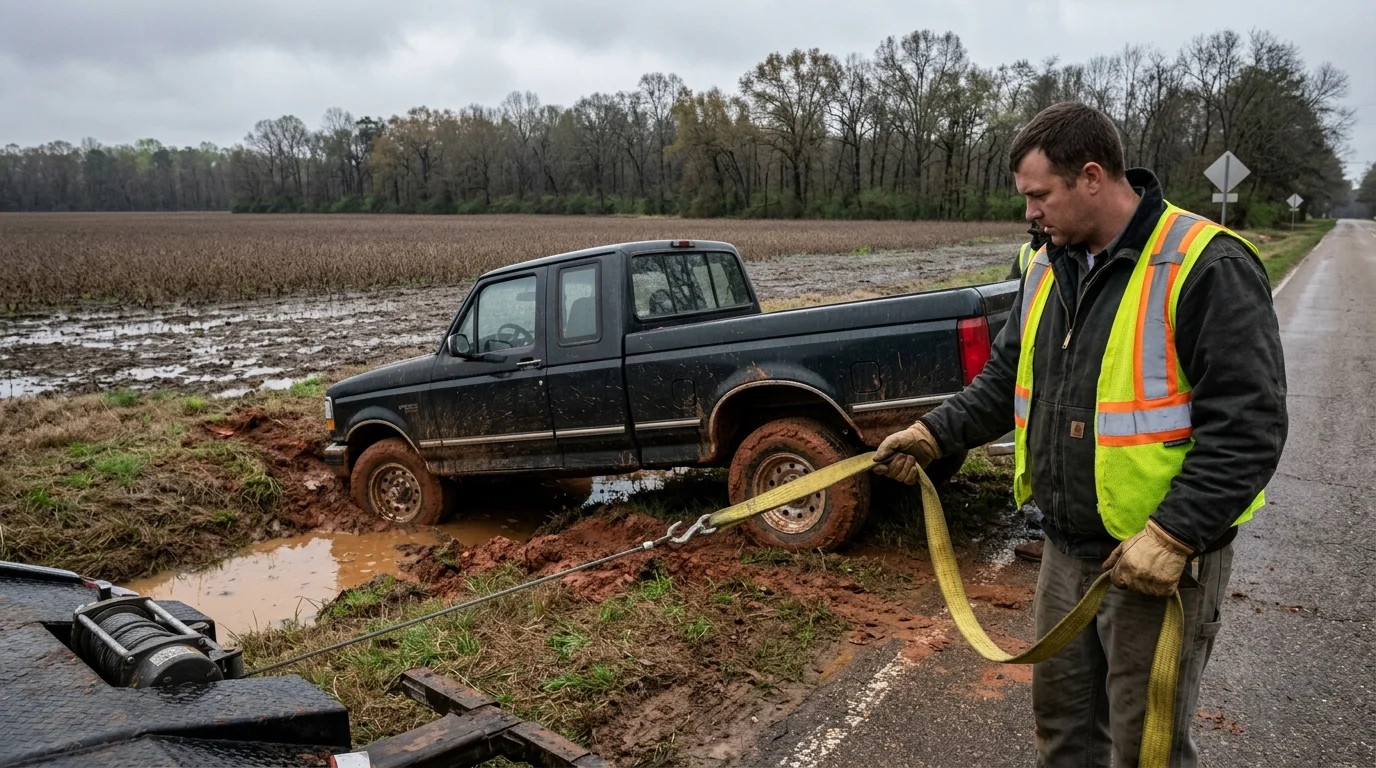
A wheel slips beyond the pavement, the tires spin, and the vehicle won’t climb back. Winch out service in Memphis is the right call when a controlled pull can return it to stable ground. The job may end there, or the vehicle may still need a tow.
Why winch out service in Memphis is not a tow
A winch out moves a stuck vehicle back onto stable ground. A tow carries the vehicle somewhere else. One roadside call can require either service, or both.
That distinction should be clear before the operator begins. A vehicle that remains drivable may only need a controlled recovery. A vehicle with collision damage, a flat tire, or damaged steering may need transport after the pull.
Our winch-out referral covers situations where a vehicle can’t regain traction or reach the pavement on its own, and the operator we match you with does the pulling. The operator evaluates its position, the available access, and the safest pulling direction.
Several factors can move the total. These include vehicle size, time of day, truck type, distance, and hookup difficulty. Ask for the complete total with mileage included before agreeing. You should also ask what conditions could change that amount.
Ask the matched operator for the total in writing before you agree, plus an itemized invoice. The referral line can remind you to ask. If the job could become a tow after recovery, ask how that added transport would be handled.
Memphis restricts hourly billing in a narrow category of city-regulated work. It applies to Class B or C nonconsensual emergency wreckers that are working or ordered by an officer to wait. It isn’t a general price rule for every winch out. Our guide to tow costs in Memphis explains the main cost drivers without guessing at an unsourced recovery price.
The four ways Memphis drivers end up needing one
Memphis recoveries rarely look identical. Road surface, drainage, traffic, and vehicle position all change the job.
First, a tire can drop from the pavement onto a soft shoulder. Grass may hide wet or loose ground after rain. Spinning the tires can leave the vehicle sitting lower than it began.
Second, a driver can miss the edge of a narrow road and enter a ditch. Even a shallow drop may leave two wheels without useful traction. The vehicle might look level while its underside sits close to the ground.
Third, storm water can soften a grassy median, parking-lot edge, or unpaved turnout. Memphis is largely flat, so a small low area can collect standing water. What appears firm from the driver’s seat may not support the vehicle.
Fourth, winter ice can carry a vehicle beyond the pavement. The road may clear before the shoulder does. A driver who tries to climb back at the wrong angle can lose traction again.
Location details matter across the metro. A Midtown caller should mention nearby parked cars and curb clearance. Around Cordova, Bartlett, or the DeSoto County suburbs, ditch depth and shoulder access may matter more. Those details help the operator understand the recovery path.
State lines matter too. A job originating in Southaven or elsewhere in DeSoto County follows Mississippi law. A recovery in West Memphis or Marion follows Arkansas law. Tennessee towing rules don’t cross either border.
Why the first pull decides how much damage you take
A stuck vehicle needs more than raw pulling force. Its position determines which direction it can move without meeting another obstacle.
A poor pulling angle can drag a tire sideways or bring the body closer to the ground. It can also move the vehicle toward a ditch wall, curb, tree, barrier, or traffic lane. That’s why the first setup deserves careful attention.
Leave the attachment point and recovery setup to the working operator. Don’t connect a strap to another vehicle and attempt the pull yourself. Avoid crawling underneath the stuck vehicle or standing near the recovery line.
Stop spinning the tires once the vehicle no longer moves forward. More wheelspin can deepen the rut and change the recovery position. Tell the operator whether the wheels are turned, buried, damaged, or blocked.
A winch out can also expose damage that wasn’t obvious from the driver’s seat. If the vehicle struck another car, a barrier, or a fixed object, describe it as a collision from the start. An accident recovery referral is the better path when recovery and damage assessment belong in the same job.
Photos can help when they’re taken from a safe position. Capture the vehicle’s full position, the road edge, and the likely approach. Don’t enter traffic or unstable ground to get a better angle.
What free highway help will and will not do here
The TDOT HELP program operates free roadside patrols on covered Tennessee interstates around Memphis. Urban hours vary by day. Rural HELP covers I-269 from the Mississippi state line to Exit 19 from 6:00 a.m. to 10:30 p.m. daily, with on-call overnight support for major incidents. During service hours, dial 511 and follow the Motorist Assistance prompts. Assistance is not guaranteed.
Its Memphis routes include I-40 and the Hernando de Soto Bridge. Coverage also includes I-55 from state line to state line, including the Memphis & Arkansas Bridge. The full I-240 loop and SR-385, also called Bill Morris Parkway, are listed as well.
HELP’s published service list is specific. Patrols provide flat changes, fuel delivery, minor mechanical help, and help clearing blocking vehicles. That last service can matter when a disabled vehicle is obstructing an interstate lane.
HELP doesn’t tow a vehicle to a repair shop, home, or storage lot. Anything beyond lane clearance requires a private towing operator. A vehicle sitting down in a ditch may also require recovery equipment outside HELP’s listed roadside services.
Check TDOT SmartWay for current traffic, cameras, and reported incidents before choosing an approach. That can be especially helpful on I-40, I-55, and the I-240 loop.
If the vehicle needs a controlled pull followed by transport, request emergency towing. Describe the full situation instead of asking only for a tow. The recovery position may affect which operator and equipment are suitable.
What to tell the operator so the right equipment can be planned
Start with the exact location. Give the road, travel direction, nearest exit, or cross street. Say which side of the road the vehicle is on. A nearby business can help, but don’t rely on that detail alone.
Next, explain the vehicle’s position. State how many wheels remain on stable pavement. Mention whether the front, rear, or side faces the ditch. Tell the operator if the vehicle is leaning or resting against anything.
Describe the ground in plain words. Mud, standing water, loose gravel, wet grass, pavement, and a steep bank call for different planning. Don’t guess at depth, weight, angles, or winch capacity.
Give the vehicle type and its current condition. Mention a trailer, cargo, collision damage, locked wheels, visible leaks, or a tire that has left the rim. If the vehicle runs, say so. If you haven’t tried starting it, don’t assume it will drive after recovery.
Finally, explain what should happen after the pull. The operator needs to know whether you expect to drive away or need transport. If a tow may be required, provide the intended destination before agreeing to the job.
Quick Tow Memphis is a referral service. We take the details and match the caller with a local tow operator. That operator performs the work and contracts with the customer directly. Clear information helps the operator evaluate the scene and choose suitable equipment.
When to call us
If your vehicle is off stable pavement, near traffic, or needs a controlled pull, leave the recovery to a working towing operator. Our line takes calls 24/7, and we’ll take the location and vehicle details before matching your call. Call us at (901) 557-8700.