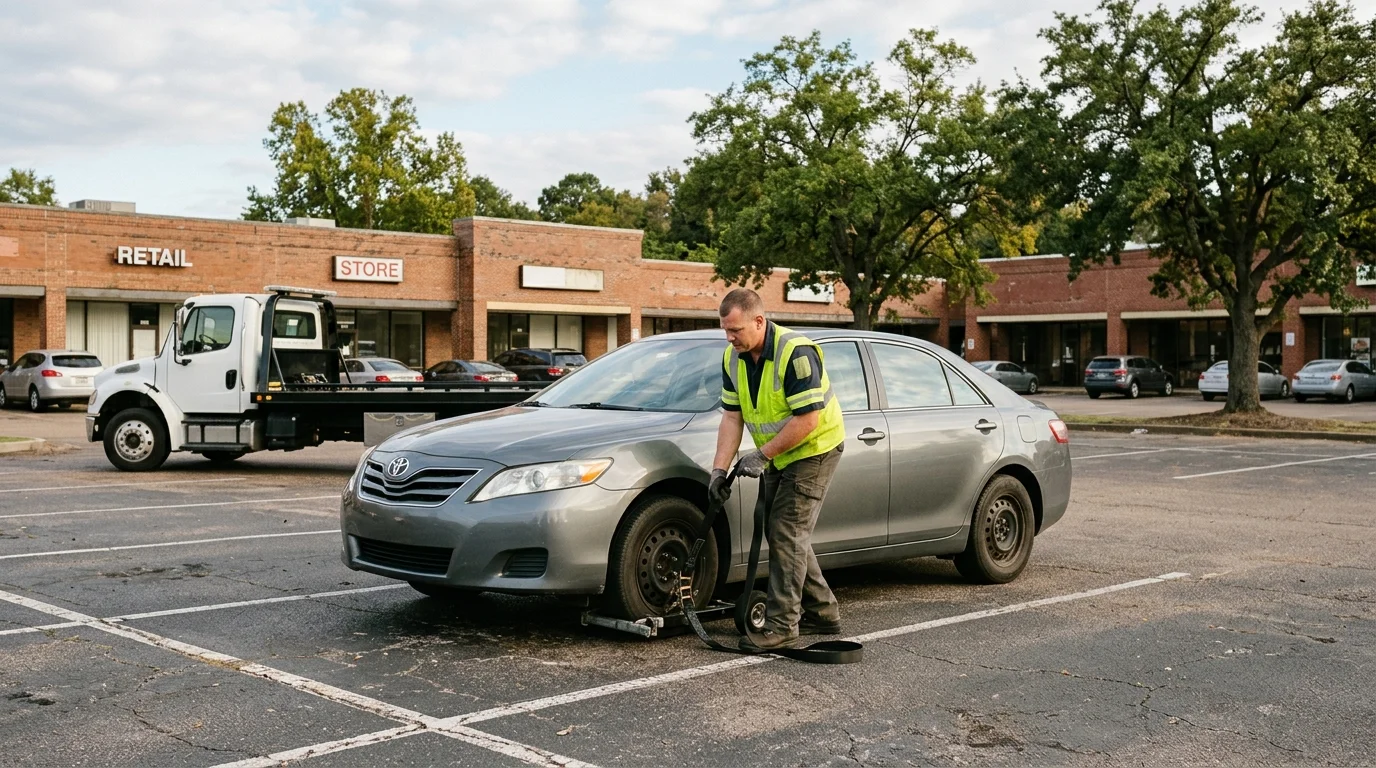
A reserved stall at a Hickory Hill complex, a fire lane behind a Poplar strip center, or a visitor space an East Memphis HOA has already warned about: that is a lot problem, and it sits with the person who controls the property. Moving the car in Memphis takes express written authorization. A handshake with a wrecker is not enough, and a faded tow-away sign does not replace the paperwork.
This page is for the manager, board, or retail owner who wants a private property tow in Memphis set up correctly, before anyone hooks a vehicle.
Who can authorize a lot tow in Memphis
Tennessee’s current towing law, the MOTION Act, requires express written authorization before a non-consent tow. The City of Memphis wrecker rules say the same thing for private-property tows inside city limits. The person who can give that authorization is the property owner or the owner’s authorized agent. For storage after the hook, the same circle applies: a law-enforcement officer with jurisdiction, the vehicle’s owner or their agent, or the property owner or their agent.
A vehicle still moves without the driver’s written okay in four situations the state spells out. First, a posted commercial or public-access lot whose signs carry the garagekeeper’s name and phone at every entrance and every exit. Second, a vehicle left unattended more than 12 hours on a lot like that, or one that is a hazard, is blocking access, or is parked illegally. Third, private property that is not open to the public, where the owner has authorized the tow. Fourth, a law-enforcement request. Those are the live exceptions. Stretching them is how a lot tow turns into a complaint.
Inside Memphis city limits, wrecker companies must be approved by the Memphis Transportation Commission. That city approval is separate from MPD wrecker rotation. A rotation call is an accident-scene dispatch. An apartment towing contract or a retail lot towing Memphis arrangement is a private-property job. Keep those two tracks apart when you talk to an operator.
Kickbacks are banned both ways. A towing company may not pay a property owner or manager to steer tows. The owner or manager may not solicit or accept that payment. If a pitch for a towing contract private property deal includes a per-car cut, a monthly kickback, or a “we’ll take care of you” referral fee, that term is unlawful under current Tennessee law. Walk away from it.
Authority also stops at the state line. A tow that starts in Southaven or elsewhere in DeSoto County, Mississippi, or in West Memphis or Marion, Arkansas, is governed by that state’s rules. Tennessee authorization language does not travel across the Mississippi River or I-55 into DeSoto. Confirm which city and which state the stall actually sits in before anyone rolls.
What the operator needs in writing
Memphis wrecker rules are specific about the slip. Express written authorization for a private-property tow has to name the person authorizing the tow, the vehicle’s year, make, model, and color, the reason, the plate if there is one, and the VIN if it can be read. That is the city’s list. Hand the operator a vague “tow whatever is in 14B” text and you have given them a problem, not a job.
Storage is a second writing, not a free extra on the hook. A garagekeeper may not store a vehicle without express written authorization from a law-enforcement officer with jurisdiction, the vehicle’s owner or their agent, or the property owner or their agent. If you want the car held off the lot, say so in writing and keep a copy.
If the owner is not standing there when the vehicle is towed, the person towing it must notify the law-enforcement agency with jurisdiction over the pickup location within one hour. That report includes the VIN, the plate, a description, the tow location, and where the vehicle will be stored. That record is public. Build it into how you work with the operator so you are not guessing where the car went at 11 p.m.
One more on-scene rule matters on a busy lot. If the tow has begun and the vehicle has not left its original parking location, and the owner or operator pays a release fee, the car must be released on the spot. State law also prohibits a release fee of more than $100 on a non-consent tow, and it bars a gate, access, or release fee during normal business hours on any day daily storage is also charged. Those limits apply to vehicles towed or stored without the vehicle owner’s express written authorization.
What we could not confirm: a statewide fill-in-the-blank contract form, a notary requirement on the authorization, or a city rule that a lot must use one exclusive wrecker. If a proposed apartment towing contract leans on exclusivity, a template you found online, or a notarized packet, ask the operator to show you the Memphis basis for it. Then check with the city’s Permits Administrator / Wrecker Coordinator at (901) 636-6735 or permits@memphistn.gov. An unverified clause is a risk you hold, not a protection.
How apartment, retail, and HOA lots differ
A Midtown walk-up, a Cordova garden-style complex, and a Germantown HOA cul-de-sac do not run on one parking rule. Tennessee splits the lots, and blending those rules is how managers get in trouble.
Residential rental property has its own track in the landlord-tenant code. A landlord may tow an unauthorized vehicle after 10 days’ written notice posted on the vehicle itself. The landlord may also tow immediately, with no wait, when the vehicle violates the landlord’s own posted permit-parking policy. There is no statewide size or wording standard for that permit signage. If you manage apartments, the lease and the posted permit policy are the documents that have to match the tow you are about to request. For the tenant-side version of a stolen stall, we already wrote car parked in my apartment spot.
Paid commercial lots, and any lot using automatic license-plate readers to enforce parking, do have mandated signs. Lettering must be red, no less than 6 inches high, on a white background. The late-fee notice goes at each designated exit. The LPR-in-use notice goes at each designated entrance. Signs have to be clearly visible from each parking space. Unpaid parking fees on those lots can carry a late fee capped at $50 if paid within 30 days, and $75 if later. That is the retail and paid-lot track. It is also the only statewide dimensioned-sign mandate we can stand behind.
Ordinary trespass and no-parking private lots are different again. Tennessee sets no statewide sign dimensions, lettering size, or wording for a plain “don’t park here” yard or rear lot. What the state requires instead is the written authorization on the tow company. That is a paperwork control on the operator. It is not a signage mandate on the owner. For the full sign split, read private-property towing sign requirements in Tennessee.
HOA lots sit closer to the residential and private-property rules than to a paid grocery lot on Union. Board authority, recorded covenants, and who actually owns the stall all matter. We cover that path in can an HOA tow your car in Memphis. Confirm the board (or its management company) is the authorized agent before you call.
Abandoned-vehicle timing is easy to mix up. Under current law, a vehicle left on private property without consent for 48 hours or more can meet the abandoned definition. A vehicle on private residential property without consent is a separate category, and the enacted text gives that category no time period at all. Do not write a 48-hour clock onto a house, a duplex, or a residential HOA stall unless your counsel has another source. For a posted commercial lot, the 12-hour unattended wait still applies unless the car is a hazard, is blocking access, or is parked illegally.
What to confirm before you place the call
Have the property address, the city, and the nearest cross street. A stall behind a Lamar Avenue shop, a garage in Downtown, and a surface lot in Bartlett can look similar on a phone. They are not the same run, and DeSoto County is a different legal world.
Name the person who will sign, and confirm they are the owner or the owner’s authorized agent. A night clerk who “usually handles this” is a weak authorizer. A regional manager with a written agency letter is a strong one.
Give the operator the year, make, model, color, plate if it is visible, and VIN if it can be read. Add the reason in plain words: fire lane, reserved permit stall, blocking the dumpster, unattended past the lot’s rule. That list is what Memphis already expects on the authorization.
Say whether the lot is open to the public. A gated East Memphis condo court and a Poplar retail pad use different exception language. Say what signs are actually on the ground today: permit policy, LPR, garagekeeper name and phone at each entrance and exit, or a simple no-parking board. Photograph them. Dates on photos help if a complaint lands later.
Ask for the full total with mileage included before you agree, and ask what would change it. Distance, vehicle size, time of day, truck type, and hookup difficulty are the cost drivers. Low cars, AWD, and blocked-in stalls change the equipment. We put the total in writing before dispatch. The operator who does the work contracts with you directly and bills the job. Ask for the authorization form and the storage paperwork on request, and keep copies.
Ask where the car will be stored, and confirm the one-hour law-enforcement report if the driver is not present. If someone shows up while the truck is still in the stall, the immediate-release rule can end the hook on the spot.
If the proposed deal includes a payment back to the property for steering tows, stop. That is the kickback ban, both directions.
What this brand does and does not do
Quick Tow Memphis is a towing referral service. We take the details from the call and match you with a local tow operator. The operator performs the work and contracts with you directly. We do not own trucks, employ drivers, run a wrecker, hold a towing permit, or operate a storage yard. We do not set the operator’s price, and we do not hold exclusive lot contracts for apartments, retail pads, or HOAs.
Private property towing is the service path for this work. The line at (901) 557-8700 takes calls 24/7. Your call routes to the operator covering the zone. Calls are recorded and transcribed, and a recording notice plays first. Tennessee is a one-party consent state for recording a call, which is why that notice is there.
What you can expect from us is process we actually control: the total in writing before dispatch, an itemized invoice from the job, written authorization and paperwork produced on request, and pay-per-call with no membership and no annual fee. City complaints about wrecker conduct go to the Permits Administrator / Wrecker Coordinator at (901) 636-6735 or permits@memphistn.gov.
If the vehicle later needs to be found after a police tow, that is a different lot. MPD, Shelby County Sheriff, and Housing and Community Development tows process through the MPD Vehicle Storage Lot at 465 Klinke Avenue. That lot is not the private operator’s yard. Keep the two destinations straight when a resident calls you angry.
When to call us
Call when you control a Memphis-area lot, the unauthorized car is still on it, and you can put written authorization in the operator’s hands. A trained wrecker handles the hook, the report, and the storage paperwork. You handle the lot, the signs, and the signature. Call us at (901) 557-8700.