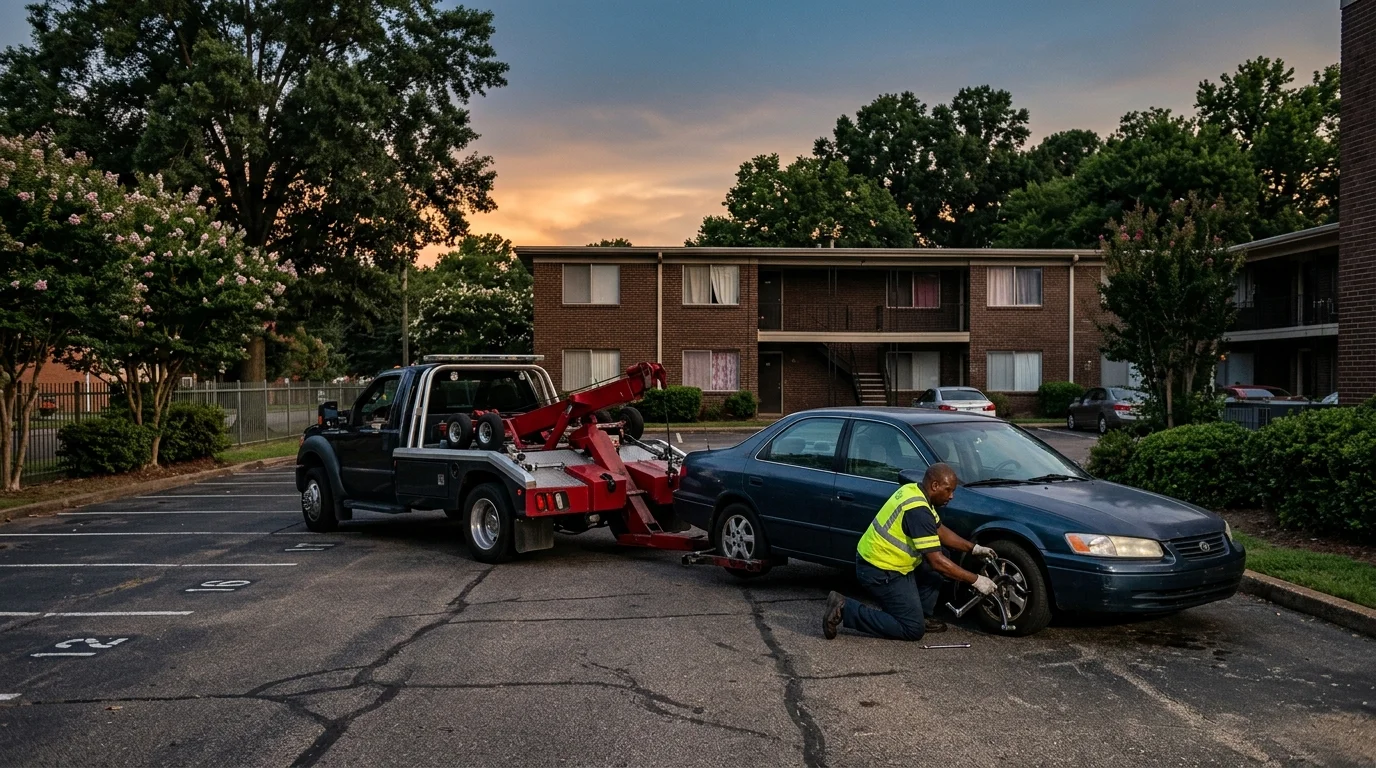
“Someone’s parked in my apartment spot in Memphis” is a leasing-office problem before it is a towing one. You need the leasing office involved before that vehicle can be towed. Your lease may reserve the space, but it doesn’t make you the property owner’s towing agent.
Parked in my apartment spot in Memphis: who can act
At a Memphis apartment complex, the landlord or an authorized property representative controls the removal process. A tenant can report the problem and provide evidence. The tenant can’t simply order a private-property tow based on a parking dispute.
Start with your leasing office or property manager. Use the after-hours contact method if the complex provides one. Explain which space is assigned to you and how the assignment appears in your lease or parking addendum.
The manager should verify two separate facts. First, the vehicle isn’t authorized to occupy that space. Second, the person requesting removal has authority to act for the property owner.
That distinction matters in Midtown, East Memphis, Hickory Hill, Cordova, and other Memphis apartment areas. Each property can have its own parking system. Some use numbered spaces and hangtags. Others track license plates or issue separate parking permits. The written property policy controls what management can verify.
Don’t call an operator while pretending to represent the property. Don’t move the vehicle, block it in, or attach anything to it. Those actions can turn a parking problem into a conflict.
Our guide to private property towing explains how an authorized property representative can request removal. Your role is to document the problem and get that representative involved.
When a posted permit policy changes the timeline
Tennessee gives residential landlords a specific path for enforcing a posted permit-parking policy. A landlord may remove a vehicle immediately and without notice when it violates that posted policy.
That rule doesn’t mean every assigned-space dispute qualifies for immediate removal. The leasing office should identify the policy, confirm that it was posted, and explain how the vehicle violates it. A space number painted on the pavement doesn’t answer those questions by itself.
Ask management for a clear written response:
- Does the property have a posted permit-parking policy?
- Where is that policy displayed?
- Which part of the policy does this vehicle violate?
- Who will provide the tow authorization?
Tennessee doesn’t impose a statewide size or wording standard for residential permit-parking signs. That’s different from the specific sign rules covering certain paid commercial lots and automatic license-plate reader enforcement. Our guide to Tennessee private-property towing signs explains that difference.
Memphis also requires written authorization for a private-property tow. A posted policy can change whether advance notice is needed, but it doesn’t turn the tenant into the authorizing property representative.
Keep a copy or photo of the posted policy. Include enough context to show where it appears on the property. That record helps management confirm which enforcement path applies.
When the vehicle needs ten days’ notice
When there’s no violation of a posted permit-parking policy, Tennessee’s residential rental rule follows a different path. The landlord may tow an unauthorized vehicle after ten days’ written notice has been posted on the vehicle itself.
The notice goes on the vehicle. A message to residents, a note on your door, or a complaint in the tenant portal isn’t the same thing. Property management should handle the posting and document when it happened.
Don’t remove, alter, or cover the notice. Don’t calculate the tow date for the leasing office. Ask management to record the posting time and confirm when its authorized representative can request removal.
Tennessee doesn’t set a statewide size or wording standard for this residential notice. That absence shouldn’t be confused with having no notice rule. The written notice and the posted permit-policy exception are separate enforcement paths.
Location also matters across the Memphis metro. Tennessee rules can apply to a Memphis, Bartlett, or Germantown apartment. They shouldn’t be carried across the state line to Southaven, Mississippi, or West Memphis, Arkansas. A property in either neighboring state follows that state’s law.
If management isn’t sure which rule applies, ask it to pause and confirm before arranging a tow. A temporary inconvenience is frustrating, but incomplete authorization can create a larger dispute for the property, operator, and vehicle owner.
What the leasing office must document
Inside Memphis city limits, a private-property tow requires express written authorization. The authorization identifies the person approving the tow and records the vehicle’s year, make, model, and color. It also states the reason for removal.
The plate should be recorded when one is present. The vehicle identification number is included when it can be determined. The operator needs this information from the authorized property representative, not an unsupported request from another resident.
Tennessee also treats storage authorization as a separate duty. Storage must be expressly authorized by law enforcement, the vehicle owner or agent, or the property owner or authorized agent.
You can help management build an accurate record. Photograph the occupied stall, its number, the vehicle, and nearby parking-policy signs. Take wider photos showing the stall’s location within the complex. Save the lease page or parking addendum assigning the space to you.
Avoid posting the vehicle’s plate or the driver’s personal information on social media. Send the evidence directly to property management.
If a tow later becomes disputed, the paperwork matters. Our guide to rights after a Memphis tow explains the records to request and the city complaint process. It also separates Memphis rules from statewide requirements.
The leasing office shouldn’t ask you to sign as the property owner’s agent unless you actually hold that authority. Reporting the violation and authorizing removal are different acts.
Steps you can take tonight
Take clear photos before the vehicle moves. Capture the assigned-space number, the vehicle, nearby signs, and enough background to establish the location. Note when you found it, then check your lease and parking addendum.
Contact the leasing office through its listed phone, email, resident portal, or after-hours channel. Keep the message short and factual. State that the vehicle occupies your assigned space, attach the documentation, and ask management to confirm its next step in writing.
Ask where you may park temporarily without violating another resident’s assignment or a posted restriction. Don’t use a fire lane, accessible space, loading area, or another reserved stall unless management specifically directs you to a lawful alternative.
Avoid confronting the driver. Don’t threaten a tow, sit on the vehicle, block its exit, or attempt to move it. If the driver returns, let property management handle the policy discussion.
If your own vehicle is removed during a parking dispute, contact the property office first. Ask which operator removed it and where it was stored. Then follow our steps for finding a towed car in Memphis.
Memphis doesn’t provide an online lookup tool for MPD, Shelby County Sheriff, or Housing and Community Development tows. Those agency tows process through the facility described on the MPD Vehicle Storage page. A routine apartment tow may use private storage instead, so begin with the property’s records.
When to call us
Call after the landlord or authorized manager confirms in writing that the vehicle may be removed. The recorded line takes calls 24/7 and matches that representative with a local operator, who performs the work and contracts with them directly. A tenant report is not authorization. Call us at (901) 557-8700.