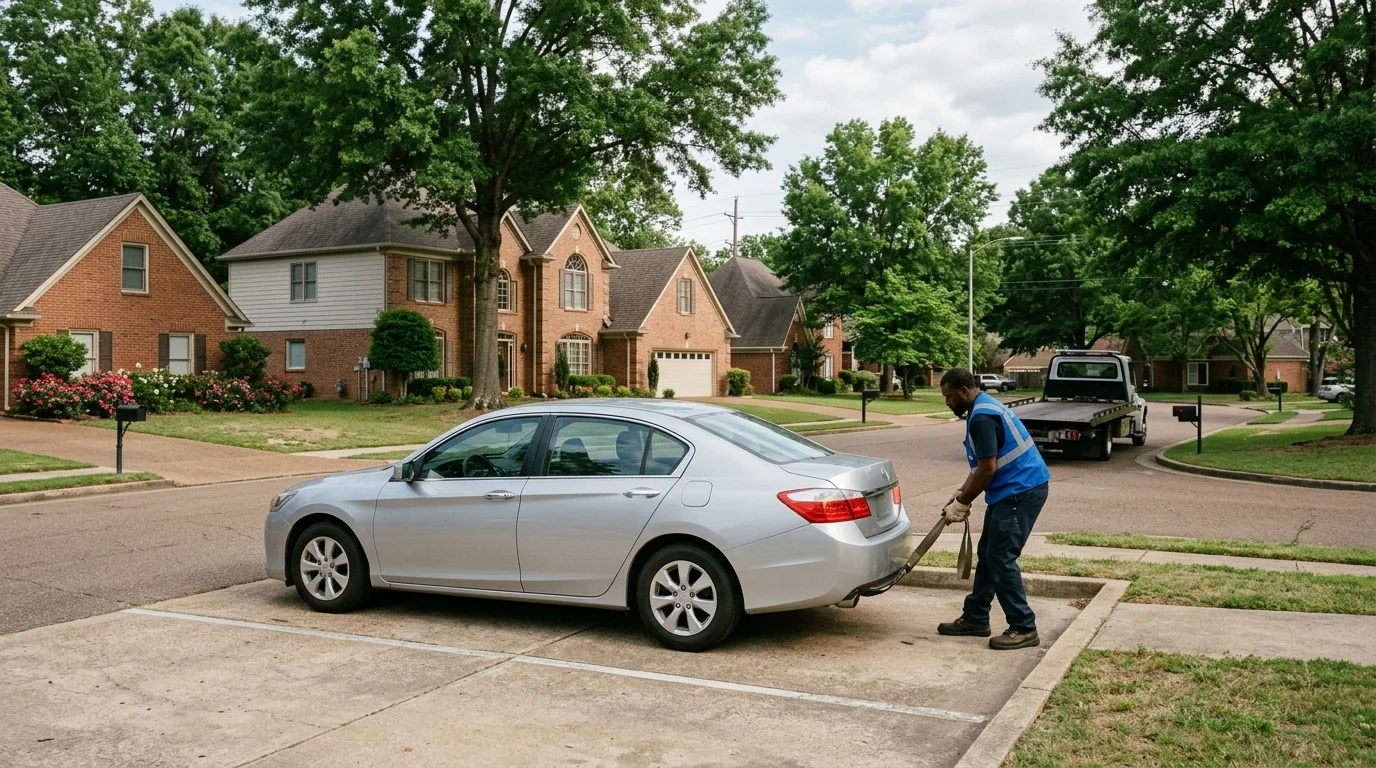
The visitor pad behind a brick ranch in Bartlett is association ground, not a city stall. An HOA or the manager it names can authorize a private-property tow from common-area parking it controls, but only with express written authorization that identifies the car and the reason. Tennessee doesn’t authorize a tow solely because the tags are expired.
Who can authorize the tow
On a subdivision lot the association owns, the person who can green-light the truck is the property owner or that owner’s authorized agent. In practice that’s the board, the management company, or someone named in the covenants. The operator still needs express written authorization before the hook goes on. Inside Memphis city limits, city wrecker rules spell out what that paper has to carry: the person authorizing the tow, the vehicle’s year, make, model, and color, the reason, the plate if there is one, and the VIN if it can be read.
The yard may not store the car without a second written authorization from a law-enforcement officer with jurisdiction, the vehicle’s owner or their agent, or the property owner or their agent. A board vote in a group chat isn’t that paper.
Tennessee also bans kickbacks both ways. A towing company may not pay an HOA or a manager to steer tows, and the HOA or manager may not solicit or take that money.
Expired tags sit in a different bucket. Operating with expired registration is a citable offense. It isn’t, by itself, a towing power. A car with dead tags becomes movable under the general private-property rules: a hazard, a blocked access lane, illegal parking, the 12-hour wait on a posted commercial or public-access lot, or the abandoned-vehicle thresholds. That’s the same split we lay out in our expired-registration guide. An HOA parking rule that treats invalid tags as a tow reason still has to fit one of those state grounds, plus the written authorization. Quick Tow Memphis matches the caller with a local operator. We don’t decide whether the HOA’s reason is lawful, and we don’t own the truck.
Don’t try to unhook the car, block the wrecker, or roll it onto your own driveway to save it. That’s how a parking fight turns into a safety fight.
Street parking versus HOA lots
Germantown, Bartlett, and Collierville mix public pavement with private common area, often on the same block. If the street is public, the HOA doesn’t control the curb. Enforcement there belongs to that city’s police or parking staff, not to a board member with a wrecker on speed dial. Poplar Pike through Germantown, Stage Road through Bartlett, and the approaches off Bill Morris Parkway in Collierville are city or state roads. A sedan on those curbs isn’t sitting in an HOA stall.
The association’s reach is the land it actually owns or is charged to manage: the clubhouse lot, the visitor pads, the cul-de-sac islands, the overflow strip by the pool. Some subdivisions also hold the internal streets as private. You can usually tell by who plows, who patches, and whose name is on the entrance monument. When that is unclear, ask the city and the management company the same question and keep both answers.
On a commercial or public-access lot with the storage company’s name and phone on signs at every entrance and exit, an unattended car can be towed after 12 hours, or sooner if it is a hazard, is blocking access, or is parked illegally. On private property that isn’t open to the public, the property owner can authorize the tow. Those are different doors. A gated Collierville street that only residents use isn’t the same as a strip-center lot on Germantown Parkway. We couldn’t confirm a statewide clock that shuts HOA towing off after dark. Overnight parking rules live in the covenants, not in a state curfew.
Abandoned-vehicle rules are another door, and they’re easy to misuse. A vehicle on private property without consent for 48 hours or more can meet the abandoned definition. On private residential property without consent, the enacted text doesn’t attach a waiting period at all. A car stored, parked, or left in a parking lot for more than 30 consecutive days can meet it too. None of those categories is “the sticker ran out last month.” If a manager is calling a tagged, operable daily driver abandoned because the registration is old, ask which of those facts they’re actually relying on.
Your own driveway is usually part of your lot, not the common area. An HOA may still have a covenant about where cars sit overnight. Whether that covenant lets anyone send a wrecker onto your pad is a question for the recorded documents and, if needed, a Tennessee lawyer.
A tow that starts in Southaven or elsewhere in DeSoto County runs on Mississippi law, not Tennessee’s. Don’t import a Shelby County HOA packet across that line.
What to record before the car is moved
If a truck is on the way, or already on the pad, collect facts. Photograph the car where it sits, the nearest signs, the painted stall, the curb, and the tags. Get a wide shot that shows the house numbers or the cul-de-sac so you can prove the location later. Note the time, the street, and whether the lot is gated. If you have the parking addendum from the welcome packet, pull that too.
Ask who authorized the tow, by name, and which company is coming. Write both down. If the operator is there and the car hasn’t left its original parking location, Tennessee requires an on-the-spot release when the owner or driver pays a release fee. Don’t argue from the hood. Pay or refuse, get a receipt, and sort the rest with paper.
If you aren’t present when the car leaves, the person towing it must notify the law-enforcement agency with jurisdiction over that pickup, within one hour, of the VIN, the plate, a description, the tow location, and where the car will be stored. That record is public. Ninety days after the state’s motor-vehicle portal is operational, the same information is supposed to go there instead. The portal’s live status isn’t independently confirmed, so treat a phone call as the working method.
For a Memphis Police, Shelby County Sheriff, or Housing and Community Development tow, the single lot is the MPD Vehicle Storage Lot at 465 Klinke Avenue. Call (901) 636-8200. There’s no online lookup. A private HOA tow often goes to the operator’s own yard, not to Klinke. Call the manager and the wrecker, not only the city lot. After a Memphis impound, personal property that isn’t physically attached to the vehicle must be released to the owner or designee on request, unless MPD orders otherwise. On-scene retrieval before the tow leaves is unconfirmed as a legal right, so don’t count on it.
How this differs from an apartment tow
A Midtown or East Memphis apartment tow runs on landlord-tenant parking rules. A landlord may tow an unauthorized vehicle after 10 days’ written notice posted on the vehicle itself, or immediately and without that notice if the vehicle violates the landlord’s own posted permit-parking policy. That’s rental property. It’s the track we cover in the apartment-spot guide.
A Bartlett or Germantown subdivision usually isn’t a landlord-tenant lot. The association’s power, if it has any, comes from the recorded covenants, the plat, and whatever common area the HOA actually owns. There’s no statewide size or wording standard for ordinary trespass or no-parking signs on those lots. What state law requires is the written authorization on the tow company. Paid commercial lots and lots that use automatic license-plate readers to enforce parking are the ones with the red-letter, six-inch signage rule. We separate those two sign tracks in our private-property sign guide. Don’t assume a faded board at a Collierville amenity lot meets a rule that was written for paid commercial parking.
Guest parking is the usual flashpoint. A contractor on a Collierville remodel, a second car during Elvis Week, or an extra sedan for a Friday cookout ends up on the visitor pad past the posted hours. That’s an HOA-lot problem. A neighbor who takes your assigned apartment stall in Cordova is a different problem with a different notice clock. Mixing the two is how people quote a 10-day apartment notice at an HOA board that never had that duty.
Unpaid assessments are another mix-up. We couldn’t confirm a Tennessee towing rule that lets an association hook a car because dues are late. Collection through the covenants is a separate path. Don’t treat a wrecker as a bill collector.
Where to verify the rule that applies
Start with the documents you already have: the covenants, the parking resolution, and the management company’s name. Call that office and ask who is listed as the authorized agent for tows, which yards they use, and what written form the operator is supposed to carry. If they can’t produce the authorization standard, you have a paper problem, not just a parking problem.
Then name the city. Memphis wrecker companies operating inside city limits must be approved by the Memphis Transportation Commission. Complaints go to the Permits Administrator / Wrecker Coordinator at (901) 636-6735 or permits@memphistn.gov. Bartlett, Germantown, and Collierville are their own cities. Their police non-emergency lines and their own codes control public streets there. Don’t assume a Memphis complaint path covers a Germantown private street.
The current statewide towing and storage chapter is the MOTION Act, re-enacted in 2025 Public Chapter 457. Read the rule in that act, not an old abandoned-vehicle chapter. The older chapter was repealed in full in 2024. If a yard sends notice, ownership has to be verified within three business days, and the owner and all lienholders notified within three more business days, by nationally recognized overnight carrier, not USPS. The reclaim window is 20 days from the notice date.
For the sticker itself, Tennessee Department of Revenue Vehicle Services is the registration authority. Renewing the tag doesn’t unwind a tow that already happened, but it does close the citation issue.
If you want to fight the tow, that’s a lawyer-and-paper fight. This page isn’t legal advice, and we won’t tell you that you can sue the HOA. What you can do is keep the photos, demand the written authorization, call the agency that has jurisdiction, and use the city’s wrecker complaint line when the pickup was inside Memphis.
Quick Tow Memphis is a referral service. The line takes calls 24/7. Your call routes to the operator covering that zone. We don’t own a yard, and we don’t sign the HOA’s authorization sheet.
When to call us
Call when the car needs a professional hook from a common-area pad, a visitor lot, or a private street you can’t safely move yourself, or when you need it hauled from an operator’s yard after the paperwork is sorted. Don’t try to drag it onto your driveway or stand in the wrecker’s path. Call us at (901) 557-8700.