You parked in a lot off Poplar, ran into a shop for ten minutes, and came back to an empty space. No warning, no ticket, just tire marks. Before you call around to find your car, it helps to know what Tennessee law actually requires from the lot owner who had you towed. The rules changed on July 1, 2024. Signage is one of the controls, not the whole law. Ordinary trespass lots still turn on written authorization, not statewide sign dimensions.
The old law, Title 55 Chapter 16, is gone. Tennessee replaced it with the MOTION Act, the Modernization of Towing, Immobilization, and Oversight Normalization Act. This new law reshapes how private property tows work across the state. Signage is one of the controls, not the whole law.
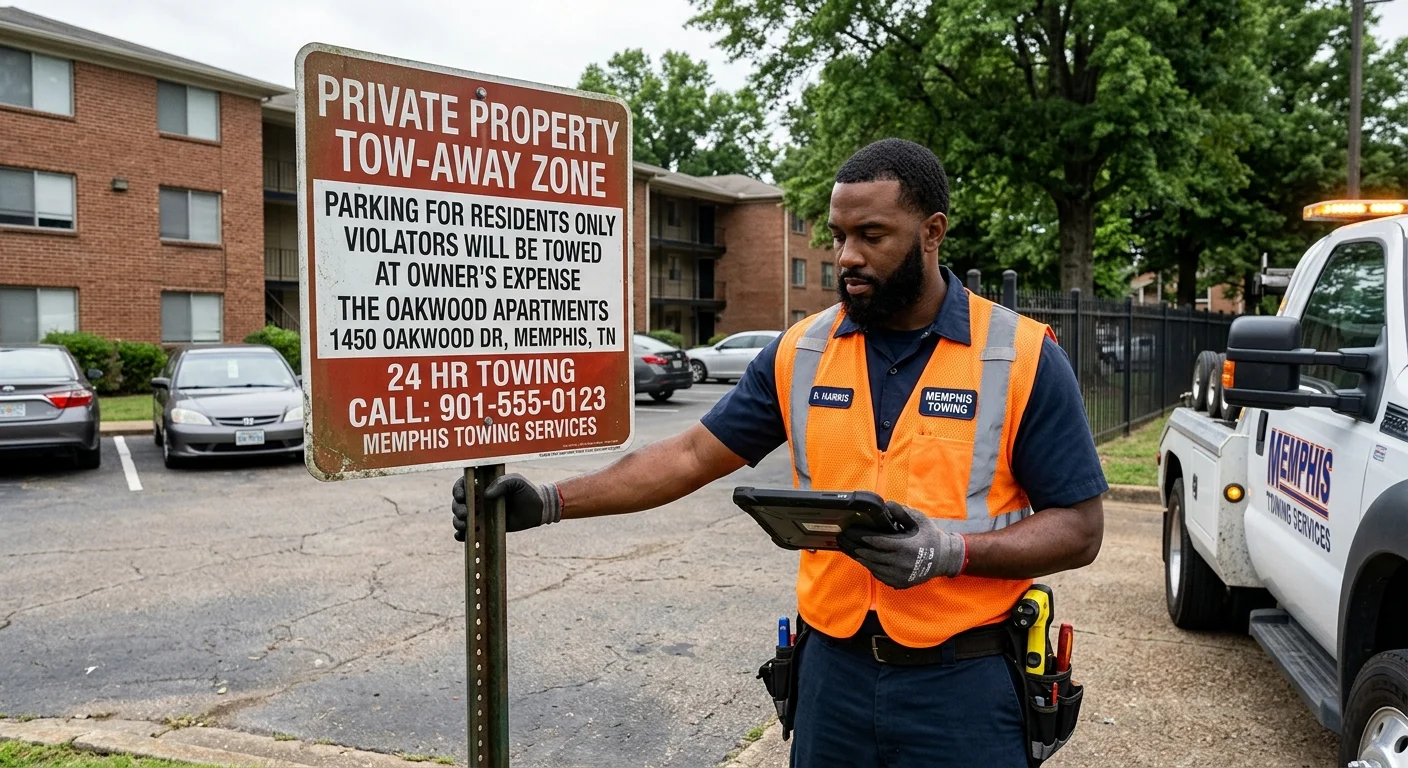
Tennessee uses two tracks, not one sign rule
Here’s the thing most drivers don’t realize: Tennessee doesn’t have one blanket rule for all private property towing signs. It has two separate tracks, and which one applies depends on the kind of lot you parked in.
The first track covers ordinary private lots. Think of the empty lot next to a warehouse on Lamar Avenue, or the gravel patch behind a bar in Midtown. For these lots, state law doesn’t set specific sign dimensions or wording. What it requires instead is written authorization for the tow itself. The tow company must have express written permission from the property owner or their agent before hooking up your car. That’s a paperwork control on the operator, not a signage mandate on the property owner.
The second track is where signage becomes mandatory. If the lot is a paid commercial lot, or if it uses automatic license plate readers to enforce parking, the law steps in with specific requirements. These lots must post red lettering no less than 6 inches high on a white background at every designated entrance and exit. The signs need to be clearly visible from each parking space.
The distinction matters. On a paid or LPR lot, missing the required notices is a signage failure. On an ordinary trespass lot, the control is written authorization, not a missing six-inch sign.
What paid and LPR lots must post
For paid commercial lots and lots using license plate readers, the signage rule is specific. The law requires red lettering on a white background, at least six inches tall, posted at each designated entrance and exit, clearly visible from each parking space.
The content depends on what the lot is enforcing. For unpaid parking fees, the sign must carry a late-fee notice. State law caps that late fee at $50 if paid within 30 days, and $75 if paid later. For lots using license plate readers to enforce parking, a separate notice must be posted at each entrance telling drivers the technology is in use.
For ordinary no-parking lots, Tennessee doesn’t dictate sign size, lettering height, or specific wording. The legal protection comes from the written authorization requirement. A property owner in East Memphis can post a simple “Private Property, No Parking, Tow-Away Zone” sign, and that’s enough to put you on notice. What they can’t do is call a tow company without the proper authorization paperwork in place.
If you’ve been towed and never saw a sign, that’s worth noting. It doesn’t automatically make the tow illegal, but it’s evidence the lot may not have followed the rules.
Where the sign has to be placed
Placement rules exist for the lots that require signage. The red-lettered notices must go at each designated exit for the late-fee notice and each designated entrance for the license plate reader notice. And they must be “clearly visible from each parking space.” That’s a high bar. A single small sign near the office door won’t cut it.
For ordinary private lots, placement isn’t regulated the way you might expect. Tennessee law doesn’t specify where signs must be posted or how large they must be. The practical standard is that the property owner should make their parking rules reasonably knowable. A sign at the lot’s entrance is the normal practice, but the law focuses on the tow authorization, not the sign’s location.
This is where Memphis drivers get caught. A strip mall on Winchester with one faded sign near the back entrance might feel like a trap, but the legality of the tow doesn’t hinge on the sign alone. It hinges on whether the lot owner gave proper written authorization to the tow company.
If you’re dealing with a tow after parking in a lot with no visible signs, ask the tow company to show you the authorization. Under the MOTION Act, they need express written authorization from the property owner or their agent. If they can’t produce it, the tow may violate state law.
How the rule applies to apartments and shopping centers
Apartment complexes and shopping centers follow the same two-track structure, but each has its own wrinkles.
Apartments. Residential rental property has a separate rule under Tennessee’s landlord-tenant code. A landlord may tow an unauthorized vehicle after 10 days’ written notice posted on the vehicle itself. That’s the slow path. There’s also a fast path: the landlord can tow immediately and without notice if the vehicle violates the landlord’s posted permit-parking policy. So if you park overnight without a permit at a complex near the University of Memphis, and the complex has a posted permit policy, your car can be towed with no warning at all.
The key detail for apartment tenants: the 10-day notice rule only applies when there’s no posted permit policy. If the complex has a permit system, the posted policy itself is the notice.
Shopping centers. Retail lots on Germantown Parkway or in the Cooper-Young district usually fall into the ordinary private lot category. That means no mandated sign dimensions, but the written authorization requirement still applies. The property manager or agent must give express written authorization that identifies the person authorizing, the vehicle year/make/model/color, the reason, the plate if any, and the VIN if it can be read. Do not treat a generic standing contract as a substitute for that writing.
Newer shopping centers are increasingly using license plate readers to manage their lots. Once that technology is in use, the full signage requirement kicks in: red lettering, white background, six-inch minimum height, posted at every entrance and exit.
What happens if the sign’s wrong
If a lot fails to meet the signage requirements, or the tow company lacks proper authorization, several consequences follow under the MOTION Act.
First, the tow itself may be unlawful. A vehicle must not be towed without the owner’s express written authorization unless one of four exceptions applies. The exceptions include a posted commercial or public access lot with proper signage, a vehicle unattended more than 12 hours, a vehicle creating a hazard or blocking access, or a law enforcement request.
Second, the penalties are real. A violation of the towing, storage, or signage provisions is a Class B misdemeanor. A second offense is a Class A misdemeanor. That’s criminal liability, not just a civil dispute.
Third, fees can be clawed back. The MOTION Act includes an immediate release rule: if the tow has begun but the vehicle hasn’t left its original parking location, and the owner pays a release fee, the vehicle must be released on the spot. And if the tow was improper, the property owner or tow company may owe you more than an apology.
How to check if a tow was legal
Start with the sign. If you were parked in a paid lot or a lot with license plate readers, did you see red lettering on white background at the entrance and exit? Could you read it from your parking space? If not, the signage requirement likely wasn’t met.
Next, ask for the written authorization. The tow company must have express written permission from the property owner, their agent, or a law enforcement officer. Ask to see it. A legitimate operator will show you the paperwork.
Check the timing. If your car was parked on a private lot and you weren’t there when the tow happened, the towing company must notify the law enforcement agency with jurisdiction within one hour of the tow. That report includes your VIN, plate, vehicle description, the tow location, and where the vehicle is being stored. If the car is already gone, start with finding your towed car in Memphis.
Finally, know your rights on fees. If your car was towed without your express written authorization, the release fee can’t exceed $100. And no gate, access, or release fee can be charged during normal business hours on any day that daily storage is also charged. Storage charges can’t run past 21 days without your consent unless you were notified and refused to collect the car.
If you believe the tow was illegal, call the City of Memphis Permits Administrator at (901) 636-6735. That office handles wrecker complaints. If you need a permitted operator for a lawful private-property job, call (901) 557-8700. The recorded line takes calls 24/7 and matches you with a local operator.
What do private property towing laws in Tennessee require?
Private property towing laws in Tennessee split into two rules that are easy to blend and should never be. Paid commercial lots, and any lot using automatic license-plate readers to enforce parking, carry the MOTION Act’s signage requirements. An ordinary trespass or no-parking private lot has no statewide sign standard at all, and residential rental property runs under its own separate rule in the landlord-tenant code.
If you need a lawful private-property match
Complaints go to the City of Memphis Permits Administrator at (901) 636-6735. Rights after the hook sit on know your rights when towed in Memphis. If you need a permitted operator for a lawful private-property job, call (901) 557-8700. The recorded line takes calls 24/7 and matches you with a local operator. See private property towing.