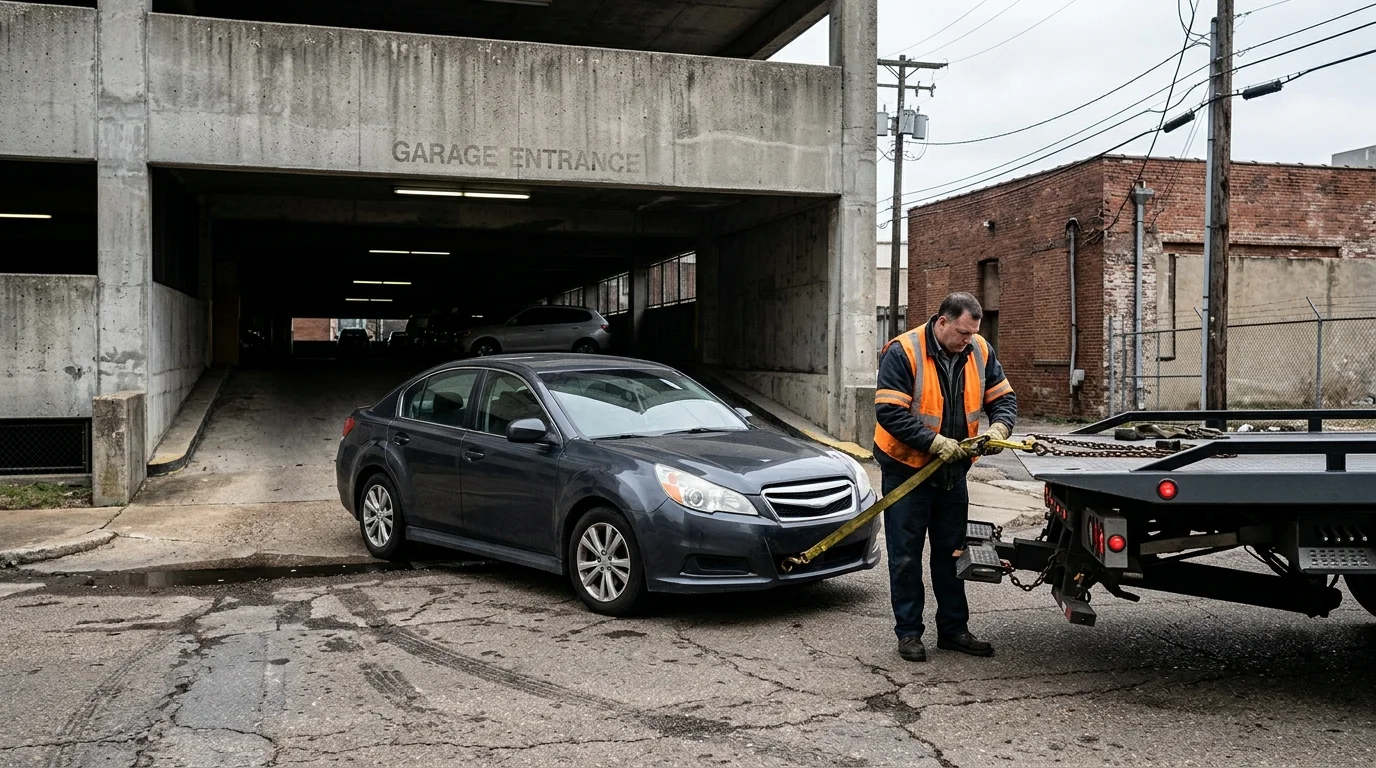
A disabled car below street level doesn’t automatically rule out towing. Parking garage tow truck access depends on verified clearance, turning room, and the car’s condition. The operator needs those facts before choosing a recovery plan.
Clearance and turning space decide the setup
The posted height at the entrance is the first detail to record. It must be compared with the actual tow vehicle and its working setup. Don’t assume every wheel-lift vehicle fits, or that every flatbed must remain outside.
Take a clear photo of the clearance sign. Include the entrance, gate arm, ramp, and nearby columns. Another photo from farther back can show the approach from the street. Those views help the operator assess more than the height alone.
Turning space matters once the truck passes the entrance. Curved ramps, concrete columns, parked cars, overhead pipes, and tight corners can affect the approach. The route to your level matters just as much as the first opening.
A Midtown garage and an East Memphis parking deck shouldn’t share an assumed plan. The same applies to enclosed parking in Cordova or Bartlett. Each property has its own entrance and interior layout.
Truck selection also depends on the car. A wheel-lift towing setup and a flatbed towing setup handle vehicles differently. Neither should be promised before the operator reviews the access route and vehicle details. Our guide to flatbed versus wheel-lift towing in Memphis explains how vehicle requirements influence that choice.
Tell the recorded line which level and entrance is closest
Start with the garage name and its exact street entrance. Large properties may have several gates, but only one may reach your section. Say which floor you’re on and whether the level appears on a sign, ticket, or parking marker.
Give the operator these details during the call:
- The floor, section, and nearest marked space
- The posted height at the entrance you used
- Any lower clearance signs along the route
- Whether the wheels turn or remain locked
- Whether the steering responds normally
- Whether the parking brake releases
- The property manager or security contact
- Photos of the entrance and disabled car
Describe how the vehicle sits. Say whether it’s straight within a space, close to a wall, beside a column, or stopped on a ramp. Mentioning a narrow aisle or sharp turn helps the operator evaluate the approach before committing to a setup.
Quick Tow Memphis is a referral service. We collect the location and vehicle details, then connect the caller with a local towing operator. The operator performs the work and contracts with the customer directly.
The line takes calls around the clock. Still, access needs to be checked for the actual garage. A truck type shouldn’t be selected from the neighborhood or vehicle name alone.
What changes when the wheels will not roll
A car that rolls and steers presents a different recovery decision from one with locked wheels. Tell the operator which tires move, whether the steering responds, and whether the parking brake releases. Don’t move the vehicle merely to make the pickup easier.
The owner’s manual can change the transport plan. Vehicle instructions apply to the exact model year and trim, not every car with the same badge. For axle-specific answers, use the all-wheel-drive, front-wheel-drive, and rear-wheel-drive pages. For body geometry, use low-clearance vehicle. This page stays on garage height, route, and property access.
Check access with the property manager
A garage operator may control gates, removable barriers, loading areas, and entry permissions. We couldn’t confirm a citywide procedure that gives tow vehicles automatic access to every Memphis parking garage. Ask the property manager or security desk what access they can provide.
Get a contact name and working callback method. Confirm which entrance reaches the vehicle’s floor. Ask whether a gate, ticket system, or controlled door affects entry. If the building has a designated service entrance, have the manager identify it rather than guessing.
Property access and authorization to tow aren’t the same issue. Tennessee’s current MOTION Act requires express written authorization before towing unless a listed exception applies. The responding operator should handle the required authorization for the specific job.
The rules also change across state lines. A pickup in Southaven falls under Mississippi law. A garage in West Memphis falls under Arkansas law. Tennessee towing rules shouldn’t be carried across either border.
If the garage won’t allow the proposed tow vehicle inside, pass that information to the operator. Don’t promise access on the property’s behalf. The operator and property contact need to agree on a workable route before equipment enters.
When the operator may need another recovery plan
Another plan may be needed when the truck doesn’t match the posted clearance or interior route. The same is true when columns prevent the required approach, the wheels won’t roll, steering doesn’t respond, or the parking brake remains engaged.
The exact alternative depends on the garage and the vehicle manual. It also depends on what the property allows. A method that works for one car shouldn’t be copied to another model without checking its instructions.
Don’t assume the car can simply be pulled through the garage. Improper towing can damage some drivetrains or low-clearance cars. Give the operator the exact year, model, drivetrain, and wheel condition, then use the dedicated drivetrain and low-clearance pages for those method answers.
If access remains uncertain, send updated photos before equipment enters. Show the lowest posted clearance and the tightest visible turn. Include the car’s position relative to walls, columns, and nearby vehicles.
The goal isn’t to force a preferred truck into the structure. It’s to give the operator enough information to choose a plan that matches the garage and the manufacturer’s transport guidance. That decision belongs with the towing operator, not with a hurried guess inside the garage.
When to call us
Call when your car is disabled inside a garage and the access route needs professional review. The recorded line takes calls 24/7, takes the garage and vehicle details, and matches you with a local operator. Call us at (901) 557-8700.