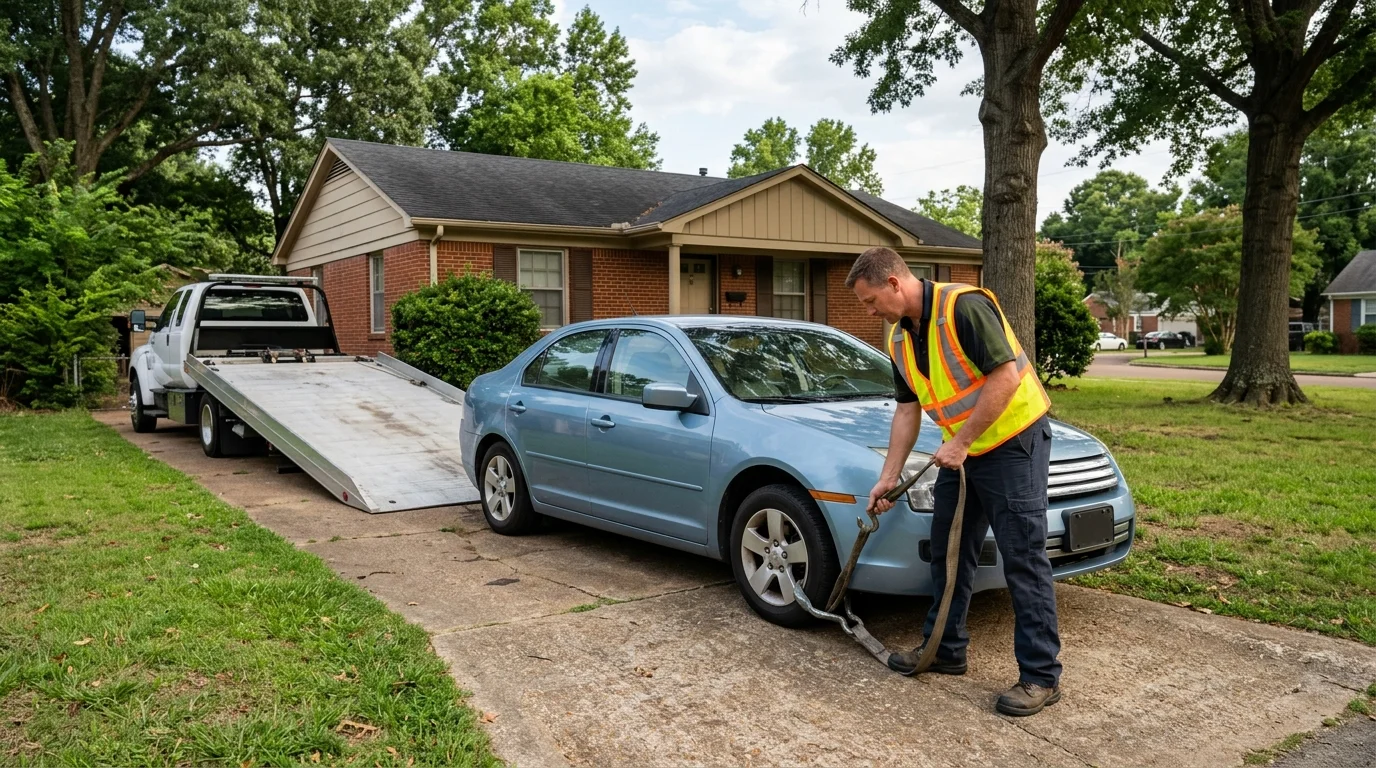
A vehicle on your Memphis driveway may be removed after the property owner or authorized agent gives the towing operator express written authorization. A phone complaint alone isn’t enough. If the car is on a public street across the driveway entrance, law enforcement may control the next step.
Who can request removal from a Memphis driveway
The property owner can authorize a tow from private property. An authorized agent may also act for the owner. That could include someone responsible for managing the property, provided they actually have that authority.
Being inconvenienced doesn’t automatically make someone the authorizing party. A neighbor, visitor, or tenant shouldn’t claim authority they don’t have. The operator may need to confirm who controls the property before accepting the removal request.
This distinction protects everyone involved. A towing operator can’t remove a vehicle from private property simply because a caller demands it. Memphis requires express written authorization for a private-property tow. Tennessee law also recognizes authorization from the property owner or an authorized agent.
A rented home can present another question. The lease and the owner’s instructions may determine whether the tenant has authority to order a tow. If that authority isn’t clear, contact the property owner or manager first.
Apartment and rental parking can follow different rules. Tennessee allows a landlord to remove an unauthorized vehicle after written notice has remained posted on the vehicle for 10 days. Immediate removal is allowed when the vehicle violates the landlord’s posted permit-parking policy. Our guide to private-property towing sign requirements in Tennessee explains that separate situation.
For a privately owned Memphis home, start with the person who owns or controls that property. Our private property towing service connects authorized callers with local towing operators.
The difference between blocking access and parking on the property
The vehicle’s exact position matters. A car sitting on the driveway is on private residential property. A car stopped along the public street, across the driveway apron, is in a different legal position.
The homeowner controls the driveway but doesn’t control the public street. That means written permission from the homeowner can support removal from the property itself. It may not establish authority to remove a vehicle from the roadway.
Tennessee’s non-consent towing rules generally include a 12-hour waiting period for an unattended or immobile vehicle. That wait doesn’t apply when the vehicle is blocking access, creating a hazard, or parked illegally. The blocking-access exception removes that waiting issue, but it doesn’t give every caller authority over public property.
For a vehicle fully on the driveway, the property owner or authorized agent controls the request. When the vehicle remains on the street, the law-enforcement agency responsible for that location may need to make the removal decision. Don’t describe the car as being on your property if it’s actually beyond the property line.
The same distinction matters across the metro. Memphis rules shouldn’t be carried into Bartlett or Germantown without checking the authority responsible there. Southaven is governed by Mississippi law, while West Memphis is governed by Arkansas law. Tennessee towing rules don’t cross either state line.
If the vehicle is across the entrance rather than on the driveway, see our focused guide to a car blocking a Memphis driveway.
What written authorization the operator may need
Memphis private-property towing rules call for express written authorization. The document identifies the person authorizing removal. It also records the vehicle’s year, make, model, color, removal reason, and plate when one is present. The VIN is included when it can be determined.
Don’t climb inside the vehicle or open anything to find its VIN. The operator can decide whether that information is ascertainable without improper access. A clear photograph of the visible plate can help prevent a description error.
Written authorization should identify the correct property and vehicle. It should also state why removal is being requested. “Unknown sedan” is less useful than a complete description taken from a safe position.
State law treats towing authorization and storage authorization as separate duties. A garagekeeper may store the vehicle with express written authorization from law enforcement, the vehicle owner or agent, or the property owner or agent. The operator should manage the required forms and explain what signature is needed.
When the vehicle owner isn’t present, the person towing must report specified details to the law-enforcement agency with jurisdiction within one hour. Those details include the VIN, plate, vehicle description, pickup location, and storage location. That report is the operator’s responsibility.
The current rules appear in Tennessee’s enacted MOTION Act. Older references to Title 55, Chapter 16 are outdated because that chapter was repealed. You shouldn’t need to identify a code section during the call. The practical issue is proper authority and complete paperwork.
When police or the property owner controls the next step
The property owner or authorized agent generally controls a tow from a private residential driveway. Law enforcement controls a tow made at an officer’s request. The vehicle’s location helps determine which path fits.
Call the responsible law-enforcement agency when the vehicle sits entirely on a public street. Do the same when the property line is uncertain or the situation involves a traffic hazard. Tell the agency exactly where the tires and vehicle body are positioned.
An ownership dispute also changes the call. A towing operator isn’t the right party to decide who owns the driveway or whether a caller has valid authority. If another person challenges your right to order removal, pause and let the property owner, manager, or law enforcement address that dispute.
If the vehicle owner appears after the tow begins, don’t stand between the vehicle and towing equipment. Tennessee requires release when the vehicle hasn’t left its original parking location and the owner or operator pays the applicable release fee. Once the vehicle has left, recovery follows the storage facility’s process.
Don’t touch, enter, block, or try to move the parked vehicle. Those actions can create another conflict without resolving the authorization issue. Keep people away from the working area once the towing operator arrives.
Memphis city rules apply inside Memphis. A location in Cordova may require checking whether the address falls inside the city limits. Properties near Southaven or West Memphis require extra care because crossing a state line changes the governing law.
What to document before calling the recorded line
Start with wide photographs showing the whole scene. Include the driveway, street, curb, and vehicle position. These images help show whether the car is on private property or blocking access from the street.
Take closer images of the vehicle’s make, model, color, and visible plate. Avoid photographing through windows unless it’s necessary to record visible damage or another immediate concern. Don’t open a door, lift a cover, or touch the vehicle.
Write down when you first noticed it. Record whether anyone at the property gave the driver permission to park. If the driver left a note, preserve it rather than discarding it.
Gather information showing who may authorize the removal. The operator can explain what documentation or confirmation is needed for that particular property. If you’re acting for the owner, be ready to explain that relationship.
Also note anything that changes the situation. Examples include a completely blocked garage, a vehicle partly on the street, or uncertainty about the property line. Describe those facts plainly. Don’t label the vehicle abandoned unless the responsible authority has made that determination.
Ordinary private-property towing signs in Tennessee don’t have a statewide size or wording requirement. Paid commercial lots, license-plate-reader lots, and residential rental properties follow different rules. Photograph any existing signs, but don’t assume a missing sign automatically settles whether removal is allowed.
Clear documentation doesn’t replace written authorization. It gives the operator an accurate picture before accepting the request. It also reduces the chance that the wrong vehicle or location appears on the paperwork.
When to call us
Call when the vehicle is on private property and you have authority to request removal. The recorded line takes calls 24/7 and matches that authorized person with a local operator, who performs the work and contracts with them directly. Call (901) 557-8700.