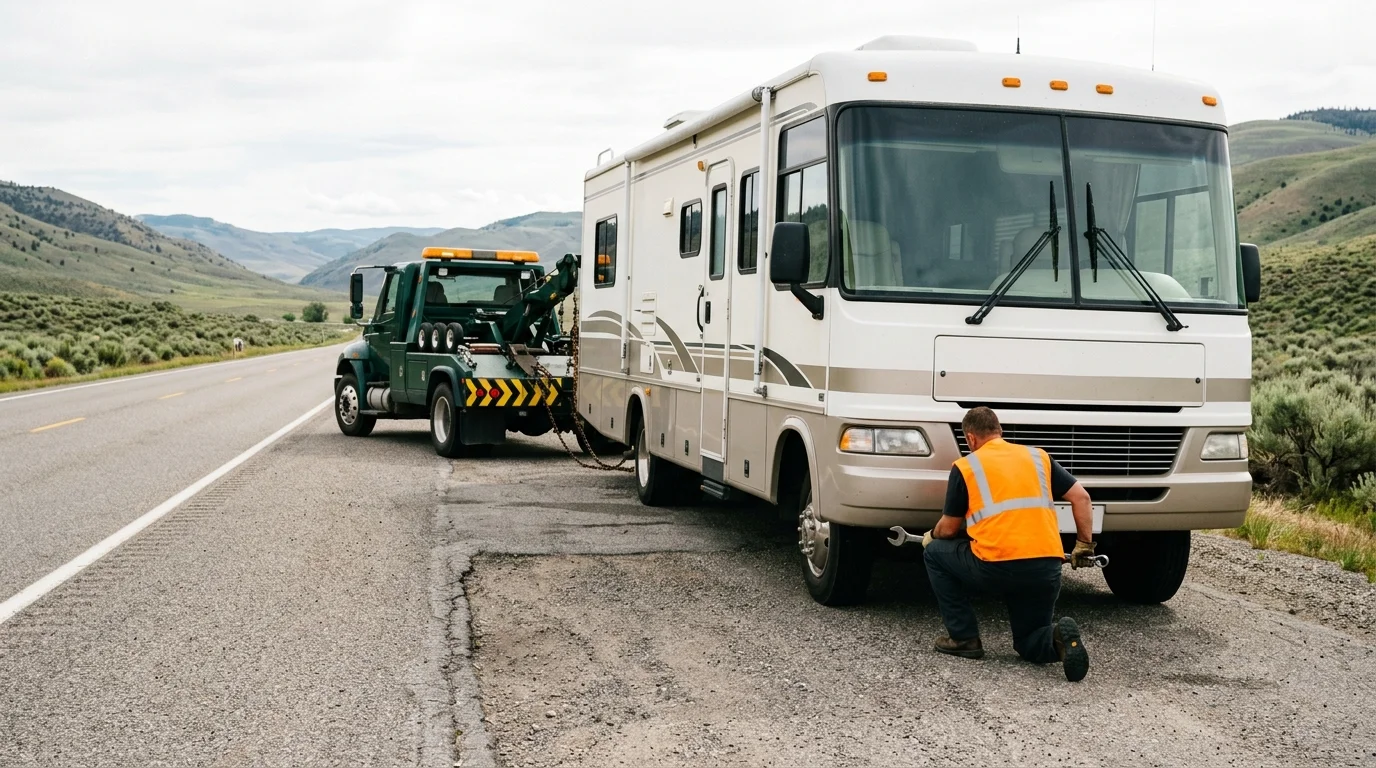
An RV breakdown creates more questions than a normal car tow. If you’re searching for “towing RV near me,” have the rig, access, and destination details ready before calling. Clear information helps the referral line match you with an operator who can assess the move.
Identify the RV and anything it is carrying
Start by describing the RV in plain terms. Tell dispatch whether it’s a motorhome, travel trailer, fifth wheel, camper, or another setup. Give the year, make, model, and overall condition when known.
Next, check your paperwork or manufacturer labels for its published dimensions and weight ratings. Don’t guess if you can’t find them. Say that the figures aren’t confirmed and tell dispatch where you looked. The operator can decide what else must be checked before accepting the job.
Mention every attached or separate load. That includes a trailer, tow dolly, vehicle, cargo carrier, bicycles, or other equipment. Explain whether anything has shifted, detached, or become damaged. Dispatch also needs to know if slide-outs, steps, leveling equipment, or an awning won’t return to their travel positions.
Share whether the RV contains passengers, pets, mobility equipment, or belongings that need separate arrangements. Don’t assume everyone can ride in the towing vehicle. Ask how the people and animals in your party should leave the scene.
Photos can help show the complete setup. Take wide views from a safe position, including the front, rear, and both sides. Add close photos of visible damage and the wheel areas. Don’t step into traffic or leave a safe location for a better angle.
Our RV and trailer towing service page explains how Quick Tow Memphis connects callers with local operators. Quick Tow doesn’t own towing equipment or perform the recovery itself.
Describe what still rolls, steers, and brakes
“Broken down” doesn’t tell an operator enough. Explain what happened and what the RV can still do. Say whether the engine starts, the transmission changes position, and the steering wheel turns.
Describe the parking brake and service brakes without trying to diagnose them. Tell dispatch if either system feels stuck, damaged, or unavailable. Report any warning shown on the dashboard using its exact wording when possible.
Walk around the RV only when you can do so safely. Note flat, missing, bent, or visibly damaged wheels and tires. Mention anything hanging below the body. Report leaking fluid, collision damage, fire damage, or contact with a curb, barrier, ditch, mud, or soft ground.
For trailers, explain the condition of the hitch area, coupler, landing gear, jack, and safety connections. Say whether the tow vehicle remains attached. If part of the setup has separated, describe where each piece rests.
Don’t try to force a wheel, release damaged equipment, or change the RV’s position for easier pickup. Dispatch can pass the condition to the operator, who decides how to approach it.
The difference between a routine transport and heavy-duty towing depends on the actual vehicle and recovery plan. Don’t choose equipment based only on the RV’s name or appearance. Give accurate details and let the operator assess the required setup.
Explain the shoulder, campsite, or parking access
Location means more than a street address. Share the nearest address, road name, travel direction, exit, mile marker, or visible landmark. Drop a map pin when the address doesn’t identify your exact position.
Memphis road networks create very different access problems. An RV beside I-40 near the Hernando de Soto Bridge isn’t approached like one inside a Bartlett campground. A breakdown on I-55 near the Memphis & Arkansas Bridge differs from a parking problem in Midtown or East Memphis.
Name the interstate before naming “the bridge.” The Hernando de Soto Bridge carries I-40. The Memphis & Arkansas Bridge carries I-55. This distinction helps prevent confusion when traffic is already moving around the vehicle.
You can check current cameras, incidents, and traffic conditions through TDOT SmartWay. Give dispatch what you can see from your position. Don’t leave a safe spot to investigate traffic or road conditions.
Describe the available working area. Is the RV fully inside a paved pullout, partly in a travel lane, parked at a campsite, or boxed into a lot? Mention narrow entrances, sharp turns, low branches, gates, parked vehicles, soft ground, and anything blocking front or rear access.
For private property, provide the property name and your site or space number. Confirm how the operator can enter. If a gate, office, manager, or property contact controls access, arrange that before dispatch when possible.
Say immediately if the RV is in Southaven or West Memphis. A tow originating in Mississippi or Arkansas is governed by that state’s law, not Tennessee’s.
Choose a destination before requesting the quote
A destination makes the request easier to assess. Decide whether the RV should go to a repair facility, dealer, campground, storage location, residence, or another suitable property.
Call the destination before requesting dispatch. Confirm that it will accept the RV in its present condition. Ask where the operator should enter, where the RV can be left, and whether someone must be present. If the business is closed, ask whether after-hours delivery is permitted.
Share the complete destination address with dispatch. Include a specific entrance or receiving area when one exists. A business name alone may not identify the correct gate or driveway.
Think about access at both ends. The pickup may offer plenty of room while the destination has a narrow entrance. Tell dispatch about gates, turns, slopes, soft surfaces, overhead obstacles, or crowded parking. If you can’t confirm access, say so before the operator accepts the move.
Distance, vehicle size, time of day, truck type, and hookup difficulty can change the total. Ask for the full amount with mileage included before agreeing. Also ask what conditions could change that figure.
Quick Tow Memphis can put the quoted total in writing before dispatch. The operator performs the work and contracts with you directly. For a closer look at pricing factors, read what affects the cost to tow an RV.
If plans change after the call, contact the line before the operator begins the trip.
Confirm the operator’s plan before dispatch
Use the final conversation to compare the plan against the facts you provided. Confirm that the operator received the correct RV type, condition, location, attached load, access notes, and destination.
Ask what preparation the operator wants completed before arrival. Don’t disconnect a trailer, move damaged parts, retract stuck equipment, or alter a drivetrain setting unless the operator gives instructions for that RV. If the manual contains an emergency-transport section, keep it available.
Recreational towing instructions aren’t automatically suitable for moving a disabled RV. A setup meant for normal travel may not address collision damage, locked wheels, failed brakes, or a parking brake that won’t release. Let the responding operator build the disabled-vehicle plan.
Ask how the motorhome, trailer, and attached load will be handled. If the operator expects separate moves, confirm each destination and written total. Make sure dispatch knows if passengers or pets still need transportation.
Repeat any fact that could change access. Examples include a blocked lane, locked gate, low branch, narrow campsite, steep entrance, or detached trailer. Send current photos when requested. Old photos may not show the RV’s present position.
Write down the operator’s name, contact path, destination, and agreed scope. Ask for the total with mileage included and what could change it. You may also request an itemized invoice and copies of written authorization or related paperwork.
Our broader Memphis RV towing guide covers planning beyond the dispatch call. For the immediate request, accurate details matter more than a confident guess.
When to call us
Call when your RV needs a working towing operator, especially when it can’t roll, steer, brake, or leave safely under its own power. Quick Tow Memphis matches your request with an operator, and the line takes calls around the clock. Call us at (901) 557-8700.