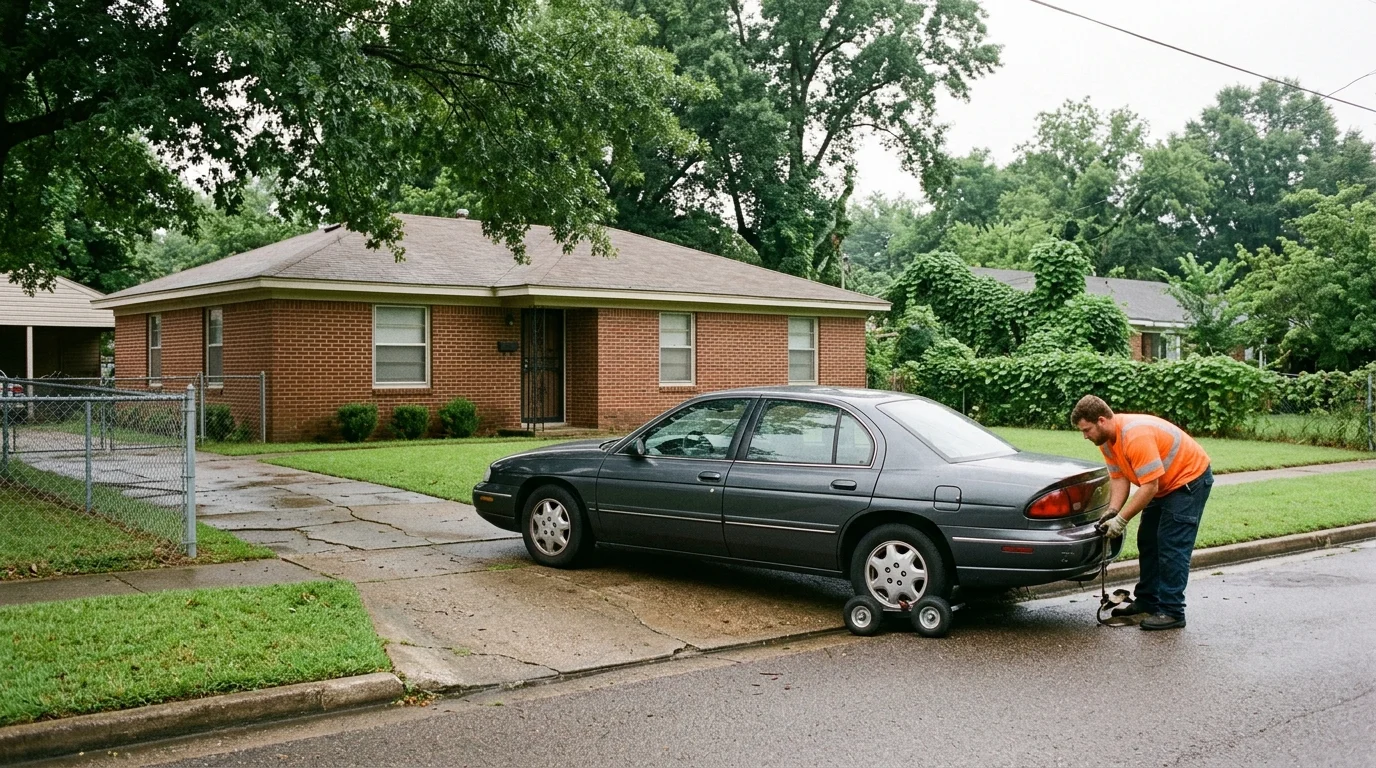
A blocked driveway in Memphis should start with the Memphis Police Department’s non-emergency line. Tell the city that a vehicle is blocking access, document its position, and follow the officer’s direction before arranging a private tow. Tennessee’s usual 12-hour wait doesn’t control when a vehicle is blocking access.
A blocked driveway in Memphis starts with a police call
A towing operator shouldn’t be your first call for an unknown vehicle. Start with the Memphis Police Department through the city’s current non-emergency line. The police can check the situation and tell you what must happen next.
Give the dispatcher your exact address. Explain whether the vehicle blocks the whole driveway or only makes the turn difficult. Tell them whether the driver is present and whether your vehicle is trapped.
Take clear photos from your property while you wait. Capture the blocked driveway, the vehicle, and its plate if visible. Don’t enter the vehicle, push it, or try moving it yourself. Avoid confronting the driver if the situation feels tense.
The police call also establishes which agency has jurisdiction. That matters around the edges of Memphis Metro. A driveway in Memphis follows Tennessee and city rules. A tow originating in Southaven follows Mississippi law. One originating in West Memphis follows Arkansas law. Tennessee towing rules don’t cross either state line.
If the exact address falls outside Memphis city limits, contact the law-enforcement agency serving that address. This can matter around Cordova and other areas near jurisdictional boundaries. Ask the agency whether an officer needs to respond or whether you may arrange a private-property tow.
Save emergency towing for situations that truly need immediate vehicle recovery. A stranger’s parked car across a driveway still begins with police documentation and proper authorization.
Your driveway is private property, and what that changes
A residential driveway isn’t treated like a paid commercial parking lot. Tennessee doesn’t set statewide sign dimensions, lettering sizes, or required wording for an ordinary trespass tow. A missing tow-away sign doesn’t create a single statewide answer for every driveway dispute.
The detailed sign rules for paid commercial lots and license-plate-reader enforcement shouldn’t be applied to a Memphis home. Our guide to Tennessee private-property towing signs explains that distinction.
What matters at a home is authority over the property and the reason for removal. Tennessee’s enacted 2025 towing act generally requires express written authorization before a vehicle is towed without its owner’s consent. The law also recognizes specific exceptions, including vehicles blocking access and removals requested by law enforcement.
Private property not open to the public has another route. The property owner or an authorized agent may authorize the removal. That still doesn’t mean a homeowner should skip the police call. An officer can help establish the proper path when ownership, permission, or the exact parking position is disputed.
Renters, shared-driveway users, and condominium residents should identify who controls the affected space. Give that information to the police and towing operator. Don’t sign as the property owner if you don’t hold that authority.
The practical distinction is simple. A car parked near your driveway may be inconvenient. A car parked across the entrance is blocking access. Describe the position accurately, then let the police and operator apply the correct rule.
What an operator must hold before the hook goes on
The paperwork burden rests with the towing operator. Memphis requires express written authorization for a private-property tow. That authorization identifies the person approving the removal and the reason for it.
The document must also describe the vehicle. Memphis rules call for its year, make, model, and color. The plate should be included if one exists. The VIN is included when it can be determined.
You can help by recording what’s visible. Don’t open the vehicle or enter it to find a VIN. Give the operator your photographs and any information the police provided. Ask who is authorizing the tow and request the paperwork before the vehicle leaves.
Storage requires its own express written authorization. That authorization must come from a law-enforcement officer with jurisdiction, the vehicle’s owner or agent, or the property owner or agent. A tow and later storage aren’t treated as one undocumented decision.
When the vehicle’s owner isn’t present, the person towing it has another duty. The towing operator must report the tow to the law-enforcement agency with jurisdiction within one hour. That report includes the VIN, plate, vehicle description, pickup location, and storage location.
These steps make the vehicle traceable after removal. They also give the owner a way to start locating it through the responsible agency. Anyone facing the other side of this process can read our guide to rights after a Memphis tow.
Don’t accept a casual promise that the paperwork will be created later. Confirm the authorization before the hook goes on.
When a wait applies and when it does not
Tennessee has a baseline 12-hour wait for certain non-consent tows involving unattended or immobile vehicles. That wait doesn’t apply when the vehicle creates a hazard, is parked illegally, or blocks access.
A sedan parked squarely across a driveway blocks access. You don’t need to turn that situation into an abandoned-car case before reporting it. Tell the police exactly how the vehicle prevents entry or exit.
This distinction matters because Tennessee’s abandoned-vehicle categories use different conditions. One category covers a vehicle left on private property without consent for at least 48 hours. Private residential property also appears as its own category without a stated waiting period in the enacted text.
Those categories shouldn’t be blended into a made-up rule that every Memphis homeowner must wait 48 hours. They also don’t mean every unfamiliar car can be removed instantly. The vehicle’s position, property type, authorization, and police direction still matter.
If the car sits near the driveway but leaves usable access, say that plainly. Don’t describe inconvenience as a blocked entrance. The police or operator may need a different basis before removal.
The situation can also change while the operator is present. If towing has started but the car hasn’t left its original parking location, Tennessee requires an on-site release when the owner or operator pays the permitted release fee. Let the towing operator handle that interaction and its paperwork.
Keep your photos and the time of your police call. They provide a clear record of what the driveway looked like before the vehicle moved.
What this costs you, and what it does not
No verified public figure confirms what a Memphis homeowner will pay for this specific driveway situation. The city’s on-scene wrecker rate schedule is referenced but isn’t publicly available in the material we could confirm. Ask the police and operator who will be billed before signing anything.
Don’t assume the removal is free. Don’t accept an unsupported fixed number either. If you agree to pay for a private service, ask that operator for the full total with mileage included, in writing, before you agree. Ask what could change it.
Distance, vehicle size, time of day, truck type, and hookup difficulty can affect the total. The operator performing the work contracts with the customer directly. Quick Tow Memphis is a referral service and doesn’t set the operator’s final price.
City impound charges are separate from a private operator’s quote. If the car already left for a city lot, locating it and the pickup folder live on finding a towed car in Memphis and what to bring for a Memphis impound release. City $135 impound and $30 daily storage are the city’s charges, not ours. This page is police documentation and blocking-access removal from the driveway.
If a towing charge or authorization looks wrong, preserve the paperwork. Memphis directs wrecker complaints to the city’s Permits Administrator or Wrecker Coordinator at (901) 636-6735 or permits@memphistn.gov.
When to call us
When police confirm that a private operator may move the vehicle, the recorded line takes calls 24/7 and matches the authorized property representative with a local operator. Call (901) 557-8700.