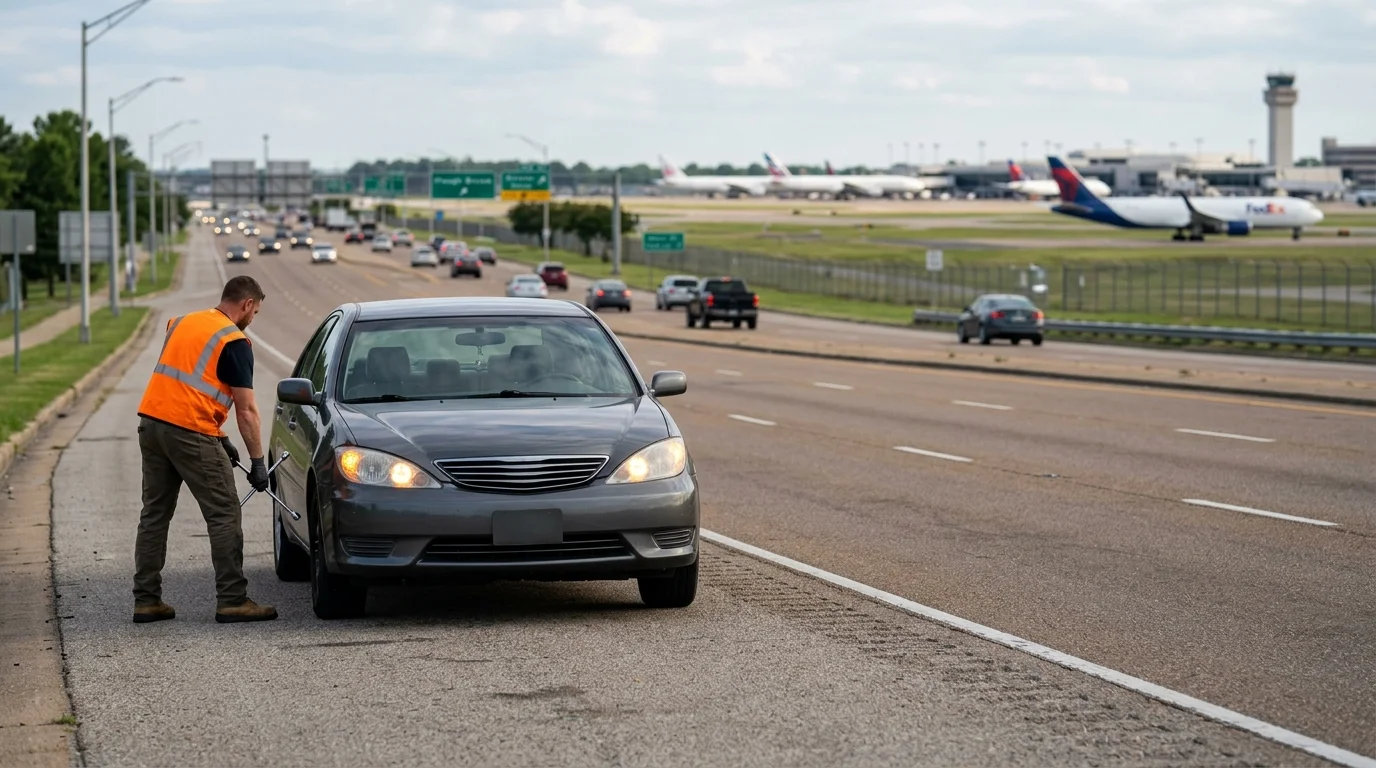
A stalled car near Memphis airport creates two immediate questions. Where exactly is the vehicle, and can roadside service solve the problem? Give those answers before you agree, especially inside a controlled lot or garage.
Pin down the road, lot, or garage location
“Near the airport” covers too much ground for an accurate pickup. Start with the location shown on your phone. Then describe the setting around the vehicle.
If you’re on a public road, share the road name and travel direction. Mention the last intersection, entrance, or readable sign you passed. Lamar Avenue carries US-78, so say “Lamar Avenue” rather than only describing the area as south Memphis.
For a vehicle inside a lot, send the lot name or location label. Add the section, row, level, or nearby landmark when available. If you’re in a garage, report the level and the entrance you used. Share any posted clearance before equipment is selected.
A map pin helps, but it doesn’t replace those details. Phone location markers can land on the wrong side of a road or structure. A short description gives the operator another way to locate the correct entrance.
Tell the call taker whether you’re a traveler, airport worker, rental customer, or someone collecting another driver. That context can clarify who has the keys and who controls access.
Also confirm which state the vehicle is physically in. A tow starting in Southaven follows Mississippi rules, even if the trip began in Memphis. A West Memphis pickup follows Arkansas rules. Tennessee towing rules don’t carry across either state line.
Decide whether roadside service may solve it
Not every disabled car needs to leave on a truck. Describe what happened before choosing between roadside assistance and towing.
Say whether the engine turns over, warning lights appeared, or the vehicle lost power while moving. Mention a flat tire, an empty fuel gauge, visible collision damage, or a key problem. Don’t diagnose the cause if you aren’t sure. Describe what the car does when you try to start or move it.
A car that won’t start may still need a simple roadside service. Our guide to a car that won’t start in a Memphis parking lot explains what information helps narrow the next step. If the fuel gauge is the issue, review the local fuel-delivery guide before requesting a full tow.
Location matters here too. TDOT HELP patrols I-240 in Memphis during published urban hours that vary by day. During HELP service hours, dial 511 and follow the Motorist Assistance prompts. Assistance is not guaranteed. HELP may clear a blocking vehicle, but it does not tow a disabled vehicle to your chosen shop, home, or storage lot.
For trouble inside an airport parking area, contact the facility controlling that property when access help is needed. Its staff can explain its current procedure. Then tell the operator what the facility said.
How parking access changes the pickup
Parking access can matter as much as the mechanical problem. A tow operator needs a workable route to the vehicle, not only its map location.
We couldn’t confirm one airport-wide procedure covering every road, lot, garage, rental area, and privately controlled parcel. The facility controlling the vehicle’s location sets the current access process. Contact that facility before you agree when instructions aren’t clearly posted.
Ask whether an outside towing operator may enter the area. Confirm which entrance should be used and whether someone must meet the operator. Ask how the vehicle can exit if a ticket, access card, or account is involved. Don’t assume one lot’s procedure applies somewhere else.
For a garage, share every posted height restriction you can see. Tell the call taker whether the car is near a ramp, wall, low ceiling, or tight turn. Those details help the operator decide what equipment can reach it. They also keep the matched operator from heading toward an entrance it can’t use.
If the vehicle belongs to a rental company, contact that company as well. Ask whether it wants to arrange the service and where it wants the vehicle taken. Keep the rental agreement available, along with the vehicle description and location.
Workers should also check with the employer or parking manager controlling their lot. Travelers using off-airport parking should contact that specific operator. Get current directions from the people managing the property, then pass those directions to the towing operator.
What to do when the vehicle cannot roll
A car that won’t roll needs a clearer equipment conversation. Tell the call taker which wheels move, whether the keys are present, and whether the steering can be operated. Mention collision damage, a stuck parking brake, or a wheel sitting at an unusual angle.
Also give the year, make, model, and drivetrain if you know them. Don’t rely on a general rule for all-wheel drive, four-wheel drive, or rear-wheel drive vehicles. The correct transport setup can vary by model year and trim. Check the towing or emergency-transport section of the owner’s manual when it’s available.
Ground clearance matters too. Report lowered suspension, body damage, a steep parking ramp, or anything hanging beneath the car. Loading aids may be needed in some situations, but the responding operator should choose the actual setup.
Leave the movement and equipment decisions to the operator. Moving a vehicle from a garage stall differs from collecting one beside I-240 or Lamar Avenue. A blocked wheel, tight corner, or damaged steering system can change the plan.
When transport is necessary, emergency towing can connect the situation with an operator equipped for the move. Have a destination ready when possible. Confirm that the destination will accept the vehicle, especially outside its normal business hours.
If law enforcement or facility staff are directing traffic around the car, follow their instructions. Tell the operator about any directions, restrictions, or designated meeting point they gave you.
What to confirm before the operator accepts
Before you agree, review the request from beginning to end. Confirm the pickup location, vehicle description, access instructions, condition, keys, and intended destination. Make sure the operator receives a phone number that will remain reachable during the pickup.
Ask which service is being arranged. A roadside attempt and a full tow are different requests. If the car can’t roll or steer, say that before the matched operator accepts the job.
Our published standard light-duty hookup starts at $95. That figure covers the hookup starting point, not every part of the final bill. Distance, vehicle size, time of day, truck type, and hookup difficulty can move the total.
Ask for the full total with mileage included before agreeing. Ask what circumstances could change it. Ask the matched operator for the total in writing before you agree, plus an itemized invoice, written authorization, and related paperwork. The referral line can remind you to ask.
Quick Tow Memphis is a referral service. We take the details and match callers with a local tow operator. That operator performs the work and contracts with the customer directly. The line takes calls 24/7, and your call routes to the operator covering your zone.
Ask the assigned operator for current timing after the request is matched. Airport traffic, parking access, and the required equipment can affect the individual job, so we don’t publish a general arrival window.
When to call us
If the car won’t roll, can’t leave the parking area, or needs transport, the move belongs with a working towing operator. We’ll collect the location, vehicle, access, and destination details. Call us at (901) 557-8700.