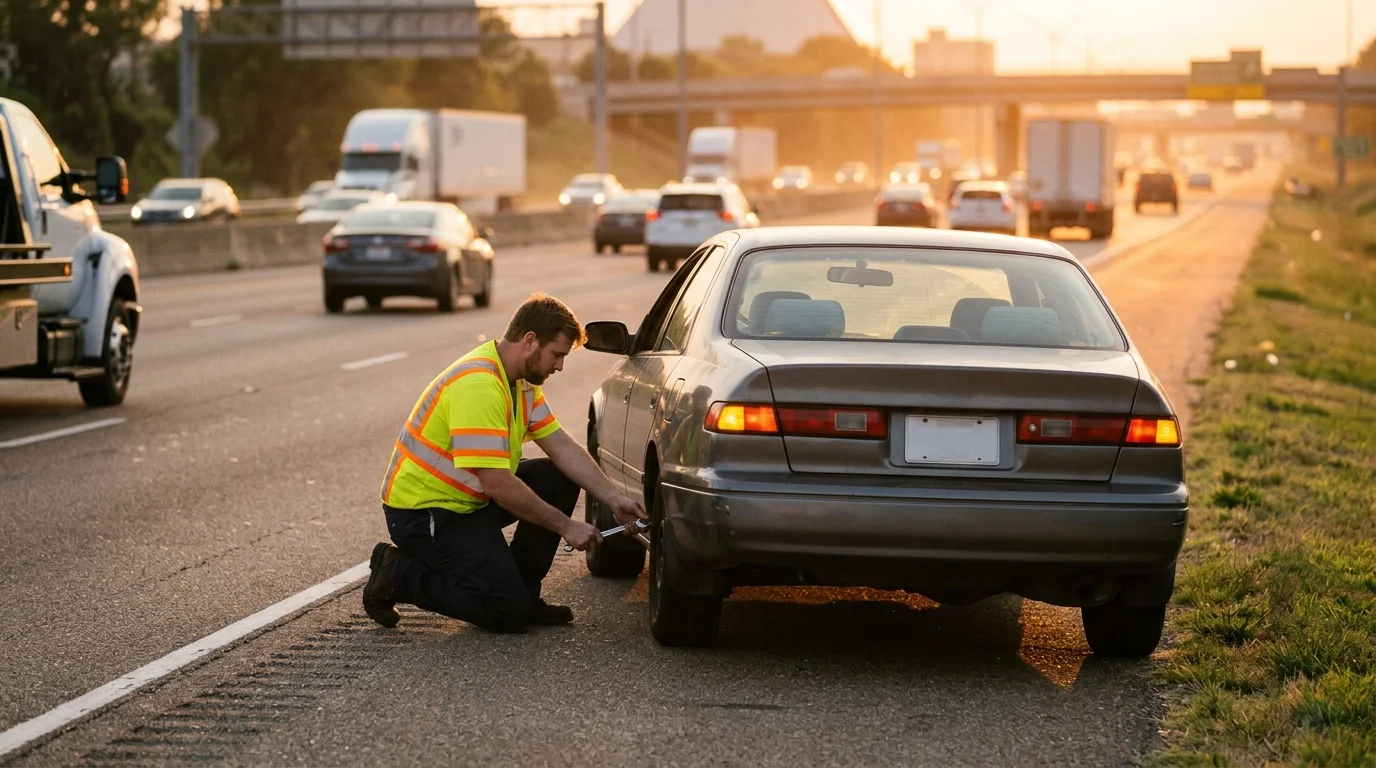
A fuel delivery request in Memphis connects you with a local roadside operator. The operator brings the fuel type you confirm and contracts with you directly. Your first job is staying safe and sharing an exact location.
What to do the moment the engine dies
Turn on your hazard lights as soon as the car loses power. Move away from active traffic if you can do so safely. Don’t step into a travel lane or attempt roadside work beside moving vehicles.
If the car stops in an active lane, contact emergency services. Tell them the roadway, direction of travel, and nearest exit. Mention any curve, hill, barrier, or blocked lane that affects visibility.
Once you’re out of immediate danger, collect the details a roadside operator needs:
- Your exact location and travel direction
- The vehicle’s year, make, and model
- The fuel type shown on the fuel door or cap
- Whether the vehicle is safely accessible
- Whether fuel may have leaked
Use a map pin when street signs aren’t visible. On I-240, “near Memphis” isn’t precise enough. Give the nearest exit, interchange, or recognizable landmark. In a parking lot, name the business and the side of the building.
Don’t guess about gasoline, diesel, or fuel grade. Check the label near the filler opening or the owner’s manual. If neither settles it, say that the fuel type isn’t confirmed.
Quick Tow Memphis takes these details from your call, and matches callers with local operators. The operator performs the fuel delivery in Memphis and sets the service price. Ask the matched operator for the full total, including the fuel, in writing before you agree.
Where you are matters: interstate, bridge, surface street
Memphis fuel delivery changes with the road beneath your car. A shoulder on I-40 presents different access problems than a Midtown parking lot. A narrow bridge shoulder also needs more careful location details.
The Hernando de Soto Bridge carries I-40 across the Mississippi River. The Memphis & Arkansas Bridge carries I-55. If you stop near either crossing, name the bridge and travel direction. Don’t describe the location only as “the Memphis bridge.”
TDOT HELP patrols covered Tennessee interstates around Memphis during published urban hours that vary by day. Rural HELP also covers I-269 from the Mississippi state line to Exit 19 from 6:00 a.m. to 10:30 p.m. daily, with on-call overnight support for major incidents. During service hours, dial 511 and follow the Motorist Assistance prompts. Assistance is not guaranteed.
The program’s listed services are flat changes, fuel delivery, minor mechanical help, and clearing blocking vehicles. TDOT HELP doesn’t tow a vehicle to a repair shop, home, or storage lot. Work beyond lane clearance requires a private towing operator.
Patrol coverage isn’t an arrival promise. Check TDOT SmartWay for current traffic, cameras, and incident information while arranging help.
Surface-street calls need the same precision. Summer Avenue through Berclair differs from Lamar Avenue, which carries US-78 and heavy truck traffic. Hickory Hill, East Memphis, Cordova, Bartlett, and Whitehaven also require distinct routing.
State lines matter too. A request originating in Southaven falls under Mississippi law. One beginning in West Memphis falls under Arkansas law. Tell the operator which state you’re in, even if downtown Memphis is visible. For more crossing-specific guidance, read our Memphis bridge breakdown guide.
How much fuel a delivery actually brings
There isn’t a confirmed standard quantity for every Memphis fuel delivery. The approved local material and TDOT information don’t establish one universal amount. Ask the assigned operator what quantity will be brought before you agree.
A roadside fuel delivery also shouldn’t be treated as a full tank unless that was expressly agreed. Confirm whether the planned amount is intended for a restart and a drive to a nearby station. Share your location so the operator understands the next leg of your trip.
Before accepting service, confirm these points:
- The exact fuel type and grade
- The quantity the operator plans to bring
- The full service total, including the fuel
- What happens if the vehicle still won’t start
- What could change the quoted total
Distance, time of day, vehicle size, truck type, and hookup difficulty can affect towing costs if the call turns into a tow. Ask for the complete total with mileage included before approving that change.
Quick Tow Memphis is a referral service, not the fuel seller or towing operator. We match the caller with a local operator, who contracts with the customer directly. Ask the matched operator for the total in writing before you agree, plus an itemized invoice.
Keep the fuel receipt and service paperwork. If the car restarts, head toward an appropriate station instead of assuming the emergency supply will cover the rest of your plans. If it doesn’t restart, don’t keep treating the problem as an empty tank. The vehicle may need diagnosis or transport.
Diesel, gas and the mistakes that cost an engine
Fuel type is the detail that can’t be guessed. “Regular car” isn’t enough because gasoline and diesel vehicles can look similar from the outside. Read the fuel-door label, cap, dashboard message, or owner’s manual.
Tell the operator the complete label you find. If the vehicle requires diesel, say “diesel” clearly when requesting service. If the gasoline grade matters, include that too. The vehicle’s year, make, and model provide another useful check, but they don’t replace the label.
Running a diesel vehicle completely dry may involve a model-specific restart process. Follow the manufacturer’s instructions. Don’t improvise beside a Memphis highway or ask an untrained passenger to work around traffic.
If the wrong fuel has already entered the tank, don’t attempt another start. Tell the operator exactly what was added and whether the engine ran afterward. A fuel drop won’t remove contaminated fuel. Transport to a repair facility may be the better next step.
The same caution applies when the fuel type can’t be confirmed. Waiting for correct information is better than choosing based on the pump handle’s color or someone’s memory.
Fuel odor, a visible puddle, or damage around the filler opening changes the call. Move away from traffic and ignition sources when it’s safe. Contact emergency services when there’s an immediate danger. Don’t pour more fuel into a vehicle that may be leaking.
For a dead battery, lockout, flat tire, or another non-fuel problem, request the matching form of roadside assistance. A clear description helps match the right kind of help.
When a tow beats a fuel drop
Fuel delivery fits a narrow problem: the vehicle is out of the correct fuel, accessible, and otherwise able to run. A tow makes more sense when those conditions don’t hold.
Choose transport instead when the wrong fuel entered the tank. The same applies when the correct fuel was delivered but the engine still won’t start. At that point, an empty tank may not be the whole problem.
A tow may also be appropriate when:
- The fuel tank or filler area appears damaged
- Fuel is leaking from the vehicle
- The fuel type can’t be confirmed
- The vehicle needs inspection at a repair shop
- Its position prevents a safe roadside fuel transfer
- It must be moved beyond TDOT HELP’s lane-clearing role
Don’t try to push a disabled vehicle across an interstate shoulder or bridge approach. The road position and traffic exposure belong in the first description you give the operator. That information affects the equipment and approach needed.
If the call becomes a tow, ask where the vehicle is going before you agree. Confirm the complete total with mileage included and ask what could change it. Vehicle size, truck type, destination, and hookup difficulty can all matter.
The starting state remains important across the Memphis metro. Tennessee towing rules shouldn’t be applied to a tow originating in Southaven or West Memphis. Give the exact pickup location before discussing paperwork or charges.
When to call us
Call when the fuel type is confirmed but roadside delivery belongs to a working operator. If the car won’t restart, the fuel is uncertain, or the vehicle needs a shop, we’ll match you with a local towing operator. Our line takes calls 24/7. Call us at (901) 557-8700.