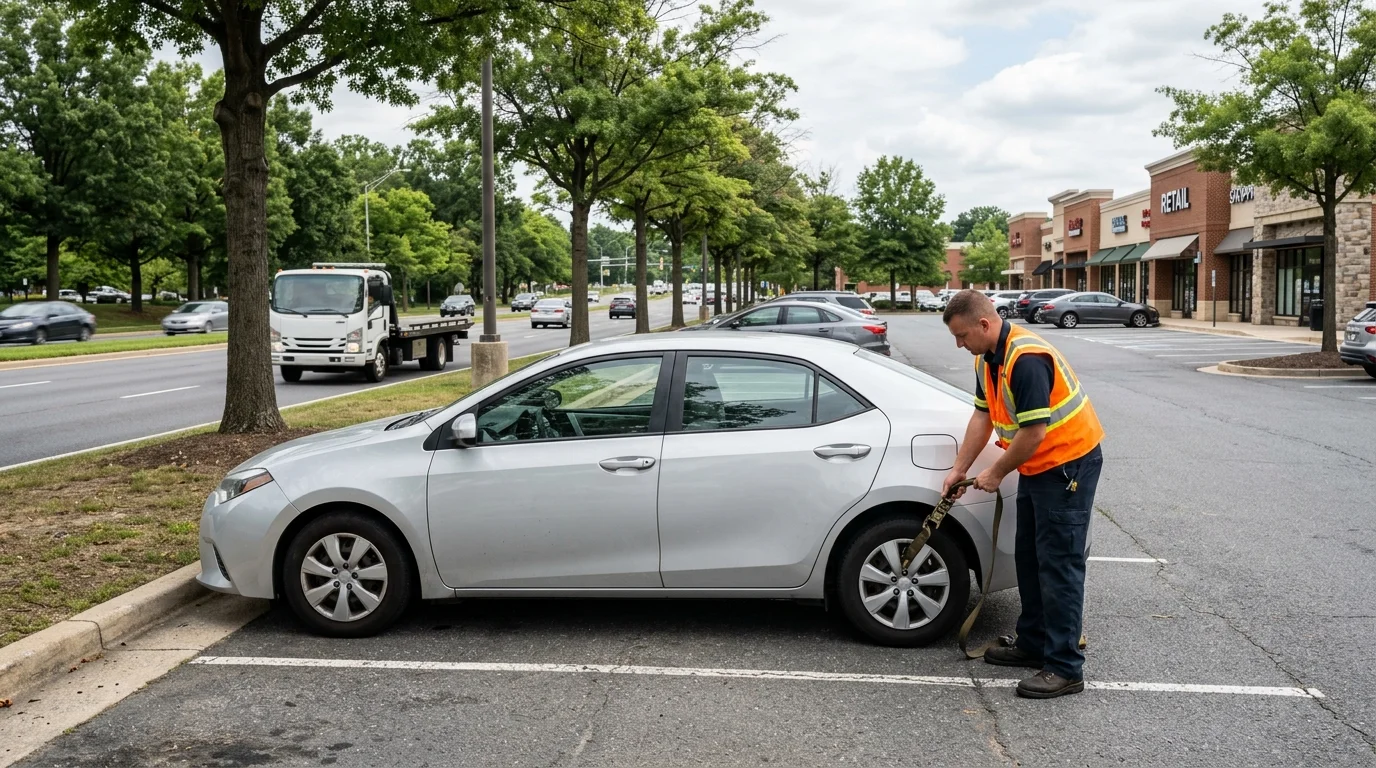
A breakdown in Germantown starts with one decision: roadside help or a tow. Give the operator a precise location, clear symptoms, pickup access details, and your destination before you agree.
Share the exact road, lot, or garage
Start with the place where the car sits now. “Germantown” alone doesn’t give an operator enough pickup detail.
Name the road and nearest visible cross street. Say whether you’re along Poplar Avenue, Germantown Parkway, a residential street, or inside a retail parking area. If you’re sharing a map pin, also describe what the operator should see upon arrival.
Retail properties may have several entrances and separate parking sections. Give the business name, your side of the building, and the nearest marked entrance. Mention whether you’re in an open surface lot or inside a parking garage.
For a garage pickup, read any posted clearance sign to the operator. Explain which entrance you used and where the car is parked. Include the floor or section if it’s marked. Don’t assume every towing setup will fit through the entrance.
On a residential street, provide the full street address or nearest house number. Tell the operator whether the car is at the curb, in a driveway, or blocking access. Tennessee’s towing rules distinguish vehicles creating a hazard or blocking access, so an accurate description matters.
Stay consistent when sharing the location. A map pin, road name, and landmark should all identify the same pickup point. That reduces confusion when the operator reaches the property.
Describe what the car does now
Report what you can observe without guessing at the cause. The operator needs symptoms, not a diagnosis.
Say whether the engine starts, cranks without starting, clicks, or stays silent. Mention warning lights you can see. If the car overheated, lost power, or stopped after an impact, say exactly that. Don’t label the problem as a failed battery, alternator, starter, or fuel pump unless it has been confirmed.
Tell the operator whether the car can shift into neutral. Mention whether the parking brake releases and whether you have the keys. If a wheel or tire looks damaged, describe its position. Our guide to flat tire service in Memphis explains what information helps when a tire problem leaves the car parked.
The year, make, model, and trim also belong in the call. Share whether the vehicle is front-wheel drive, rear-wheel drive, all-wheel drive, or four-wheel drive if you know. Don’t substitute a guess. The towing or emergency-transport section of the owner’s manual is the right source for your exact model year.
A car that won’t start in a retail area creates a different pickup than one stopped on a residential street. The guide to a car that won’t start in a Memphis parking lot covers that situation in more detail.
Decide whether roadside help or towing fits
The symptoms and destination guide this decision. The operator can determine whether the job calls for roadside work or vehicle transport.
A flat tire, empty fuel tank, or minor mechanical problem may fit roadside assistance. Describe the condition first. The operator covering your zone can tell you whether the requested work fits the situation.
A tow fits when the vehicle needs transport to a repair shop, home, or another approved destination. It may also be the better request when the cause isn’t clear or the car can’t be moved normally. Our emergency towing service connects callers with local operators who perform the work and contract with customers directly.
There’s also a public highway layer near Germantown. The TDOT HELP program patrols SR-385/Bill Morris Parkway during published urban hours that vary by day. Rural HELP also covers I-269 from the Mississippi state line to Exit 19 from 6:00 a.m. to 10:30 p.m. daily, with on-call overnight support for major incidents. During service hours, dial 511 and follow the Motorist Assistance prompts. Assistance is not guaranteed.
TDOT HELP doesn’t tow a vehicle to a shop, home, or storage lot. Anything beyond lane clearance requires a private tow. Don’t extend that program’s coverage to Germantown streets or retail lots that aren’t on its published route list.
Explain the pickup access before the operator accepts
Access details help the operator evaluate the pickup before accepting it. Share anything that separates the car from an open roadway.
For a retail lot, describe gates, entrance restrictions, curbs, covered areas, and narrow lanes. If the business controls access, ask its staff whether the operator needs help entering. Don’t promise access that hasn’t been confirmed.
For a parking garage, give the posted clearance and parking level. Mention tight turns, ramps, columns, or a disabled gate when visible. The operator can decide what equipment fits the space. Don’t move the car or attempt a recovery method that belongs to the responding professional.
Residential pickups need the same detail. Say whether the vehicle is behind another car, beside a fence, under a covered area, or on a sloped driveway. Tell the operator if access depends on a property owner, tenant, or gate code. If the car is on a public street, identify its position without guessing about local parking rules.
Current Tennessee towing law requires express written authorization before towing unless a stated exception applies. Ask the matched operator for written authorization and related paperwork before they move the car.
Keep your phone available after the request. If the pickup description changes, pass along the new information before the operator commits to an approach. A different entrance, locked gate, or garage level can change how the pickup must be handled.
Confirm the destination and quote
Choose the destination before the matched operator accepts whenever possible. Give its full street address, not only a shop or neighborhood name.
Confirm that the destination expects the vehicle. If it’s a repair shop, ask where an after-hours vehicle should be left. If it’s a home, describe the intended parking spot and any access issue there. A tow has both a pickup and a drop-off, so both locations affect the job.
Our standard light-duty hookup starts at $95. That figure covers the starting hookup, not every possible part of the tow. Distance, vehicle size, time of day, truck type, and hookup difficulty can move the total.
Ask for the full total with mileage included before agreeing. Also ask what conditions could change that amount. Ask the matched operator for the total in writing before you agree and for an itemized invoice. The service is pay-per-call, with no membership or annual fee.
Make sure the written details match what you reported. Check the pickup, destination, vehicle, and requested service. If the operator recommends different equipment after reviewing the car or access, ask how that affects the total before authorizing the job.
Don’t compare quotes using the hookup amount alone. Compare the full trip based on the same pickup, destination, vehicle, and access details. That gives each Germantown towing service the same job description.
When to call us
Call when the vehicle needs professional roadside work or transport from a Germantown road, residence, garage, or retail lot. The recorded line takes calls 24/7 and matches you with a local operator who contracts with you directly. Your call routes to the operator covering your zone. Call (901) 557-8700.