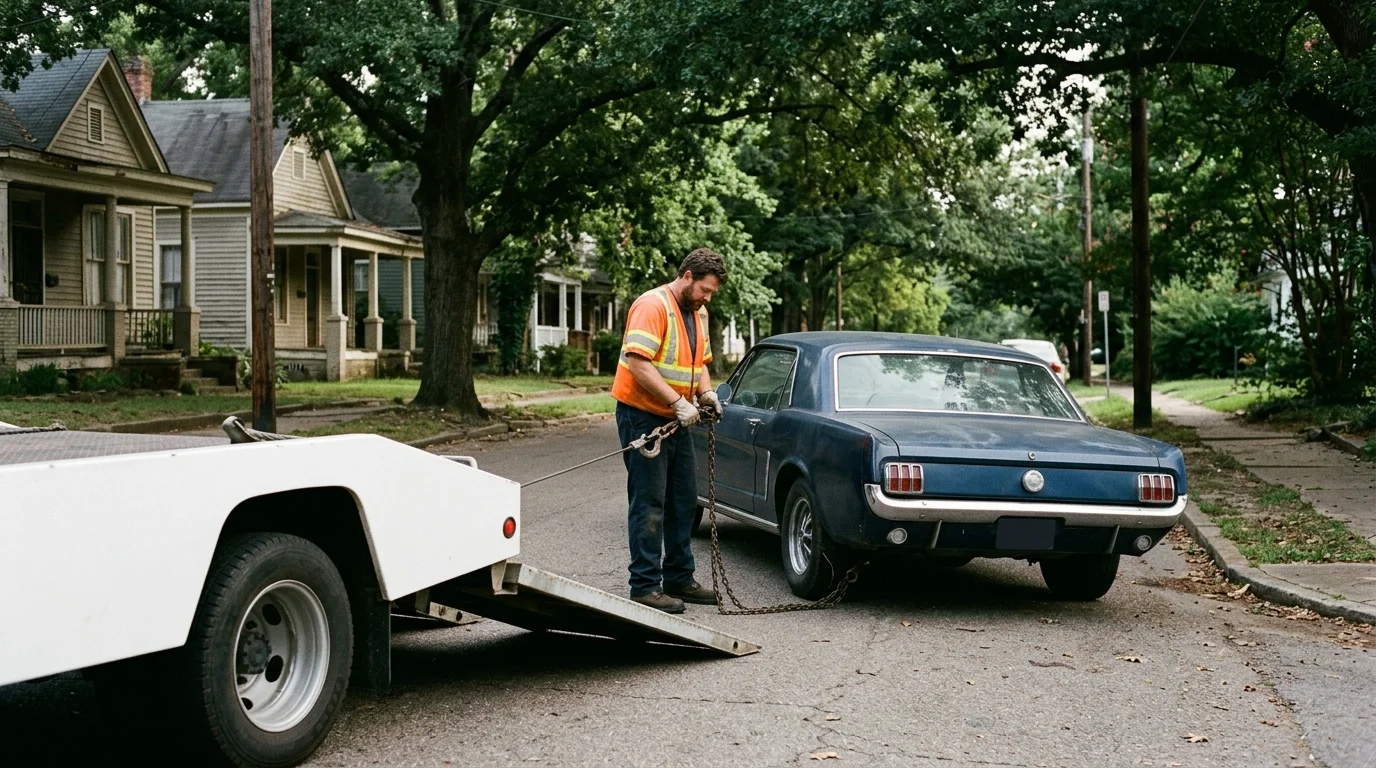
A rear-wheel-drive vehicle is commonly towed with its rear drive wheels raised when a wheel lift is permitted. That reverses the ordinary front-wheel-drive arrangement. The front tires may remain on the road, so their condition and direction matter. A carrier or wheel dollies can keep all four tires off the pavement when the manual or damage calls for it.
Which axle must an RWD tow protect?
The rear axle is the driven axle on a rear-wheel-drive vehicle. Leaving it on the pavement can turn connected drivetrain parts during transport. The operator therefore starts by checking whether the rear wheels must be raised or supported.
The official 2024 Mazda MX-5 Miata manual makes this concrete. Mazda identifies the rear wheels as the drive wheels and says a towed RWD MX-5 should have them off the ground. If damage or another condition prevents that arrangement, the manual names wheel dollies.
That statement belongs to the 2024 MX-5. It should not be copied onto a 2014 BMW 3 Series, a 2021 Dodge Charger, or even a different MX-5 year without checking that vehicle’s manual. Model years, transmissions, parking brakes, and manufacturer instructions change the answer.
How is an RWD wheel-lift setup different from an FWD setup?
An RWD wheel-lift plan focuses on raising the rear, while an FWD plan normally focuses on raising the front. The difference is mechanical, not cosmetic.
| Vehicle layout | Driven end | End commonly considered for a wheel lift | Wheels that may remain on the road |
|---|---|---|---|
| Front-wheel drive | Front axle | Front | Rear wheels |
| Rear-wheel drive | Rear axle | Rear | Front wheels |
The table is only a starting map. The exact manual can require a carrier or another arrangement. Damage can also make the ordinary lift points or rolling wheels unusable.
Read our flatbed versus wheel-lift towing comparison for the truck-side mechanics. Our wheel-lift towing service page explains what information an operator needs before deciding whether that setup fits.
What must be checked at the front wheels?
The front wheels must be able to roll and remain controlled if they stay on the road. A bent wheel, damaged steering, locked column, or front tire pushed against bodywork can make that impossible.
Look at the front tires from a safe position. Tell the operator if one points in a different direction, sits farther back in its opening, or will not turn. Do not straighten a damaged wheel by force. Do not crawl beneath the car to inspect steering parts.
A rear lift also changes the car’s angle. A long front overhang or low air dam can move closer to the pavement after the rear rises. That makes an RWD sports car with a low nose a different loading problem from a taller RWD sedan. Approach-angle and air-dam geometry live on how to tow a low-clearance vehicle. This page stays on the rear drive axle.
What changes when the rear wheels are damaged?
Rear-wheel damage affects the same axle the operator would ordinarily want to raise. A missing tire, bent rim, tilted wheel, or collapsed rear corner can prevent an ordinary wheel-lift cradle from supporting that end as expected.
Describe what you see in plain language:
- The rear tire is flat or separated from the rim
- The rear wheel sits at an angle
- The rear wheel appears pushed forward or backward
- One rear corner rests lower than the other
- A part hangs near the differential, axle, or exhaust area
These observations do not identify the failed component. They help the operator plan loading without relying on a diagnosis. A carrier, dollies, skates, or another rigging approach may be considered after inspection. None is promised before the operator reviews the vehicle.
Why does the parking brake still matter on RWD?
The parking brake matters because it can prevent the rear wheels from moving during positioning and loading. The 2024 MX-5 manual requires all four wheels raised if the parking brake cannot be released.
Do not force an electronic or mechanical parking brake. Tell the operator what the indicator shows and whether the control responds. If the battery is dead, report that too. A model-specific manual may document a release process, but the procedure for one year should not be used on another.
This is where RWD differs sharply from the FWD case. On the FWD car, a stuck rear brake affects the wheels expected to roll on the road. On the RWD car, it affects the axle the operator may need to position in a rear lift. Both matter, but they create different hookup problems.
Can an RWD car be loaded facing either direction?
Do not assume direction is interchangeable. The 2024 MX-5 manual warns against towing that car forward with its drive wheels on the ground. The operator must follow the diagram and direction shown for the exact model.
Pickup access can also constrain direction. A car backed tightly against a Midtown garage wall may not offer the same approach as one facing an open street. Posted height and whether a truck can enter live on can a tow truck reach a Memphis parking garage. Tell the recorded line which end faces the exit and how much working space surrounds each side.
If a carrier is considered, low front and rear bodywork still matter during winching. Share photos that show the nose, rear valance, side profile, driveway slope, and any curb or ramp between the car and street.
What should you report before an RWD tow?
Report the driven axle, the condition of all four wheels, and the exact parking position. The recorded line takes calls 24/7, takes RWD wording from the manual plus rear-axle and front-roll condition, and matches you with a local operator who contracts with you directly.
Have these details ready:
- Year, make, model, trim, and RWD wording from the manual
- Automatic or manual transmission
- Whether the transmission selects neutral
- Whether the parking brake releases
- Whether both front wheels roll and point normally
- Whether either rear wheel is damaged or blocked
- Low bodywork, suspension changes, or oversized wheels
- Pickup position, access path, and destination
For a roadside stop, give the route, direction, and nearest exit first. Distinguish the Hernando de Soto Bridge on I-40 from the Memphis and Arkansas Bridge on I-55. The recorded line takes calls 24/7, takes RWD wording from the manual plus rear-axle and front-roll condition, and matches you with a local operator who contracts with you directly. Call (901) 557-8700.
Can a rear-wheel-drive car be towed with the rear tires rolling?
Only when the exact manufacturer instructions allow it. The 2024 MX-5 manual instead says its rear drive wheels should be off the ground.
Do wheel dollies help with an RWD vehicle?
They can support wheels that should not roll on the pavement. The responding operator decides whether dollies fit the vehicle, damage, and working space.
Is a flatbed always required for RWD?
No single rule covers every RWD model. The manual, wheel condition, clearance, and pickup access determine what the operator can use.