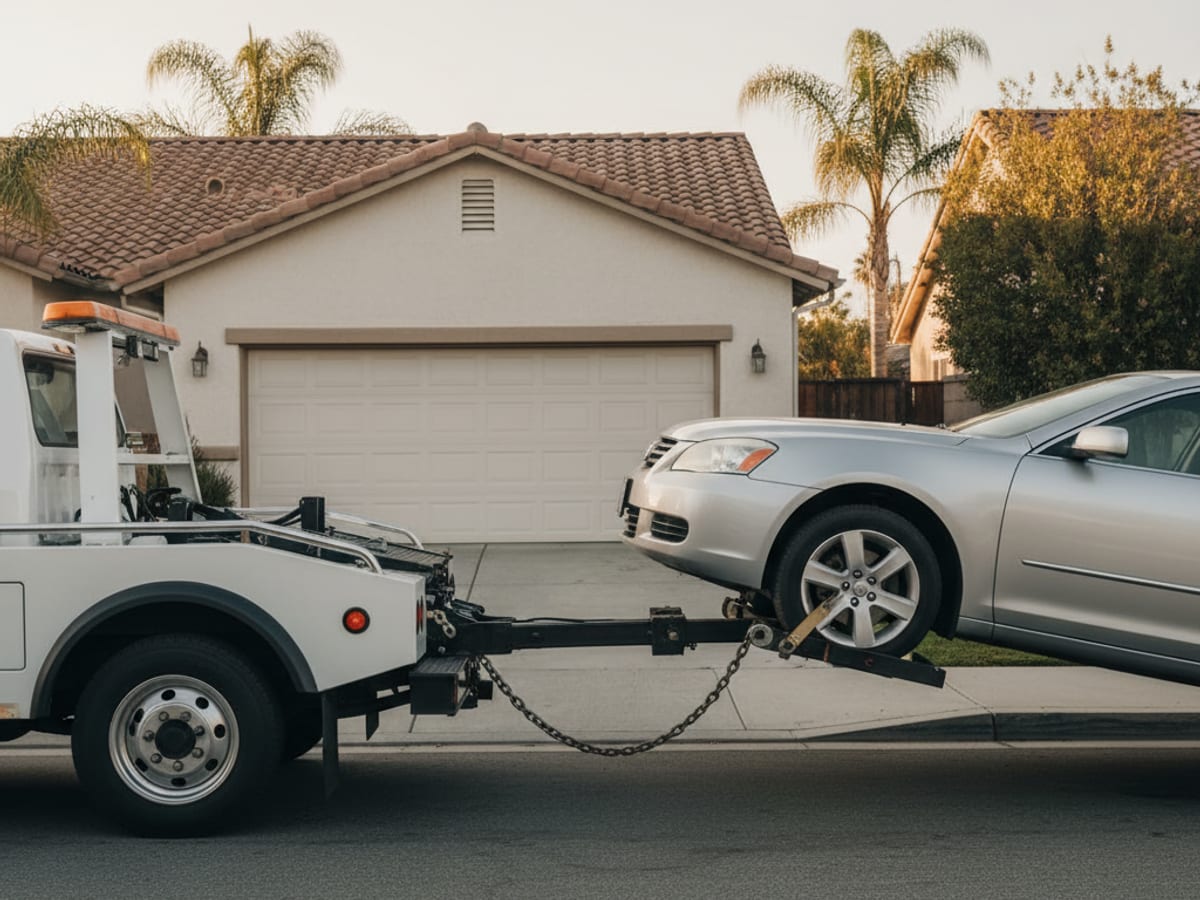
A front-wheel-drive vehicle is commonly positioned with its front wheels raised when a wheel lift is allowed. The front axle supplies the drive, so lifting the front keeps the driven wheels off the pavement. The rear tires remain on the road and must be able to roll freely. A flatbed remains another option for the responding operator to evaluate.
Which end of a front-wheel-drive car comes off the road?
The front end comes off the road in the ordinary wheel-lift arrangement for a front-wheel-drive car. This is not a guess based on body shape. The operator confirms the drivetrain and reads the exact model-year towing instructions first.
Honda’s 2024 Civic Sedan Owner’s Manual gives a concrete example. Its emergency-towing section calls a flatbed the best transport method. It also describes a wheel lift under the front tires, with the rear tires remaining on the road, as acceptable for that Civic.
That manual applies to the 2024 Civic Sedan. It does not authorize the same setup for every Civic year, every Honda, or every front-wheel-drive vehicle. Check the manual that came with your car or the manufacturer’s manual tied to its year and model.
Why does lifting the rear create the wrong question for FWD?
Lifting only the rear would leave the driven front wheels on the pavement. The operator would then need specific manufacturer permission for those drive wheels to rotate during transport. You should not infer that permission from neutral.
The practical axle map is simple:
| Part of the car | Role on a typical FWD wheel-lift tow | What must be true |
|---|---|---|
| Front axle | Driven axle held by the wheel lift | Front wheel area can be supported without relying on damaged parts |
| Rear axle | Rolling axle left on the road | Rear tires roll, parking brake releases, and no rear damage blocks movement |
| Whole vehicle | Alternative position on a carrier deck | Operator can load and secure it within the manual’s instructions |
Our flatbed versus wheel-lift comparison explains the truck-side difference. The wheel-lift towing service page shows the location and vehicle details needed before an operator evaluates that method.
When does the rear axle stop being the easy rolling end?
The rear axle stops being the easy end when a rear tire, wheel, hub, or parking brake will not release. A front-wheel-drive label does not solve a locked rear wheel. A standard front lift would still leave that problem on the pavement.
The 2024 Civic manual makes the parking-brake issue explicit. If its parking brake cannot be released, Honda directs flatbed transport. That is a model-specific instruction and a useful intake lesson: tell the operator about the rear wheels, not just the driven front axle.
Report what you observe without diagnosing it:
- A rear tire does not turn as the car is nudged within a safe loading area
- The parking-brake indicator remains on
- One rear corner sits lower than the other
- A rear wheel looks tilted, bent, or pushed out of position
- A loose part hangs near a rear tire
Do not drag the car to test a blocked wheel. The operator may consider a carrier, dollies, skates, or another loading method. The choice depends on the actual failure, access, and support points.
What if a front drive wheel is damaged?
A damaged front wheel affects how the driven end can enter the lift or climb a carrier. The drivetrain still says the front axle supplies power. The damage says that wheel may not roll, steer, or sit normally in the equipment.
Describe the wheel rather than naming a broken part. “The front passenger tire is flat and the rim touches the pavement” is useful. “The axle is broken” is a diagnosis unless a repair professional has confirmed it.
Send photos if requested and safe. Include a straight view of the wheel, a side view of the car, and the open space ahead and behind it. A nose-in car against a wall in an East Memphis garage presents a different loading path from a Civic beside an open Bartlett driveway. Posted height and whether a truck can enter live on can a tow truck reach a Memphis parking garage. This page stays on the front drive axle and which wheels can roll.
Does putting a FWD car in neutral make the setup automatic?
No, neutral does not choose the towing method. It may help a vehicle roll during loading when the manual documents that behavior, but it does not repair a locked wheel, release an electronic parking brake, or cancel model-specific restrictions.
Do not search for a shift-lock location on a different model. Open your manual and look for “emergency towing,” “shift lever does not move,” or “parking brake.” If your manual documents an override, keep those instructions available for the operator. Do not force a control.
Tell the recorded line if the engine will not start or the 12-volt system appears dead. Electronic shifters and parking brakes can behave differently without power. The responding operator decides how to load the vehicle in its current state.
What details identify a front-wheel-drive tow correctly?
The exact drivetrain, rolling condition, and parking-brake state identify the job. “It is a sedan” is not enough because the same model line can have different drivetrains or transport instructions across years and trims.
Tell the recorded line these details:
- Year, make, model, and trim
- Front-wheel-drive wording from the manual or build record
- Whether the car starts and selects neutral
- Whether the parking brake releases
- Whether each front and rear wheel appears able to roll
- Visible damage at either axle
- Pickup position, access limits, and destination
The recorded line takes calls 24/7, takes FWD wording from the manual plus which wheels roll, and matches you with a local operator who contracts with you directly. For a vehicle beside I-240 or I-40, give the direction and nearest exit first. Call (901) 557-8700.
Can a front-wheel-drive car go on a flatbed?
Yes. A carrier can support all four wheels, but loading and securement still depend on the vehicle’s condition and manual.
Can a FWD car be towed from the rear?
Do not assume so. A rear lift leaves the driven front tires on the road, so the operator needs exact manufacturer instructions before considering it.
What matters besides the driven axle?
The rear wheels must roll in an ordinary front-lift setup. A stuck parking brake, damaged rear wheel, or blocked access can change the plan.