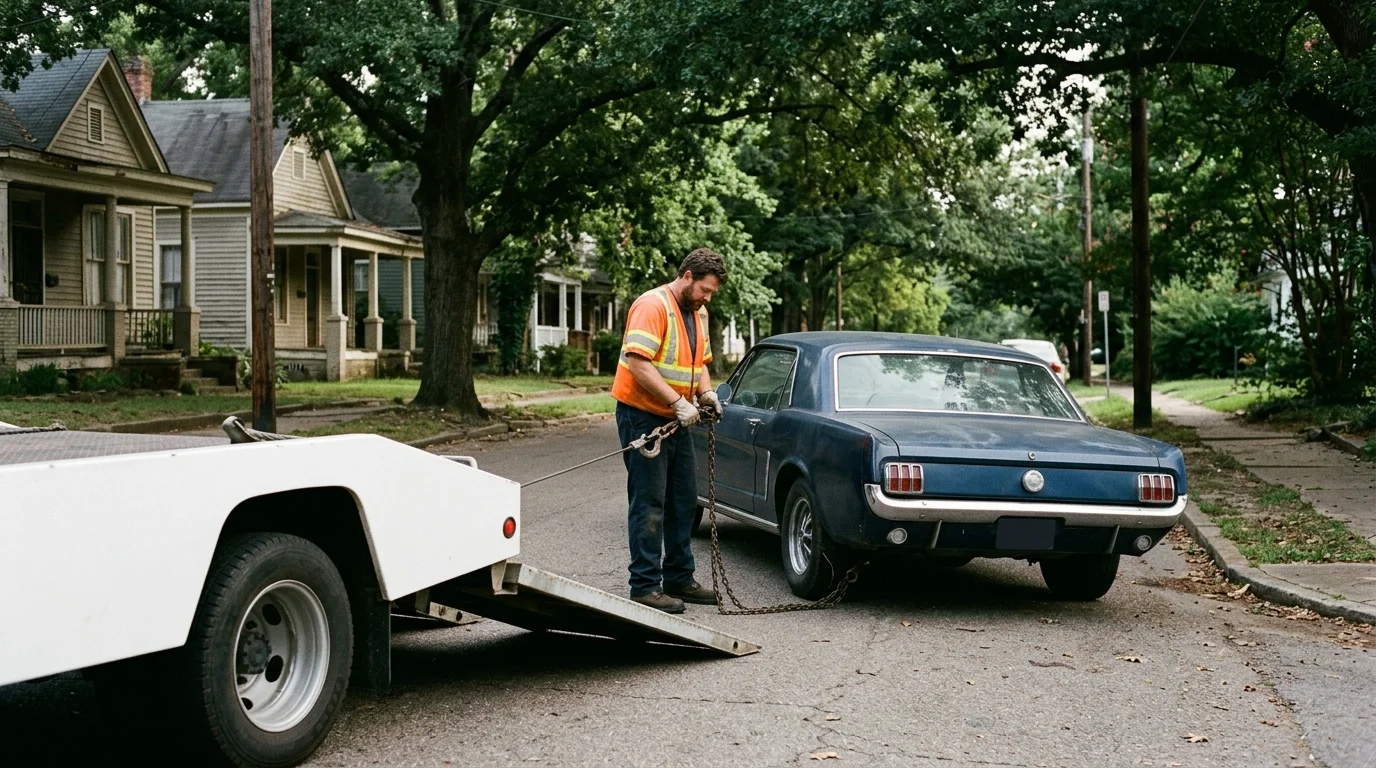
A low-clearance vehicle needs a loading plan that manages changing angles from street to ramp to deck. The first contact point may be a front air dam, splitter, side skirt, exhaust, or rear valance rather than a tire. Photos of the car and approach path help the responding operator choose equipment and positioning. No single truck setup is promised before that review. Collector condition, keys, and enclosure asks live on classic car towing in Memphis.
What makes a low-clearance tow different?
Body geometry makes this tow different, even when the drivetrain is ordinary. A lowered front-wheel-drive sedan and a stock rear-wheel-drive sports car can face the same scraping risk for different reasons.
Ground clearance alone does not describe the problem. The operator needs to see three areas:
- The front overhang and approach to the first ramp edge
- The center of the car as the front wheels climb and the wheelbase crosses a slope change
- The rear overhang as the car reaches the deck
This is why one guessed clearance measurement is not useful. A long nose can contact before a lower component near the center. A short car can still catch a deep front splitter. A steep driveway can add another slope change before the carrier deck begins.
How do approach angle and air dams affect loading?
Approach angle describes whether the front tires can reach a slope before the lowest front bodywork contacts it. A long front overhang reduces the room available at that transition. An aftermarket air dam or splitter can become the first contact point.
Manufacturers address this issue in vehicle-specific ways. The official 2013 Chevrolet Corvette Owner’s Manual tells the reader to account for low ground clearance and transport that disabled model with all four wheels off the ground. The 2014 Corvette Stingray manual directs flatbed transport and warns that a wheel lift could damage that vehicle.
Those statements cover the 2013 and 2014 Corvettes, not every Corvette year or every lowered car. Read the exact model-year manual. A factory air dam, an aftermarket lip, and collision-damaged bodywork can each create a different lowest point.
What loading aids can change the ramp transition?
Ramp extensions or other operator-selected loading aids can make the transition more gradual. Their purpose is to change the path the tires follow before the body reaches the deck.
The official 2018 Chevrolet Colorado Owner’s Manual provides a manufacturer example. It directs flatbed transport for a disabled Colorado and says ramps may be used when needed to reduce the approach angle. That instruction belongs to the 2018 Colorado, but it shows why operators ask about the ramp transition instead of relying on a body-style label.
Possible aids include ramp extensions, wood blocking made for the operator’s loading plan, skates for a wheel that cannot roll, or repositioning the carrier on a flatter surface. The operator decides whether any of these are appropriate. Do not build an improvised ramp or drive a disabled car onto loose boards.
Our flatbed versus wheel-lift towing comparison explains how the vehicle sits on each truck type. The flatbed towing service page shows the pickup details needed before a carrier setup is evaluated.
Which modifications must be reported?
Report every modification that changes ride height, overhang, wheel position, or low bodywork. Factory dimensions no longer tell the full story after those changes.
Tell the operator about:
- Lowering springs or adjustable coilovers
- Air suspension and the car’s current displayed setting
- Front air dams, splitters, canards, and body kits
- Side skirts and low running boards
- Oversized wheels or tires with a different profile
- Low exhaust parts, diffusers, or trailer hitches
- A front license-plate bracket or tow hook that projects outward
Do not raise or lower air suspension from internet instructions. Some vehicles document a transport, jack, service, or suspension setting for a particular model year. Others do not. Read your manual and tell the operator whether the system responds.
Why can the middle of the car scrape after the nose clears?
The center can contact at a slope change even after the front bumper clears. As the front wheels climb, the car can pivot over the point where the ramp meets the street or deck. A long wheelbase and low center section make that transition important.
Photograph the side profile from several steps away. The image should show the front tire, rocker panel, center underside, rear tire, and nearby pavement in one frame. A close-up of the front lip alone cannot show the center transition.
Also photograph the driveway or parking-deck crest. A below-grade garage or parking-deck crest is part of the approach path. Posted height, columns, and whether the property will let a truck in live on can a tow truck reach a Memphis parking garage. This page stays on the car’s geometry on that path. The carrier’s own loading angle is only part of that path.
What if the lowered car cannot roll or steer?
A non-rolling or misaligned wheel adds a separate loading problem. Low clearance describes possible body contact. It does not tell the operator whether the tires can climb a ramp.
Report these observations:
- A wheel will not rotate
- A tire is flat or separated from its rim
- One wheel points differently from the other
- One corner sits lower after a collision
- A loose panel or exhaust part drags
- The steering wheel turns but a road wheel does not follow normally
Do not drive the car to test clearance. Do not place yourself downhill from it. The operator may consider a winch, skates, dollies, altered deck position, or another setup after inspection.
What photos let an operator assess the approach?
Useful photos show both the vehicle and every slope it must cross. Take them only from a safe position away from moving traffic.
Capture these views:
- Full side profile at tire height
- Front corner showing the air dam or splitter
- Rear corner showing exhaust and valance
- Space directly ahead of and behind the car
- Driveway, curb, garage ramp, or parking-deck crest
- Any damaged wheel or hanging component
Include a wide view. The operator needs to see whether the carrier can line up straight. A narrow Midtown driveway with street parking differs from an open lot in Bartlett even when the car is identical.
What should you tell Quick Tow Memphis?
Tell the recorded line the lowest visible parts, suspension changes, drivetrain, and full approach path. The recorded line takes calls 24/7, takes the lowest visible parts, suspension changes, and approach path, and matches you with a local operator who contracts with you directly. The operator performs the tow and selects the equipment.
Have these details ready:
- Year, make, model, trim, and drivetrain
- Factory or modified suspension
- Air-suspension status, without changing it unless the manual directs you
- Front, center, and rear low points
- Whether all four wheels roll and steer
- Pickup surface, slope changes, curbs, and working space
- Destination and its unloading access
- The exact model-year emergency-towing section
For a car beside I-240, I-40, or I-55, report the route, direction, and nearest exit before taking photos. The recorded line takes calls 24/7, takes the lowest visible parts, suspension changes, and approach path, and matches you with a local operator who contracts with you directly. Call (901) 557-8700.
Does every lowered car need a flatbed?
No universal rule covers every modified car. The exact manual, drivetrain, clearance points, wheel condition, and access determine the operator’s plan.
Is front-bumper clearance the only concern?
No. The center underside, side skirts, exhaust, rear valance, and driveway transitions can contact after the front clears.
Should you change an air-suspension setting before loading?
Only when the exact model-year manual or responding operator directs it. Do not copy a service or transport mode from another vehicle.