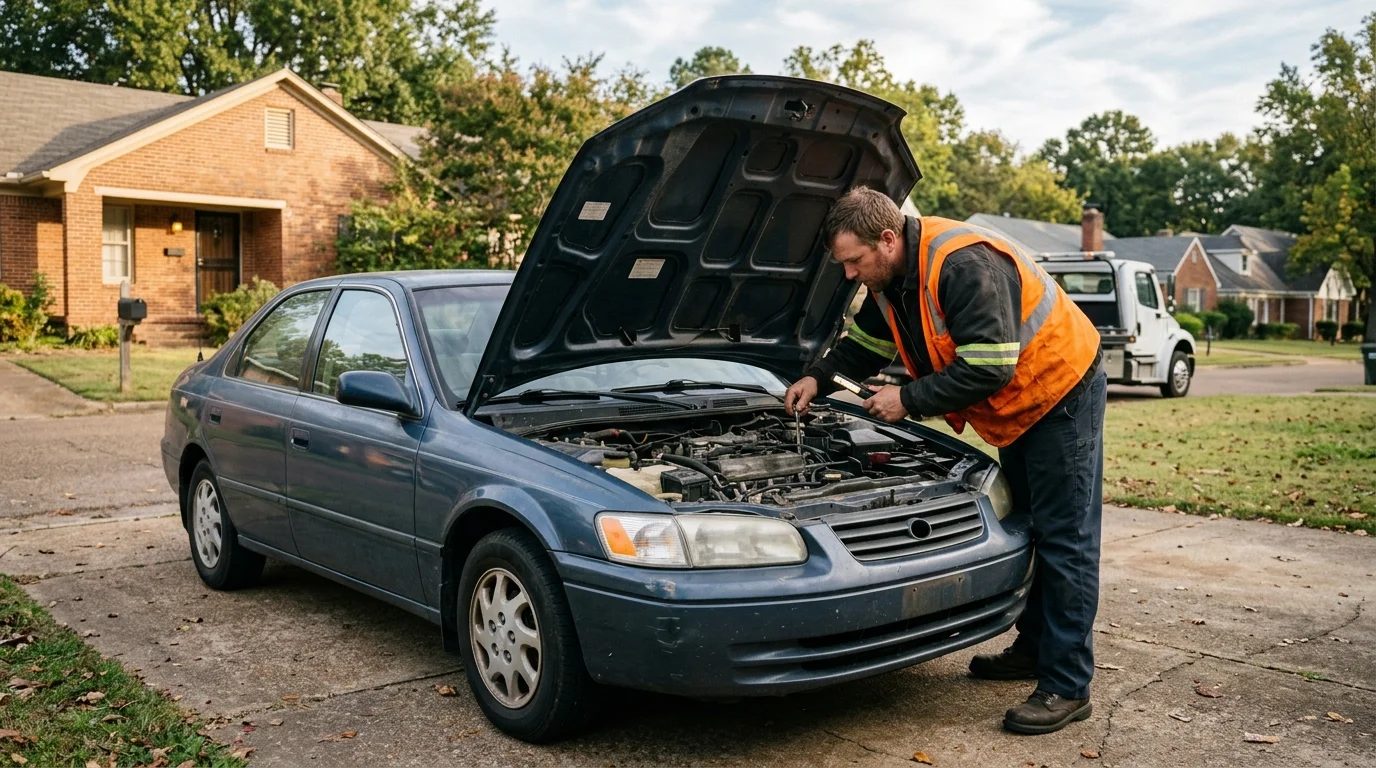
Yes, roadside assistance can come to a Memphis home for many common problems. Your car doesn’t need to be stranded beside an interstate. Access, property rules, and the actual problem determine what happens next.
Yes for most jobs, with conditions
A dead car in your driveway is still a disabled vehicle. The same can be true in a carport, apartment lot, or private parking space. An operator may be able to handle the problem there.
At-home calls often involve a battery problem, flat tire, lockout, or empty fuel tank. Sometimes the first visit shows that roadside work won’t solve the issue. The vehicle may need towing to a repair shop instead.
Start by giving the exact location and describing the parking space. Tell the dispatcher whether the car is inside a garage, behind a gate, or blocked by another vehicle. Mention steep pavement, soft ground, tight corners, or low overhead clearance. Those details help the operator assess access before dispatch.
Quick Tow Memphis is a referral service. We take the details and match callers with local operators. The operator performs the work and contracts with the customer directly. Our line takes calls 24/7, and no annual membership is required.
The cost can change with distance, vehicle size, truck type, time of day, and hookup difficulty. Ask for the full total, including mileage, before agreeing. Also ask what circumstances could change that total. We put the quoted total in writing before dispatch.
Our roadside assistance service covers calls at homes as well as other accessible locations. Confirm the full street address first. A Southaven address is governed by Mississippi rules, while West Memphis falls under Arkansas rules. Tennessee towing rules don’t carry across either state line.
Driveways, carports and gated complexes
The street address only gets the operator to the property. The position of the car determines whether the work can happen where it sits.
A wide driveway in East Memphis presents a different access problem than a narrow Midtown parking pad. A car under a low carport may leave limited working room. A vehicle parked nose-first inside a garage may be difficult to reach from the front. Describe that layout before dispatch.
Move other household vehicles when you can do so safely. Open the driveway gate and clear loose items near the disabled car. Keep children and pets away from the work area. Don’t try to push a disabled vehicle into the street just to create more room.
Gated communities need another layer of planning. Give the gate name, building number, unit number, and parking-space location. If visitors need a code or resident entry, arrange that before the operator reaches the property. Ask the property manager about any rules for service vehicles if you aren’t sure.
Street parking also changes the situation. Explain which side of the street the car occupies and how closely other vehicles are parked. In denser parts of Midtown or Berclair, access may depend on the available space around the vehicle.
Be exact about the surface too. Concrete, gravel, grass, and sloped pavement present different working conditions. The operator needs to decide whether the requested service can be completed safely in that spot. If not, towing may be the practical next step.
What a home jump start can and cannot fix
A home jump start can help when the battery lacks enough power to start the car. It doesn’t repair every problem that produces a no-start condition.
Tell the dispatcher exactly what happens when you turn the key or press the start button. Mention whether the dashboard lights appear, the engine turns, or you hear a clicking sound. Don’t diagnose the problem if you aren’t sure. A clear description is more useful than a guess.
Battery location also matters. Some batteries sit under covers or in less obvious parts of the vehicle. Give the year, make, and model so the operator can evaluate the request. Mention any battery modifications or recent repair work you know about.
A jump start won’t fix a failed starter, damaged wiring, an empty fuel tank, or another mechanical fault. It also won’t guarantee the battery will keep working afterward. If the vehicle still won’t start, the operator may recommend a tow for further diagnosis.
Our jump-start service page explains how to request help for a battery-related problem. You can also read our guide to choosing a jump-start service in Memphis before calling.
Don’t keep making repeated start attempts when something smells burned, wiring looks damaged, or the battery appears physically damaged. Describe what you see and let the operator decide the next step. A driveway call should solve an accessible roadside problem, not turn the property into a repair bay.
Apartment lots: who has to authorize the visit
Roadside help for your own car isn’t the same as removing someone else’s vehicle. You can request service for a vehicle you own or are authorized to use. Apartment management may still control gate access, visitor procedures, and where a service vehicle can park.
Tell the dispatcher whether your name appears on the lease or parking permit. If you’re borrowing the car, be ready to explain your connection to its owner. Keep the keys available. If ownership or authority is unclear, the operator may need more information before touching or moving the vehicle.
Ask management about access when the car sits inside a controlled garage or secured lot. A resident gate code may not work for a larger service vehicle. Some properties require visitors to enter through a specific gate or check in with on-site staff. Those procedures come from the property, so confirm them directly.
Different rules apply when someone wants an unwanted vehicle removed. Memphis private-property tows require express written authorization. The paperwork identifies the person authorizing the tow, the vehicle, and the reason for removal. Tennessee also requires written authorization before a vehicle is stored, except within the situations recognized by current law.
The state’s current towing framework appears in the enacted 2025 MOTION Act. Those non-consent rules shouldn’t be confused with a resident requesting help for their own disabled car.
If another car blocks yours, don’t present yourself as the property owner. Contact apartment management and let the authorized party handle any removal request.
What to have ready before the truck arrives
Good details prevent confusion at a house, duplex, or apartment complex. Gather the information before requesting dispatch.
Have these basics ready:
- The complete street address, including the unit or building number.
- The vehicle’s year, make, model, and color.
- Its exact location on the property.
- A clear description of what the car is doing.
- Gate instructions and any visitor-entry requirements.
- Details about tight access, low clearance, slopes, or blocked sides.
- The keys and any information showing you can authorize the work.
- A repair shop or other destination if towing may be needed.
Photograph the vehicle’s position when access is hard to explain. The dispatcher may be able to pass those details to the operator. Don’t include private documents or unrelated personal information.
Before dispatch, ask whether the request sounds like roadside service or a tow. Confirm the full total with mileage included. Ask whether vehicle size, access, truck type, or the final destination could change it. Get the quoted total in writing and request an itemized invoice.
Stay where you can receive calls, but don’t wait inside the disabled vehicle if the setting feels unsafe. Keep the driveway or assigned space accessible. If property staff must open a gate, coordinate that directly with them.
For homes near the edge of the metro, confirm the municipality and state. Cordova and Bartlett calls remain in Tennessee. Southaven is in Mississippi, while West Memphis is in Arkansas. The address controls which jurisdiction applies if the job becomes a tow.
When to call us
Call when the car won’t start, can’t be handled safely, or may need towing from the property. We’ll take the details and match you with a local operator who can assess the job. Call us at (901) 557-8700.