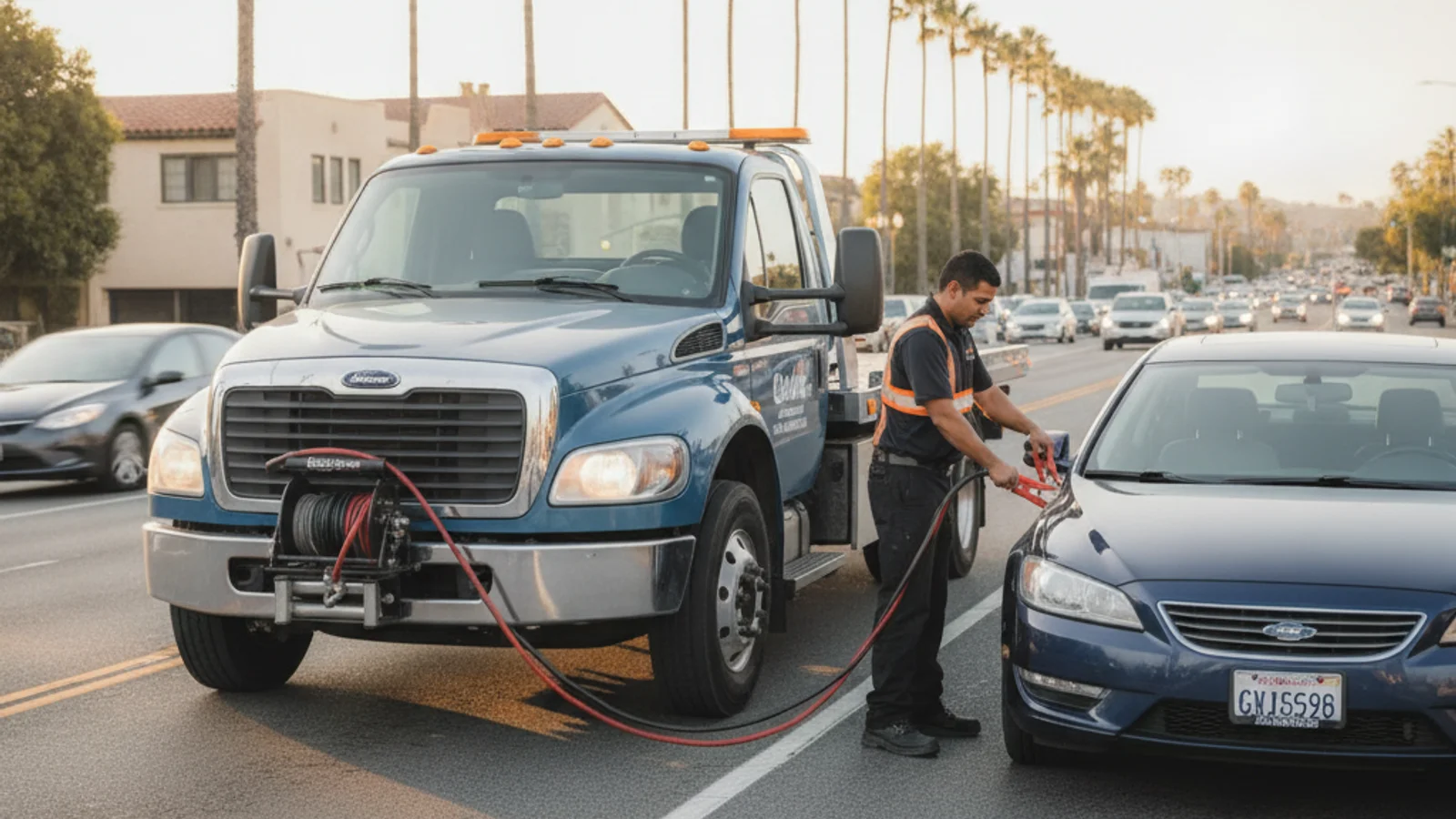
A jump start fixes one thing: a battery that’s drained but still healthy. It won’t fix a failing alternator or a worn-out starter. It won’t fix a battery that’s damaged and can’t hold a charge, no matter how long you wait. Knowing which one you’re looking at decides whether you need a neighbor with jumper cables or a truck. That decision matters even more on a weekend. Free options run on limited hours, and a neighbor with cables isn’t always awake or around.
How to tell a dead battery from a dead alternator or starter
A slow crank points to the battery. So does a dash that dims and a radio that cuts out the moment you turn the key. A jump usually gets you moving again in either case. Total silence, no click, no crank, no dash lights, usually points to the battery too. Check the terminals for corrosion first, just in case. Memphis’s humid summers make corroded terminals more common here than in a drier climate. Most auto parts stores will test a battery for free in a few minutes, which settles the question before you spend money guessing.
One quick check before you call anyone: turn on the headlights. If they come on bright and steady, the battery likely has enough charge and something else is going on. If they’re dim or barely visible, that points straight at the battery.
A single loud click with no turnover points to the starter. A jump won’t touch that. If the car starts fine off a jump but dies again a few miles later, that points to the alternator. So does a battery warning light that stays lit once the engine’s running: it means the alternator isn’t recharging the battery while you drive. A jump only buys a few minutes in that case. Driving on a failing alternator usually ends with the car dying again, sometimes somewhere worse than where it started.
What a jump will and won’t solve
A jump start puts a temporary charge into a battery so the engine can turn over on its own power. That’s the whole job. It works when the battery is otherwise fine and just ran down. Headlights left on overnight will do it. So will a door that didn’t latch all the way, or a string of short trips that never gave the alternator time to catch up. A battery that’s simply old loses capacity faster too, especially through a long Memphis summer.
A jump doesn’t fix a starter that’s worn out mechanically. It doesn’t fix a fuel or ignition problem that has nothing to do with the battery. It doesn’t fix an alternator that’s stopped charging, either, though it can mask that problem for a few minutes. Then the car comes right back to where it started, sometimes on the interstate instead of in a driveway.
If you’re doing it yourself
A jump start is simple when the battery is genuinely the problem. Connect positive to positive. Then connect negative to a solid, unpainted metal point on the dead car’s frame, not to the battery’s own negative terminal. Let the working vehicle run a few minutes before trying to start the dead one. Keep both engines off while you connect the cables, and make sure the two vehicles aren’t touching. Never jump a battery that’s cracked, swollen, leaking, or smells like rotten eggs. Walk away and call for help instead. The same goes for an EV’s 12-volt battery. If you’re not sure exactly where the access point is on that make and model, that’s a call to make, not a guess to take.
Modern cars and EVs change the answer
Most vehicles built in the last decade or so run more electronics off the 12-volt battery than older cars did. Keyless entry, lane cameras, infotainment, and more all draw power, even when the car is parked. That means a small drain can flatten a modern battery faster than it would have flattened a simpler one. A phone charger left plugged in, or a trunk light that didn’t shut off, is often all it takes. Some newer vehicles are also pickier about jump procedure and connection points than the battery-under-the-hood cars a lot of people grew up on.
Electric vehicles still carry a small 12-volt battery, separate from the large traction battery that actually drives the car. That 12-volt battery can die the same way any other one does, usually from sitting too long in an accessory or standby mode. A dead 12-volt battery on an EV can leave the car unable to wake up, unlock, or even shift out of park. It can sometimes be jumped like a normal one, at the right access point for that make and model. The traction battery itself, the large one that powers the motor, is never something to jump. It runs at a voltage that isn’t safe to touch with jumper cables.
The weekend and overnight gap
Tennessee runs TDOT HELP on covered interstates around Memphis. Urban patrol hours vary by day. Rural HELP covers I-269 from the Mississippi state line to Exit 19 from 6:00 a.m. to 10:30 p.m. daily, with on-call overnight support for major incidents. During HELP service hours, dial 511 and follow the Motorist Assistance prompts. Assistance is not guaranteed. The current published program information does not confirm jump starts. HELP may clear a blocking vehicle, but it does not tow you to your chosen home, shop, or lot. A battery-specific call may still require private roadside service.
TDOT HELP is Tennessee’s own program. If you’re stalled across the state line in Southaven, Horn Lake, Olive Branch, Hernando, West Memphis, or Marion, that coverage doesn’t reach you. A private call applies there regardless of the Tennessee schedule.
Memphis still has a large overnight driving window. FedEx runs its global Superhub out of Memphis International Airport. It’s close to 250 flights a night, most of them landing and taking off between 10 p.m. and 5 a.m. That’s a shift economy built into the middle of the night, not an afterthought. Sort workers, freight crews, and everyone who drives to support that operation are on the road during those hours. Urban HELP hours vary by day, while Rural HELP’s overnight response is reserved for major incidents. Neither is a guaranteed battery-service response.
Heat and ice wear a weak battery
Heat and ice both wear a weak battery. A jump that waits until Monday morning is a different job than one that needs to happen tonight.
What actually happens on a jump-start call
A jump start puts a temporary charge into a battery so the engine can turn over. It does not diagnose the starter or alternator. Tell the recorded line what you hear and see (click, dim lights, dies after a short run). The matched operator decides whether a jump is even offered for that vehicle.
When the honest answer is a tow, not a jump
A few situations call for a tow no matter what the battery is doing. If you’re stalled on the Hernando de Soto Bridge carrying I-40, get off first and diagnose later. The span carries heavy interstate and truck traffic around the clock. The older Memphis & Arkansas Bridge carries I-55. Either way, working under the hood mid-span is a different kind of risk than a dead battery in a driveway.
Past that, the honest read is a tow whenever the symptoms point away from a simple drained battery. A car that needed a jump yesterday and needs one again today isn’t actually fixed. It’s borrowing time, and the next place it dies might not be as convenient as the driveway it’s dying in now.
What we do
The recorded line at Quick Tow Memphis matches you with an independent operator. That operator quotes their own total before they hook up. If the symptoms point to a starter, an alternator, or a battery that isn’t safe to jump, say so and ask for a tow instead of pretending a jump will hold. Call (901) 557-8700 any time, including outside the published urban HELP hours. That’s true whether the call comes in at noon on a Tuesday or two in the morning on a Sunday. For anything that isn’t urgent, use our contact form.