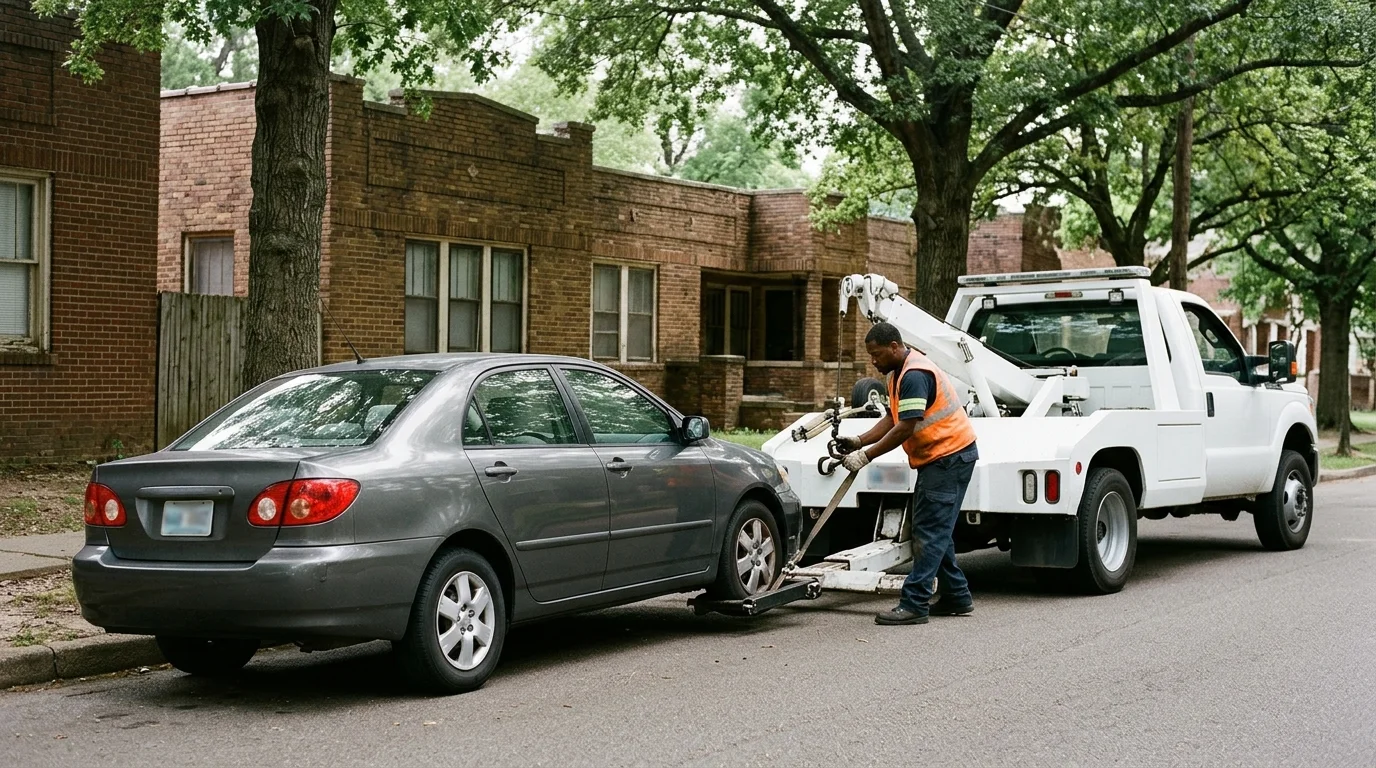
The truck question on a Midtown curb or a downtown ramp is whether a yoke can pick this car up without chewing the drivetrain. Quick lift towing is the smaller wrecker that lifts one axle. The other tires roll on the pavement or sit on dollies. That setup fits some Memphis cars in tight lots. The current owner’s manual, the driven wheels, and the tires you can see still have to allow it.
Start with the drivetrain and wheel condition
A wheel-lift tow raises one axle with a yoke. Which axle goes up depends on this year, this trim, and how the car sits right now. A badge on the trunk is only a starting point.
Begin with the driven wheels if you know them. Front-wheel drive sometimes allows a yoke under the front tires, with the rears rolling. Honda’s 2024 Civic sedan emergency towing section is one published example, and it still ranks a flatbed first. Rear-wheel drive usually wants the drive wheels off the ground. Mazda’s 2024 MX-5 Miata section says the rear wheels are the drive wheels and should leave the pavement. It permits a wheel-lift or a flatbed, and it names dollies when damage blocks that setup. All-wheel drive is stricter. Subaru’s 2020 Legacy and 2023 Outback getting-started guides say Symmetrical All-Wheel Drive distributes power to all four wheels, improper towing can damage the system, and a flatbed is the preferred method.
Then look at the tires you can see. A locked caliper, a bent rim, a flat that will not rotate, or a wheel that will not steer changes the loading plan. If the parking brake will not release, the Civic page requires a flatbed and the MX-5 page requires all four wheels raised. Dollies only help when the operator has them and the remaining tires are supposed to stay off the pavement. Tell dispatch that wheel condition before anyone picks a truck.
Some drivers ask about an “80 percent rule” for towing. We could not confirm any percentage like that as a wheel-lift dispatch standard in Tennessee, or in the manufacturer pages on file. The live test is the current towing or emergency-transport section for your exact model year and trim, plus whether those wheels can roll, steer, and release the parking brake.
When a wheel-lift can reach a tight spot
Wheel lift towing in Memphis is often an access ask. A full-size flatbed needs room to tilt, back, and swing. A yoke truck is shorter. It can be the better request in a tight courtyard, a downtown garage, or a Hickory Hill apartment aisle, if the vehicle itself can take that method.
Downtown decks around Beale, South Main, and the medical district often post clearance, then add a steep ramp and a last turn a long bed will not make. East Memphis office lots and Wolfchase decks add pipes, gates, and speed bumps. The operator still confirms the truck, the yoke height, and the exit path.
Measure what you can. Read the posted feet-and-inches at the entrance. Photograph the ramp, the last turn, and the way out. If you are in a garage, say so on the call. We have a separate walkthrough on whether a tow truck can reach a Memphis parking garage. Share that clearance and those photos. No single truck-height claim covers every operator in this network.
A breakdown on I-240, I-40 through Cordova, or Lamar Avenue may have room for either truck, or a narrow shoulder with traffic stacked behind you. TDOT HELP patrols I-40 including the Hernando de Soto Bridge, I-55 from state line to state line, the full I-240 loop, and SR-385 / Bill Morris Parkway, Monday through Sunday from 6:00 a.m. to 8:30 p.m. Those patrols can change a flat, bring fuel, give minor mechanical help, and clear a blocking vehicle. They do not tow to a shop, home, or lot. A private operator still handles that run.
A pickup in Southaven or elsewhere in DeSoto County is Mississippi work. A pickup in West Memphis or Marion is Arkansas work. Name the city when you call.
What to check in the current owner’s manual
Open the current owner’s manual, not a forum thread and not last year’s trim. Find the emergency towing or transport section. Recreational towing instructions, the kind written for a trailer vacation, are not a substitute for a disabled-vehicle plan.
The Civic and MX-5 pages above show how specific that section gets. Pull the same heading for your car. Ford’s 2024 F-150 manual separates emergency towing from recreational towing. The 4x2 recreational section requires all four wheels off the ground. The 4x4 recreational section allows four-wheel-down towing only through that model’s Neutral Tow feature, which places the transfer case in neutral and confirms that state in the instrument cluster. That procedure stays on that truck, that trim, and that year.
Low cars need their own check. Chevrolet’s 2013 Corvette manual says a disabled Corvette should travel with all four wheels off the ground and calls out low ground clearance and special equipment. The 2014 Stingray manual directs flatbed transport and says a wheel lift could damage the vehicle. Those instructions apply to those model years. Chevrolet’s 2018 Colorado manual, as a loading-angle example, directs flatbed transport and tells the professional service to use ramps when needed to reduce the approach angle. That supports asking about ramp extensions. It is not a promised setup for another vehicle.
If the glove box is empty, say the year, make, model, and trim on the call. The operator taking the job still confirms the method against current guidance. Keep a photo of the towing page if you have it.
What to tell dispatch before they roll
Quick Tow Memphis is a towing referral service. We take the details from the call and match you with a local operator. That operator performs the work and contracts with you directly. We do not own the wrecker. Clear intake is how the right truck gets the job.
Give this if you can: year, make, model, and trim. Driven wheels: front, rear, all-wheel, or four-wheel. Whether the car will roll, steer, and shift. Whether the parking brake is stuck. Which tires are flat, locked, or damaged. Exact pickup, including garage level, gate code, and the last turn that looks tight. Destination: home, dealer, or independent shop.
If this is already a police tow, that is a different path. Memphis Police, Shelby County Sheriff, and Housing and Community Development tows all process through the MPD Vehicle Storage Lot at 465 Klinke Avenue. The lot is open 24 hours. There is no online lookup. Call (901) 636-8200 to locate the vehicle.
For a private request, say if the car sits on a grade, in a stall, against a wall, or on a narrow shoulder. Mention pipes, gates, speed bumps, and posted clearance. If the keys are missing, say that. If it will not go into neutral, say that.
Ask for the full total with mileage included before you agree. Distance, vehicle size, time of day, truck type, and hookup difficulty all move the number. Ask what would change it. Get that total in writing before dispatch. The operator should produce an itemized invoice.
Describe the car and the hole it is sitting in. Wheel-lift towing is the request when access is tight and the manual allows a yoke. Flatbed towing is the request when all four wheels need to leave the ground. Our line takes calls 24/7. Calls are recorded, and a recording notice plays first.
When to ask for a different setup instead
Ask for a different setup when the current manual prefers or requires all four wheels off the pavement. Subaru’s all-wheel-drive examples sit in that group. The 2013 and 2014 Corvette examples sit in that group. A parking brake that will not release sits in that group on the Honda and Mazda pages above.
Ask for a flatbed, or for dollies under the remaining tires, when a wheel will not rotate. A seized brake, a collapsed corner, or a wheel turned sideways in a curb strike is not a rolling axle.
Accident damage follows the same logic. If the steering will not track, or the car sits too low for a yoke without scraping, the operator should look at a deck, ramps, or another recovery plan. Our comparison of flatbed versus wheel-lift towing in Memphis walks through that method choice. This page is the narrower question: does a wheel-lift fit this car, in this spot, tonight.
A longer run changes the risk even when a short neighborhood move would have been acceptable. Remaining-tire condition, speed, and the operator’s equipment all sit in that decision. If the operator taking the job says the yoke will not fit, take that. The accepting operator confirms which axle must be raised, whether dollies are required, and whether the exit path will clear. Give those facts early enough that they can bring the right truck the first time.
When to call us
A wheel-lift belongs to a working operator once the car will not roll out on its own, the access is tight, or the drivetrain needs a confirmed loading plan. Stay off the I-240 shoulder and out of the path of a downtown ramp while that plan comes together. Call us at (901) 557-8700. The line takes calls around the clock, and we match you with the operator covering your zone.