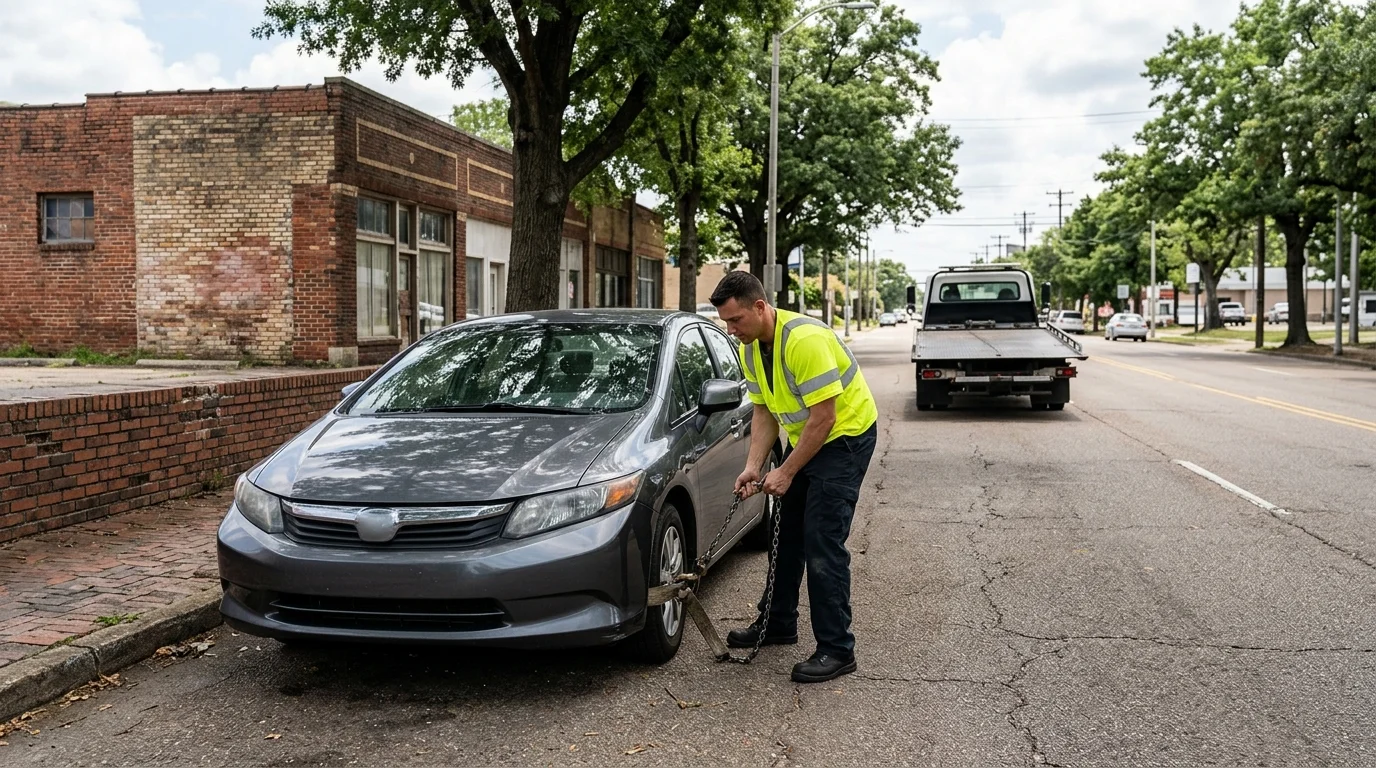
Your car is on a hook, or already gone, and you need the statewide rule, not a rumor. Towing laws in Tennessee now sit in the MOTION Act. They set who can order a non-consent tow, what notice you should get, and how long you have to reclaim the car. The old abandoned-vehicle chapter was repealed in full in 2024. The 2025 rewrite is the live map. A Midtown lot, a Cordova apartment, and a Southaven driveway are not the same file.
Who can order the tow
Three people can put a non-consent tow in motion: a law-enforcement officer with jurisdiction, the vehicle’s owner or their agent, or the property owner or their authorized agent. Express written authorization is the default. Storing the car is a separate duty. A garagekeeper still needs written authorization from one of those same three.
The exceptions are narrow. A posted commercial or public-access lot can support a tow when the signage carries the garagekeeper’s name and phone at every entrance and exit. On that kind of lot, an unattended car can be moved after 12 hours. It can move sooner if it is a hazard, blocking access, or parked illegally. On private property that is not open to the public, the property owner can authorize the tow. Law enforcement can order a tow of an abandoned or immobile vehicle. For a car used in unlicensed curbstoning on residential property, the department must post 48 hours’ notice on the vehicle before seizing it.
Memphis adds a city layer. Wrecker companies working inside city limits must be approved by the Memphis Transportation Commission. MPD wrecker-rotation approval is a separate step. On a city scene, the owner’s choice of towing company is honored unless MPD decides the company isn’t permitted, cannot respond in reasonable time, or the vehicle is an immediate traffic hazard.
A property owner cannot take a kickback for steering the tow. A towing company cannot pay for that steering either. Both directions are banned.
If the pickup is in Southaven, Olive Branch, West Memphis, or Marion, stop. Mississippi and Arkansas run their own towing statutes. Tennessee’s authorization rules do not travel across the state line.
For a lot tow you are arranging yourself, private property towing is the service path. We take the details and match you with a local operator. The operator does the work and contracts with you. We do not decide whether a tow is lawful.
What you should be told when the car moves
If you are not standing there when the car is hooked, the person towing it has one hour to tell the law-enforcement agency that covers the pickup spot. The report must include the VIN, the plate, a description, where it was towed from, and where it will be stored. That record is public. A statewide motor-vehicle portal is written into the 2025 act. Several duties switch to the portal 90 days after it is operational and available. Independent confirmation that the portal is live has not landed, so treat a Memphis police tow as a phone lookup. Call the MPD Vehicle Storage Lot at (901) 636-8200. No online lookup tool exists for that lot.
If the hookup has started but the car has not left its original parking space, you can stop the move by paying a release fee. On a non-consent tow, a release fee over $100 is prohibited statewide. The operator also cannot add a gate, access, or release fee during normal business hours on a day it is already charging daily storage.
Written notice comes next. The garagekeeper has three business days to verify ownership, then three more business days to notify the owner and every lienholder. Notice goes by a nationally recognized overnight carrier, not USPS, with proof of delivery requested. It must name the year, make, model, and VIN, the storage location, and the right to reclaim within 20 days of the notice date on payment. Missing that notice is a Class B misdemeanor. A violation of the booting, towing, storage, or kickback rules is a Class B misdemeanor, and a second offense of those rules is a Class A misdemeanor.
A claimed chance to pull personal items off the car at the scene, before it rolls, has not been confirmed as a legal right. Ask. Write down what you asked. Do not count on it.
A towing charge is the operator’s bill for the hookup, the miles, and related work. Distance, vehicle size, time of day, truck type, and hookup difficulty all move the number. Ask for the full total with mileage included before you agree, and ask what would change it.
How private lots differ from public streets
Private-lot tows and street tows are different jobs under the same chapter.
Paid commercial lots, and lots that use automatic license-plate readers to enforce parking, must post specific signs. Red lettering no less than six inches high on a white background. Late-fee notice at each designated exit. LPR-in-use notice at each designated entrance. Clearly visible from each parking space. Unpaid parking fees on those lots can carry a late fee capped at $50 if paid within 30 days, $75 if later. The full sign map is on our private-property towing sign requirements in Tennessee page. Do not blend that rule with ordinary no-parking lots.
Ordinary trespass lots in Tennessee do not have a statewide size, color, or wording mandate. What the law requires is paperwork on the wrecker: express written authorization naming the person who ordered it, the vehicle year, make, model, and color, the reason, the plate if any, and the VIN if it can be read.
Residential rental property sits in landlord-tenant law, which the towing rewrite did not touch. A landlord may tow after 10 days’ written notice posted on the vehicle. The landlord may also tow immediately, with no notice, if the car violates the landlord’s own posted permit-parking policy. There is still no statewide size or wording standard for that sign.
On public streets, the 12-hour wait is the baseline for an unattended or immobile car unless it is a hazard, blocking access, or illegally parked. Abandoned-vehicle thresholds then take over. A car more than four years old and unattended on public property for 10 days or more can qualify. So can one in obvious disrepair and unattended on public property for three days or more. So can one left illegally on public property for 48 hours or more. On private property without consent, the clock is 48 hours. On private residential property without consent, the enacted text carries no waiting period at all. A car stored, parked, or left in a garage, trailer park, or parking lot for more than 30 consecutive days can also qualify. Obvious disrepair includes inoperability, missing wheels, a burned condition, and multiple broken windows.
A Hickory Hill shopping-center tow, an East Memphis office-lot tow, and a Bartlett street tow can look the same from the sidewalk. They are not the same file.
How to reclaim the car and your things
You have 20 days from the notice date to reclaim on payment. That doubled the old 10-day window, which is no longer law. Storage generally cannot be billed past 21 days without the owner’s or lienholder’s consent, unless you were told the car was ready and you refused to collect it. No storage fee for a day the car was not available for release, unless law enforcement placed a hold. To bill past 21 days, the garagekeeper must notify the owner and all lienholders at least 10 days before the extra fee starts. Miss the three-day ownership check or the three-day notice, and the garagekeeper may not collect more than six days of storage-related expenses.
If the car is never reclaimed, it can go to public auction. The buyer takes title free and clear of liens and ownership claims. Surplus proceeds are held for 60 days from the sale date, then go to a special fund.
Memphis police, Shelby County Sheriff, and Housing and Community Development tows all process through one city lot: the MPD Vehicle Storage Lot at 465 Klinke Avenue, Memphis, TN 38127. Open 24 hours, seven days. The city’s published charges are a $135.00 impound fee and $30.00 per day storage, excluding winching or other extras. Cash and credit. Bring proof of ownership, the plate or VIN, and a valid photo ID. A licensed driver must drive it off, or a tow is arranged for an added fee. Non-owners need a notarized statement from the owner, a legible copy of the owner’s photo ID, and the plate or VIN. Criminal-investigation holds: call (901) 636-8200 before you go.
Inside Memphis, personal property and cargo not physically attached to the vehicle must be released to the owner or designee on request, unless MPD orders otherwise. No retrieval fee and no set hours attach to that city rule. It is on request.
A statewide right to an itemized invoice, or to a state administrative hearing, was not located in the current chapter. Memphis runs its own complaint path: Permits Administrator / Wrecker Coordinator, (901) 636-6735, permits@memphistn.gov. City wrecker rules also say an overcharge is cured by reimbursing every dollar paid, or by releasing the vehicle free. For the dollar-cap question, see whether towing fees are regulated in Tennessee. The Memphis-side walkthrough is know your rights when towed in Memphis.
Where to confirm the rule that applies
Read the enacted 2025 text, not a blog summary and not an old code index. The live chapter is 2025 Tennessee Public Chapter 457, which deleted and replaced the 2024 MOTION Act numbering. The repeal of the old abandoned-vehicle chapter is 2024 Public Chapter 1017. Those PDFs are the Secretary of State’s published acts.
Tow rates themselves are not one statewide dollar cap. A garagekeeper may not charge more than the maximum the Tennessee Highway Patrol district has approved for the same service. The current Memphis-district schedule on form SF-1118 could not be opened in our research, so no district dollar figure belongs here. The hard statewide money limits that are confirmed are the $100 release-fee cap, the no-gate-fee-on-a-storage-day rule, and a $75 boot-removal cap that sits inside the lawful-booting exception. That last figure is not a general towing-fee cap. No statewide boot-removal deadline appears in either enacting act.
City of Memphis wrecker rules still govern wreckers inside city limits. The complaint number above is municipal. It is not a statewide hearing right.
On the interstates, TDOT HELP patrols I-40 including the Hernando de Soto Bridge, I-55 from state line to state line, the full I-240 loop, and SR-385 / Bill Morris Parkway, Monday through Sunday, 6:00 a.m. to 8:30 p.m. Those trucks change flats, deliver fuel, give minor mechanical help, and clear blocking vehicles. They do not tow you to a shop, a house, or a lot.
Southaven PD non-emergency is (662) 393-8652 at 8691 Northwest Drive. Southaven publishes no impound-lot page or fee schedule. Call to locate. Do not import Tennessee reclaim clocks into Mississippi or Arkansas.
When to call us
When the car is already gone, start with the lot and the agency that covers the pickup. When you need a local operator to move a vehicle you control, or to recover one after a breakdown on I-240 or Lamar, that work belongs to a working wrecker, not to a DIY pull. The line takes calls 24/7. Call us at (901) 557-8700.