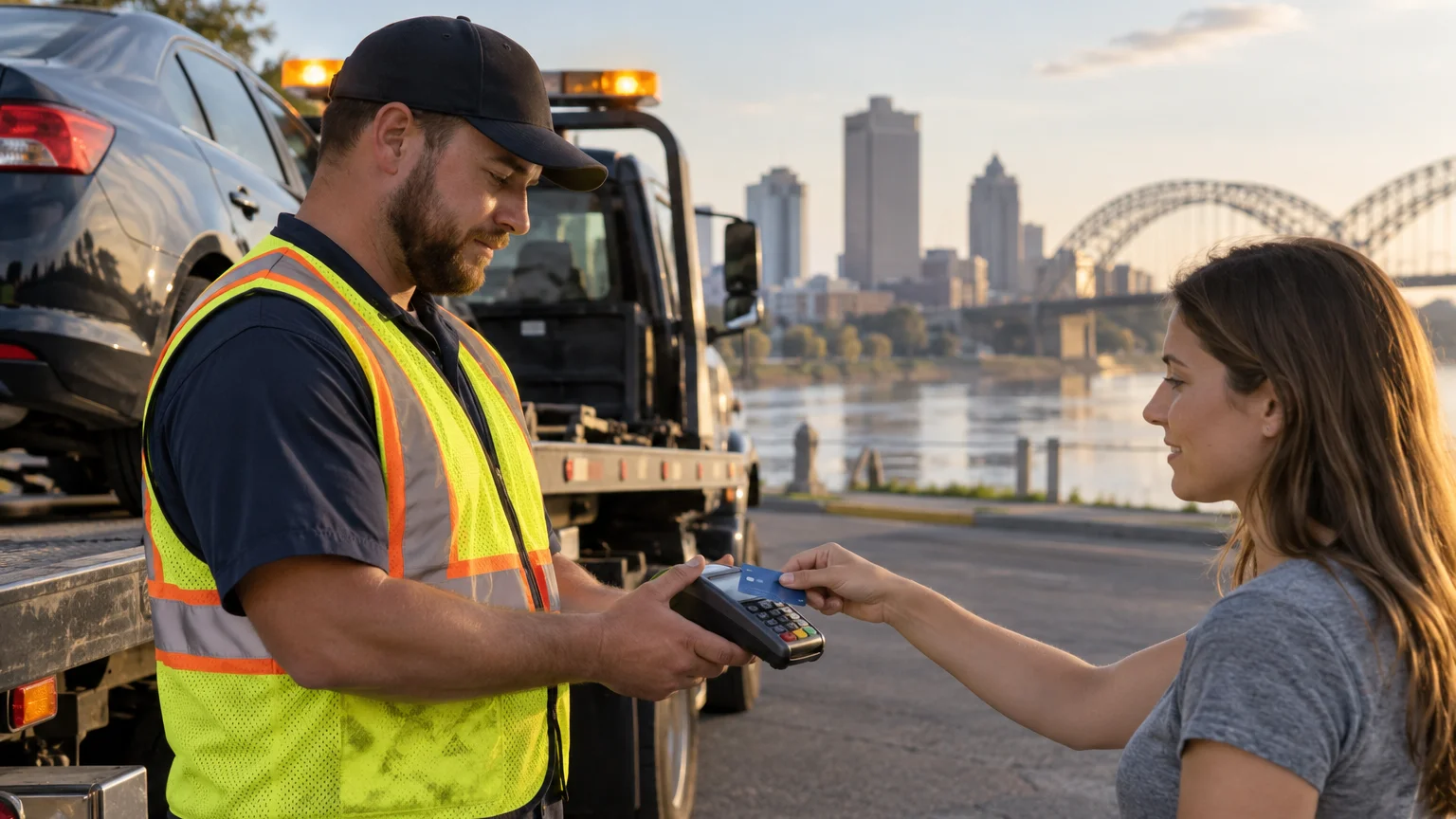
You may be ready to pay by card while the operator expects something else. In Memphis, credit is documented at the city impound lot. For an owner-requested roadside tow, confirm the payment method before dispatch.
The short answer for Memphis
Yes, you can use credit in at least one clearly documented Memphis towing setting. The Memphis Police Department Vehicle Storage Lot accepts cash and credit. That doesn’t prove every private towing operator accepts cards for every job.
We couldn’t confirm a current rule requiring every Memphis operator to accept a major credit card for an owner-requested tow. We also couldn’t confirm the current card-fee limit or whether such a rule covers roadside calls, non-consent tows, storage releases, or all three. Those details should be checked with the City of Memphis Permits Administrator or Wrecker Coordinator.
There also isn’t verified information showing what most Memphis drivers prefer. A statement such as “most want cash” would be guesswork. Payment policies can belong to the operator, while Quick Tow Memphis serves as the referral service connecting you with that operator.
Ask before the truck is sent. State that you plan to pay by credit card and request a direct confirmation. Then ask whether the quoted total includes mileage and any card-related charge. If the operator can’t confirm those points, decide whether another payment method works before agreeing.
Location matters too. A breakdown near Midtown, East Memphis, or Cordova may involve a Memphis operator. A pickup across the river in West Memphis starts in Arkansas. A tow beginning in Southaven or Olive Branch starts in Mississippi. Tennessee-specific rules shouldn’t be assumed to govern either cross-border pickup.
City impound payment is the confirmed case
The clearest local answer comes from the Memphis Police Department Vehicle Storage Lot. Its published information says cash and credit are accepted. The lot processes MPD, Shelby County Sheriff, and Housing and Community Development tows.
The city publishes an impound fee of $135 and storage of $30 per day. Those are the city’s charges, not Quick Tow Memphis prices. Winching or other additional charges may be separate.
Before visiting, confirm that the vehicle is ready for release. Criminal-investigation holds can prevent pickup. The lot requires proof of ownership, the plate or VIN, and valid photo identification for an owner pickup. A licensed driver must drive the vehicle away, or another tow must be arranged for an added fee.
Non-owner pickup has different paperwork. The city requires a notarized owner statement naming the person, a legible copy of the owner’s photo identification, vehicle details, and the plate or VIN. A rental pickup requires the rental agreement and matching identification.
Payment is only one part of a successful release. Missing paperwork can stop the process even when your credit is available. Review what to bring for a Memphis impound release before making the trip. If you don’t know where the vehicle went, start with the steps for finding a towed car in Memphis.
What to ask before an owner-requested tow
A roadside tow is different from paying the city lot. The responding operator performs the work and contracts with you directly. Quick Tow Memphis doesn’t own the truck, employ the driver, or set the operator’s total price.
Use a short payment checklist before dispatch:
- Do you accept my specific credit card?
- Will I pay the driver, the office, or another way?
- Is there any fee tied to card payment?
- What is the full total, including mileage?
- What circumstances could change that total?
- Will the amount be provided in writing?
- Can I receive an itemized invoice?
Don’t treat a digital wallet or cash-transfer app as interchangeable with a credit card. We couldn’t confirm which electronic payment methods the Memphis operator covering your zone accepts. Ask about the exact method you intend to use.
The total can depend on distance, vehicle size, time of day, truck type, and hookup difficulty. A vehicle stuck against a curb isn’t the same job as a disabled car in an open parking space. A pickup on Lamar Avenue may also require a different setup than one inside a Midtown garage.
Tell the operator where the vehicle sits and where it needs to go. Mention low clearance, locked wheels, collision damage, missing keys, or an inaccessible parking position. Accurate details help the operator explain the expected work and payment before dispatch.
Our process includes putting the total in writing before dispatch and providing an itemized invoice. Written authorization and related paperwork are also produced on request. Those commitments don’t determine which cards the operator accepts, so payment still needs separate confirmation.
Cash is a backup, not a verified Memphis requirement
Cash may be useful as a backup, but there’s no approved evidence showing that Memphis tow operators generally demand it. There also isn’t enough confirmed information to say private operators must always take a card.
That uncertainty makes preparation more useful than a broad rule. If you’re arranging a tow from a safe parking lot, settle the payment question before the operator starts toward you. If you’re stranded along I-40, I-55, or the I-240 loop, focus first on getting away from moving traffic. Don’t stand beside the travel lane while searching for cash or reading card terms.
Keep the written total available on your phone. Check that the destination is correct. Ask whether mileage is included and what could change the amount. If you plan to split payment between methods, confirm that arrangement before dispatch.
Crossing a state line adds another distinction. A tow from Memphis to West Memphis begins in Tennessee. A tow from West Memphis back to Memphis begins in Arkansas. The same pattern applies between Memphis and Southaven. The pickup state’s rules govern the originating tow, so a Memphis payment assumption may not carry across the line.
Insurance or roadside coverage can create another payment path. Tennessee doesn’t require towing coverage as part of minimum liability insurance. Roadside assistance and towing coverage are optional policy features. Check your own policy to learn whether the operator bills the provider or whether you pay first and seek reimbursement. Our guide to insurance and towing coverage in Tennessee explains that distinction.
What to do if the amount or payment method changes
Pause before authorizing more work if the payment terms change. Ask why the total changed and request the revised amount in writing. Compare it with the mileage, truck type, vehicle condition, and hookup details already discussed.
Memphis wrecker rules provide a complaint route through the City of Memphis Permits Administrator or Wrecker Coordinator. The city rules also address overcharging. The stated remedy is reimbursement of all money paid or release of the vehicle without charge. Whether that remedy applies depends on the facts and the type of tow.
Keep the written quote, invoice, authorization, and payment record. Note where the vehicle was picked up and stored. Those details are more useful than relying on a verbal recollection later. For a closer look at local options, read how to dispute a tow bill in Memphis.
Don’t confuse a payment disagreement with permission to retrieve the vehicle. An impound release can still require ownership documents, identification, and clearance of any hold. Storage may also continue while a vehicle remains at a lot. The city lot’s published charges are separate from the total for an owner-requested private tow.
The safest practical answer is simple. Credit is confirmed at the MPD Vehicle Storage Lot. For a private roadside tow, verify the exact card, any card-related charge, and the written total before dispatch.
When to call us
Call when your vehicle needs a working towing operator and you’ve confirmed how you want to pay. The line takes calls 24/7, and your call routes to the operator covering your zone. Call us at (901) 557-8700.