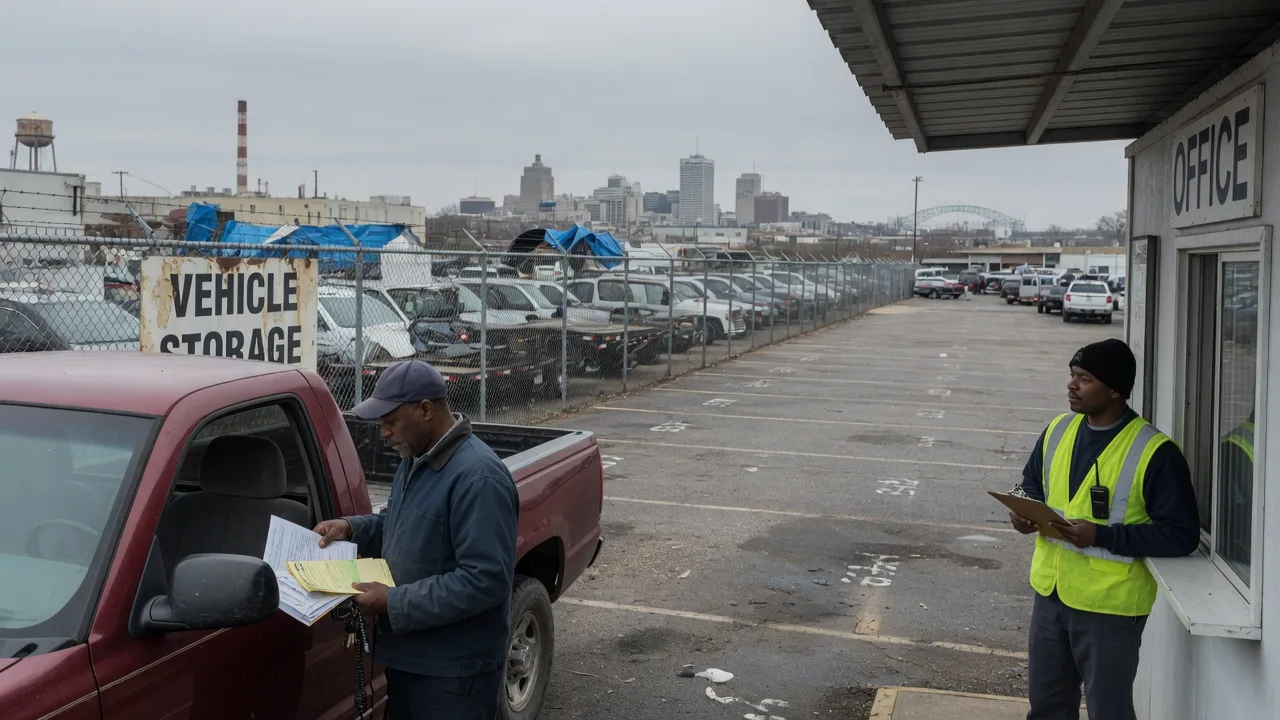
Your car is gone, and you believe police ordered the tow. In Memphis, call the MPD Vehicle Storage Lot at (901) 636-8200 with the plate or VIN. Memphis doesn’t offer a confirmed online police impound search.
Confirm it was a police-directed tow
Start with what happened before the car disappeared. A police-directed tow often follows an encounter where an officer took control of the vehicle’s removal. That could include an accident, an investigation, or another law-enforcement action.
If you were present, check any paperwork you received. Look for the agency involved, the vehicle description, and any reference information. Don’t rely on a general internet search or an unofficial vehicle database. Memphis uses the Vehicle Storage Lot phone line as its single point of contact.
The local process is unusually direct. Tows involving the Memphis Police Department, Shelby County Sheriff, or Housing and Community Development all process through the same city lot. There isn’t a separate Shelby County impound lot to search.
Have the license plate or VIN ready before calling. If you don’t have the VIN nearby, check your registration, title, lease, insurance records, or financing documents. The lot can use identifying information to check its records and explain the next step.
A missing car isn’t always a police tow. It might have been removed from private property instead. Our broader Memphis towed-car locator guide explains how to separate police, private-property, and other removal paths. If neither the city lot nor the responsible property can account for the vehicle, contact the law-enforcement agency with jurisdiction where it disappeared.
Call the agency that moved the car
For an MPD, Shelby County Sheriff, or HCD tow, call the Memphis Police Department Vehicle Storage Lot. Its address is 465 Klinke Avenue, Memphis, TN 38127. The lot is open seven days a week, 24 hours a day.
Give the lot your plate or VIN. Also have the make and year available. Ask whether the vehicle has arrived, whether it has a criminal-investigation hold, and what paperwork applies to your situation. Calling first matters because a hold can prevent pickup even when you know where the car is.
Don’t drive to Klinke Avenue based only on a map result. Confirm that the vehicle is there and available for release. The published address identifies the facility, but the phone call confirms the car’s status.
Tennessee requires the towing party to report a tow within one hour when the owner isn’t present. The report includes identifying details, where the vehicle was taken, and where it will be stored. That record is public. Memphis still directs drivers to the city lot’s phone line because no live online lookup tool has been confirmed.
The process changes outside Tennessee. A tow originating in Southaven or elsewhere in DeSoto County follows Mississippi law. A tow from West Memphis or Marion follows Arkansas law. Don’t apply Memphis pickup rules across either state line. Our who-to-call guide helps sort the correct jurisdiction.
What a city lot is versus a private yard
The MPD Vehicle Storage Lot is the city impound facility. It handles the local police-directed path described here. Quick Tow Memphis doesn’t hold impounded cars, operate the lot, or control its release decisions.
A private towing yard is different. A property owner or authorized agent may request removal from a private parking area. The operator that removes the vehicle may store it at a private facility under written authorization. That process doesn’t turn the facility into the Memphis city lot.
The distinction affects whom you call. For a confirmed MPD, Shelby County Sheriff, or HCD tow, use the Klinke Avenue lot. For a private-property removal, identify the towing operator connected to the property. Signs, written notices, or the property manager may help establish who requested the tow.
Police involvement can also affect release. A criminal-investigation hold must be checked with the city lot before pickup. Location and release are separate questions. Finding the car doesn’t mean the facility can release it immediately. Our guide to police impound holds in Memphis explains that distinction without treating every impound alike.
If the tow began in Southaven or West Memphis, stop and confirm the state first. Tennessee’s impound and towing rules don’t govern a removal originating in Mississippi or Arkansas. The pickup location, not your home address, determines which jurisdiction controls the tow.
What to ask before you drive to the lot
Ask the city lot to confirm the vehicle’s location and release status. Then ask what documents apply to the person collecting it. A wasted trip is more likely when ownership papers, identification, or driver arrangements are missing.
For an owner pickup, the city lists proof of ownership, such as registration, title, or a lease. Bring the plate or VIN and valid photo identification. A licensed driver must drive the vehicle away. Otherwise, a tow must be arranged for an added fee.
A non-owner needs more. The city requires a notarized statement from the owner naming that person. The person also needs a legible copy of the owner’s photo ID, plus the plate or VIN, make, and year. For a rental vehicle, bring the rental agreement and matching identification.
Ask for the current amount due and accepted payment methods before leaving. The city publishes a $135 impound fee and $30 per day for storage, excluding winching or other additional charges. Those are the city’s charges, not Quick Tow Memphis prices. The city accepts cash and credit.
Storage rates begin 24 hours after impound under Memphis wrecker rules. Still, don’t calculate the balance yourself. Ask the lot for the total attached to that vehicle.
If the vehicle can’t be driven safely, arrange transport after confirming its release. Distance, vehicle size, truck type, time of day, and hookup difficulty can affect a private towing total. Ask for the full amount with mileage included before agreeing.
How this differs from a private-lot tow
A police-directed impound begins with law enforcement. A private-lot tow begins with authorization tied to private property. That difference changes the first call, the storage location, and the paperwork trail.
For a Memphis police impound, the city lot is the central contact. For a private-lot removal, contact the towing operator connected to the property. If the property is a commercial lot, apartment complex, or another managed site, the owner or manager may be able to identify who authorized the removal.
Tennessee generally requires express written authorization before a non-consent tow or storage. Exceptions apply in defined situations, including law-enforcement requests and certain parking conditions. Memphis also requires written authorization for private-property tows. That record identifies the person authorizing the tow and includes vehicle details, the reason, and identifying information when available.
Don’t assume every parking sign creates the same process. Tennessee’s detailed sign rules apply to paid commercial lots and lots using automatic plate readers. Ordinary private-property towing relies on its own authorization rules. Residential rental property also has separate requirements.
Our private property towing service guide explains when a working operator may be needed after the property side is settled. It doesn’t replace the city impound process or release a vehicle held by police.
If you’re unsure which path fits, focus on who ordered the removal. Police, the Shelby County Sheriff, or HCD points toward the Klinke Avenue lot. A property owner, landlord, or parking manager points toward a private-property tow.
When to call us
Call after the city lot confirms release if the vehicle can’t be driven away, or when a private-property move needs a working towing operator. Quick Tow Memphis matches callers with local operators, while the operator performs the work and contracts with the customer directly. Call us at (901) 557-8700.