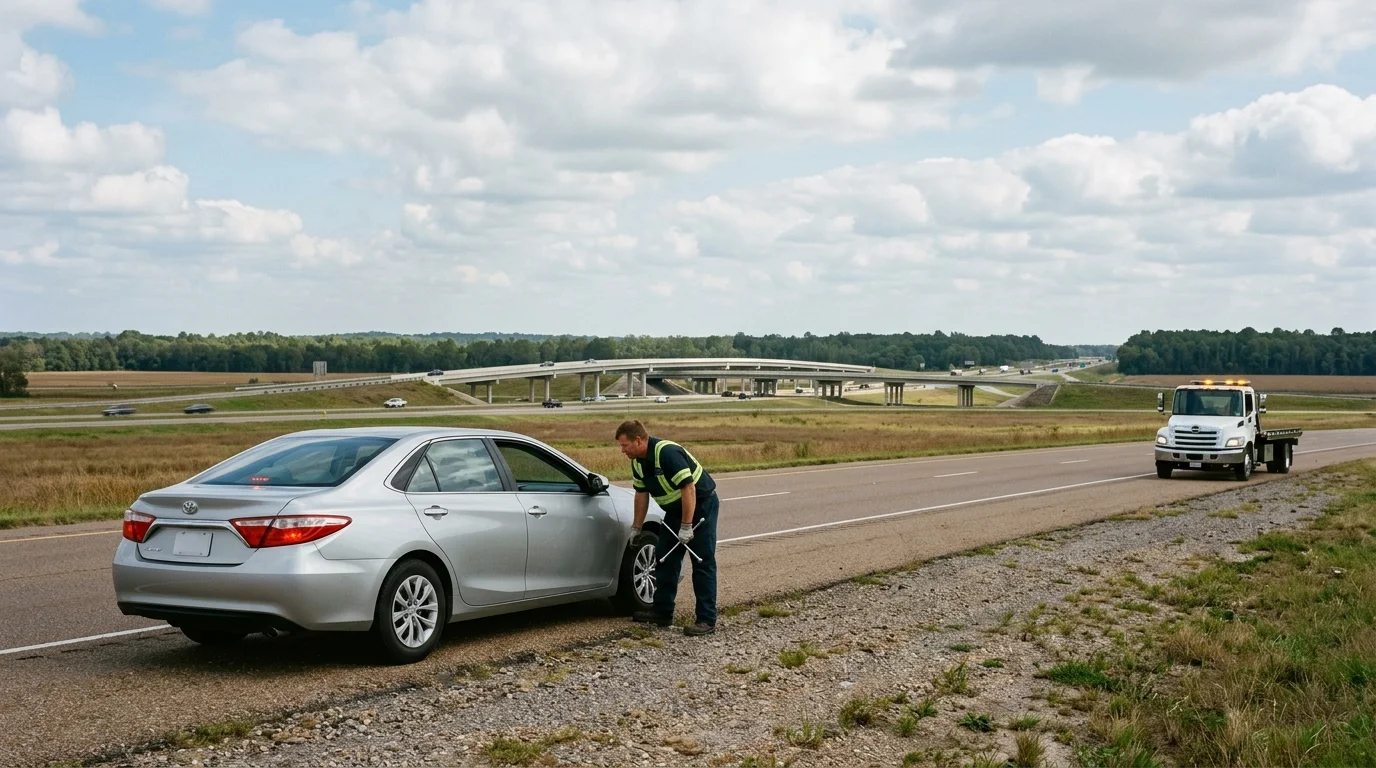
A stalled car on Military Road is a Crittenden County stop, not a Memphis one. The operators we dispatch can recover you in Marion, Arkansas, but the first job is to pin the pavement you’re sitting on. A vague “I’m in Marion” call sends the truck to the wrong ramp and blows the quote.
Share the exact Marion road or lot
Marion sits just north of West Memphis, still on the Arkansas side of the river. I-55 runs north and south through town. I-40 cuts east and west. Military Road is the old spine people actually drive when they leave the interstate. A grocery lot, a shoulder at an on-ramp, and a quiet residential street all collapse into the same pin if you only say the city.
Name the road. Name the lot. Name the nearest cross street. If you’re on I-40 or I-55, add the direction of travel and any mile marker or exit sign you can read without stepping into traffic. Say whether the car is on the shoulder, in a parking space, on a frontage road, or in a live lane. Those four facts change how the operator approaches the scene.
Stay in the car with the belts on if you’re on a highway shoulder and the cabin is safe. Call 911 if the car is blocking a travel lane. That is a safety call. It is not a substitute for a tow.
A phone pin helps, and it is not enough by itself. Read the nearest readable sign out loud. Marion’s I-55 ramps and the I-40 interchange sit close enough that a dropped pin can land the truck one interchange off. If you can see a business name on the lot, say it. If you can’t, say what the building looks like and which side of Military Road you’re on.
Quick Tow Memphis is a referral line. We take those details and match you with a local operator. The operator does the work and contracts with you directly. The more exact the Marion towing location, the cleaner that match.
If the car will not roll and you need a truck now, that is emergency towing. Tell the line you’re in Marion, Arkansas, not Memphis. Keep 911 for the lane-block. Keep our line for the recovery.
Name the Arkansas pickup, not the Memphis shop
The pickup is where the car sits. In this case that is Marion, Arkansas. A Memphis shop address is a drop, not a pickup. Mixing the two is how a quote gets built on the wrong state’s pavement.
A tow that starts in Marion is governed by Arkansas law. Tennessee towing rules do not apply to an Arkansas stop. We could not confirm a current Arkansas fee schedule, storage clock, or impound process for this page. Ask the dispatched operator which Arkansas agency controls the pickup, and confirm the live rule with that authority before you pay storage or sign anything that is not a consent tow you asked for.
This call is a breakdown you requested. Say that. You want the car hooked and moved. You are not asking anyone to snatch it off a lot. Written authorization still matters. Ask for the paperwork on request, and ask that the total go in writing before the truck is dispatched.
Do not wait on a Tennessee highway patrol truck. TDOT HELP is a free Tennessee patrol on I-40 (including the Hernando de Soto Bridge), I-55 from state line to state line, the I-240 loop, and SR-385 / Bill Morris Parkway, 6:00 a.m. to 8:30 p.m. It does flat changes, fuel delivery, minor mechanical help, and lane clearance. It does not tow to a shop, a house, or a lot. A Marion shoulder is not a HELP stop.
If a later drop is a Memphis shop, that crossing is a separate conversation. Pin the Arkansas pickup first. The river run is covered in towing from West Memphis to Memphis. Use that page when you already know the car has to leave Arkansas.
The line takes calls 24/7 at (901) 557-8700. Your call routes to the operator covering the zone. A recording notice plays first. Ask for the operator’s name and the Arkansas pickup they logged. If they read back a Memphis street, stop and correct it before anything rolls.
Describe what the car does now
Location gets the truck to the right county. Condition gets the right truck. “It broke down” is not a description. Say what the car does, and what it will not do.
Tell them if it cranks and will not fire, if it died at speed, if it overheated, if a tire failed, if it is stuck in park, or if it rolls but will not steer. Say whether it is two-wheel drive, all-wheel drive, or four-wheel drive. Say if it sits low, is an EV, or has a trailer still hooked. Say if you have the keys, and if the parking brake will release.
That last point changes the load. A 2024 Honda Civic Sedan owner’s manual calls a flatbed the best transport method and treats a front-wheel lift as acceptable only in a defined setup. The same manual requires a flatbed if the parking brake cannot be released. A 2020 Subaru Legacy and a 2023 Subaru Outback, as AWD examples, prefer a flatbed because improper towing can damage the AWD system. Those are model-year examples, not a fleet rule. Check the towing or emergency-transport section for your exact year and trim. Recreational-towing notes in a manual are not a substitute for the operator’s disabled-vehicle plan.
Do not try to drag the car onto a frontage road yourself. Do not bounce a low car over a curb to “make the hook easier.” A highway-shoulder recovery belongs to the operator, not to you with a strap from the trunk.
If fluid is under the car, say so. If the wheels will not turn, say so. If a wheel is against a curb on Military Road, say which side. Hookup difficulty is one of the things that moves the bill. The operator would rather hear it on the phone than find it in the dark.
Our standard light-duty hookup starts at $95. That is our published floor, not a market average and not a regulated cap. Distance, vehicle size, time of day, truck type, and hookup difficulty all move the number after that. Ask for the full total with mileage included before you agree. Ask what would change it.
Explain I-40 or I-55 access
Marion towing jobs often sit on, or just off, those two interstates. Access is the difference between a clean hook and a truck that cannot legally or safely reach you.
If you are on I-55, say north or south. Southbound traffic is heading toward West Memphis and, past that, the Memphis & Arkansas Bridge. Northbound traffic is heading deeper into Arkansas. If you are on I-40, say east or west. Eastbound traffic is heading toward the river and Memphis. Westbound traffic is heading into Arkansas. Do not describe the Arkansas shoulder as “the Memphis side” because you can see the skyline.
If you already left the mainline, say which ramp you used and whether you are on the frontage, in a lot, or back on Military Road. A truck that is told “I-40” will look for a shoulder. A truck that is told “Military Road, south of the interstate” will look for town pavement. Those are different setups.
Do not walk across a ramp to “meet the truck halfway.” Stay with the car unless 911 has you move. If you are on the mainline, hazard lights on, belts on, and passengers on the side away from traffic when they have to get out.
I-40 and I-55 are location context for the pickup. They are not a reason to quote the river crossing yet. Once the car is hooked, the operator still needs a legal path off the interstate and a confirmed drop. If that drop is across the state line, you are in long-distance towing territory. Mileage is part of the total. It is not a surprise add-on you discover at the shop door.
A tow truck can take the car home. It can also take it to a shop you name. Neither happens by default. You have to say the address. “Just get it off the interstate” without a drop leaves the operator guessing, and guessing is how a Marion recovery turns into an unplanned storage conversation under Arkansas rules you should confirm before you pay.
Confirm the destination before dispatch
Before anyone hooks the car, lock three things: the Arkansas pickup, the drop address, and the total with mileage in it.
If the drop is a house in Marion, say the street. If it is a shop in West Memphis, say that shop. If it is a bay in Memphis, East Memphis, or Bartlett, say that city and the street, and treat it as a long-distance run. Do not give a Memphis shop as the pickup. Do not assume “toward Memphis” is an address.
Ask for the total in writing before dispatch. Ask for an itemized invoice. Ask for the written authorization and the paperwork on request. We work pay-per-call. There is no membership and no annual fee. We do not set a flat rate, a fixed rate, or a promise that the number cannot change. What we can do is make the cost drivers plain and get the operator’s total in front of you before the truck rolls.
There is no cheapest tow company we can name, and we will not pretend otherwise. A low hook with silent mileage is not a low bill. For a Marion-to-Memphis drop, read what changes a long-distance tow cost before you approve the run. Distance, truck type, time of day, vehicle size, and how hard the hook is will show up in that total. Our $95 hookup is the start of the light-duty number, not the finish.
Insurance is your policy, not a state gift. We could not confirm an Arkansas rule that requires towing coverage. If you have roadside on the policy, call that number too and ask whether this specific Marion pickup and this specific drop are covered. Keep our line in the mix so an operator is already matched if the policy run fails.
Repeat the pickup state on the call. Repeat the drop city. If either one is wrong, the truck is wrong. When both are right, the operator can leave Military Road, I-40, or I-55 with a job that matches what you asked for.
When to call us
When the car will not roll off Military Road or an I-40 or I-55 shoulder on its own, that recovery belongs to a working towing operator, not to you with a strap. Stay out of the travel lane and let the truck handle the hook. Call us at (901) 557-8700.