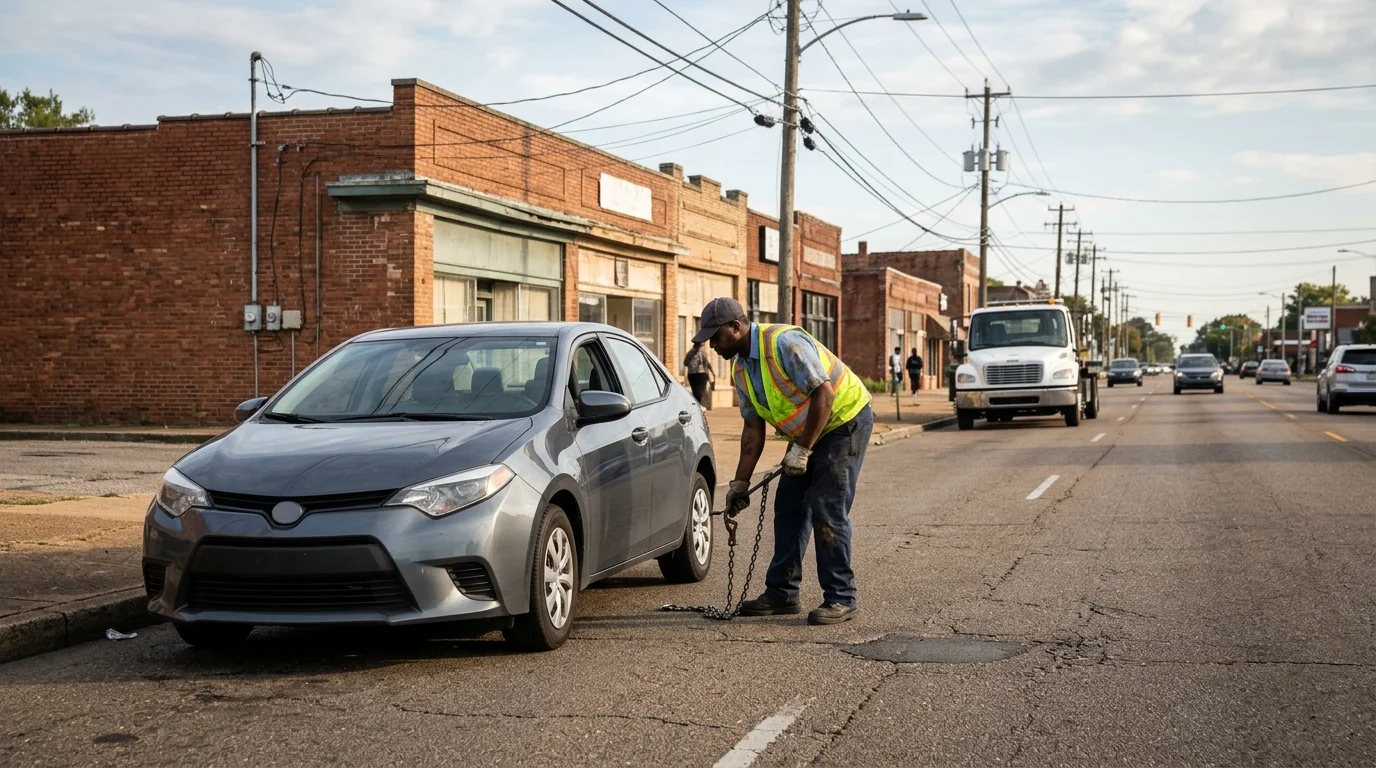
Your car died on Summer Avenue in Berclair. The strip is a long commercial corridor with curb cuts, shared lots, and Jackson Avenue as the usual approach from the south. Pin the block first, then tell us what the car is doing.
Share the exact Summer Avenue block or lot
Berclair towing starts with a pin, not a neighborhood name. Summer Avenue runs for blocks of storefronts, plazas, and side lots. “I’m in Berclair” covers too much ground for the operator covering your zone. Give the nearest cross street: Highland, Graham, Waring, or Perkins. Name the plaza if you’re off the curb. If you’re on a side street toward Nutbush, say that too.
Retail lots along Summer look similar from a truck. Share the entrance you used. Say whether you’re in a front row facing Summer, behind the building, or in a shared lot with more than one store. If a manager is on site, ask which driveway the wrecker should use. Lot rules belong to the property that controls the pavement. We cannot confirm a store’s parking policy from here, so call that business before you assume the car can sit.
If you’re still in a travel lane, move out of it when you can do that safely. Hazard lights on. Stay off the pavement once you’re clear. A car sitting in Summer traffic is a hazard, and Memphis Police can treat it that way. Inside city limits, the owner’s choice of towing company is honored, with three exceptions the department decides: the company isn’t permitted, it can’t respond in reasonable time, or the vehicle is an immediate traffic hazard. If an officer is already on scene, ask whether you still get to name the company.
Leave a landmark that belongs on this corridor. Brick storefronts, overhead lines, a named plaza, a cross street. That is how a Summer Avenue call stays a Summer Avenue call.
If the car is already gone, start with the Memphis Police Department Vehicle Storage Lot. MPD tows, Shelby County Sheriff tows, and Housing and Community Development tows all process through 465 Klinke Avenue. There is no online lookup. Call (901) 636-8200.
Describe what the car does now
The next thing the operator needs is the car, not a guess. Say whether it cranks and dies, cranks with no start, or sits dead quiet. Say whether it overheated, pulled to one side, or dropped a tire. Say whether it will roll, and whether you can steer and brake.
A car that still rolls can often leave a travel lane and wait in a lot. A car that will not roll needs a different truck and a different plan. If the parking brake is stuck, say so. If you have all-wheel drive, say the make, model, and year. Subaru’s own guides for models such as the 2020 Legacy and 2023 Outback call a flatbed the preferred way to move those cars. Honda’s 2024 Civic sedan manual also calls a flatbed the best transport method. Those notes are model-year specific. Check the towing section in your owner’s manual for your exact trim.
Stay with the car if it is safe. If you have to walk to a storefront, lock it and take your keys, ID, and registration. Personal property that is not attached to the vehicle must be released on request after a Memphis impound, unless MPD orders otherwise. Before the tow, a right to grab items from the cabin is unconfirmed in state law, so do not count on a last-minute glove-box run.
Tell us if anyone is with you, and whether the car is leaking fluid onto the lot. A fuel or coolant puddle changes how the operator approaches the vehicle. If you smell gas or see a downed line, stay back and call 911. That is a scene for first responders first.
Decide whether roadside help or a tow fits
A lot of Summer Avenue stops are small jobs. A spare that is inflated and a car that is on level pavement can be a tire stop. A tank that ran dry in a plaza can be a fuel stop. Those calls belong with roadside assistance when the car can stay put and then drive away.
A tow fits when the car will not roll, the spare is missing or unsafe, the engine is cooked, or you need the vehicle at a shop tonight. It also fits after a collision, a curb strike, or a stall that leaves the car across a driveway. That work is emergency towing. The operators we dispatch do the hookup. We match the call. We do not run the wrecker.
Ask for the full total with mileage included before you agree. Distance, vehicle size, time of day, truck type, and hookup difficulty all move the number. Ask what would change it. We put the total in writing before dispatch and the operator’s invoice should be itemized. There is no membership and no annual fee. Pay per call.
Tennessee does not require auto insurance to include towing. Whether a bill is covered turns on your own policy, not on a state rule. Check roadside or towing endorsements before you assume a reimbursement.
If you leave the car in a private lot and walk away, the property can still have it moved. State law requires express written authorization before a non-consent tow or storage, from law enforcement, the owner, or the property owner or their agent. Talk to the business that controls the lot if you need the car to sit for a while.
Summer Avenue and I-40 access
Summer Avenue is the spine of Berclair. Jackson Avenue is the usual south approach. Nutbush sits off the side streets. I-40 runs below the strip. Highland and Graham are the common drops from Summer down to the interstate. Sam Cooper Boulevard is the east-west connector drivers use when they want I-40 without staying on the avenue.
A stall on Summer is a surface-street job. A stall on I-40 is a highway job. If you made it onto the interstate, watch TDOT SmartWay for cameras and incidents, and know what TDOT HELP actually does. HELP patrols Memphis routes Monday through Sunday from 6:00 a.m. to 8:30 p.m. The Memphis list is I-40 including the Hernando de Soto Bridge, I-55 from state line to state line, the full I-240 loop, and SR-385 / Bill Morris Parkway. The patrols handle flat changes, fuel delivery, minor mechanical help, and clearing blocking vehicles. They do not tow to a shop, a house, or a lot. Anything past lane clearance is a private tow. HELP is a patrol, not a call-out.
Stay in the car with seat belts on if you are on the interstate shoulder and traffic is close. If you can reach a gore point or an exit ramp toward Highland or Graham, that is a safer wait than a live lane. Once you are back on Summer, you are in Berclair’s commercial pattern again: lots, curb cuts, and local operators.
Bartlett sits farther northeast on the same Summer corridor, past the city line. If that is where you actually stopped, use the Bartlett breakdown guide. Downtown work is a different map of one-way streets and garage ramps. That walkthrough is car trouble downtown in Memphis.
Confirm the destination before dispatch
A Berclair hookup still needs a drop. Name the shop, the house, or the lot before the truck rolls. “Just get it off Summer” is not an address. Mileage is part of the total, so a drop in East Memphis, a drop near Jackson Avenue, and a drop back toward downtown are three different jobs.
If you have a shop on Highland or Graham, say the name and the street number. If you want the car at home on a side street off Summer, confirm that a wrecker can enter and turn around. Tight driveways and low carports change the truck the operator sends. If the parking brake will not release, say that before anyone loads.
Ask the operator to put the destination, the truck type, and the total in writing. Ask for paperwork on request. If the car is a low-clearance or all-wheel-drive model, confirm a flatbed when the manual calls for one. Recreational-towing notes in an owner’s manual are not a substitute for the operator’s disabled-vehicle plan, so stay with the manual for your year and trim.
If you are waiting in a lot, stay reachable. Missed calls are how a truck rolls past the right plaza. The line takes calls 24/7, and your call routes to the operator covering your zone. A recording notice plays first. Tennessee is a one-party consent state for recording a call, which is why that notice is there.
When to call us
Call when the car will not leave Summer Avenue, Jackson Avenue, or a Berclair lot under its own power, or when a roadside fix is not enough to drive it out. We match you with a local operator for the hookup, the load, and the drop you name. Call us at (901) 557-8700.