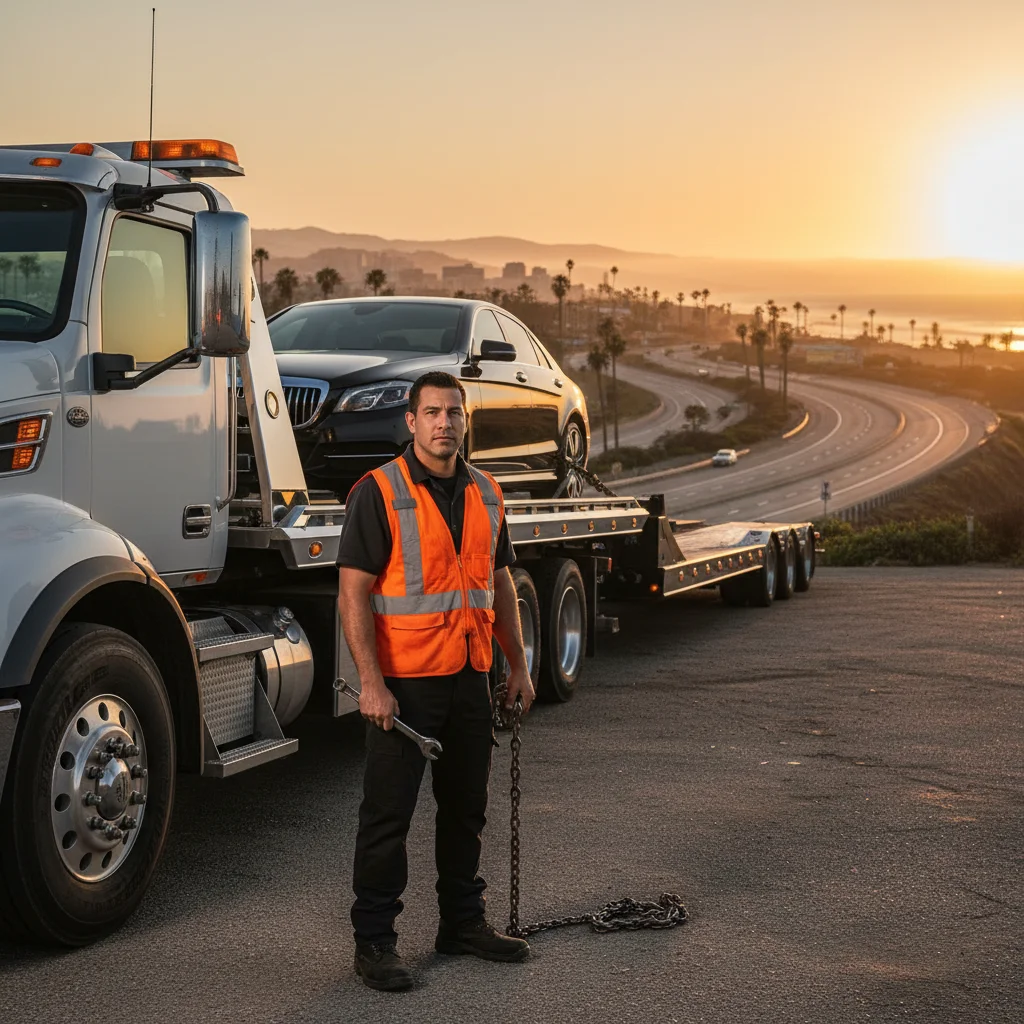
There’s no single number for a long-distance tow out of Memphis. Anyone who quotes you one before hearing the details is guessing. Here’s what actually happens: you call, we ask a handful of questions about the vehicle and the route. Then we give you the total before the truck ever rolls, mileage included.
Distance means something different here
In most cities, “long distance” is a straightforward mile count. In Memphis, it’s also a jurisdiction question, and it becomes one fast. The city sits at a genuine three-state corner. I-40 crosses the Mississippi River on the Hernando de Soto Bridge, a tied-arch span. Locals call it the M Bridge, for its two center arches. I-55 crosses a few miles south on the Memphis & Arkansas Bridge. Drive either one west out of Downtown and you’re in West Memphis, Arkansas within minutes. Drive south on I-55 or I-269 and you’re in DeSoto County, Mississippi almost as fast.
That geography is why distance here is also a paperwork question, not just a mileage one. A tow that starts a few miles from Downtown Memphis can already be crossing a state line. That can happen before the truck even settles into highway speed. The newer outer loop, I-269, makes the reach even wider. It connects DeSoto County, Mississippi to Collierville, Piperton, and Arlington on the Tennessee side. It never routes through the middle of the city. Mileage is still mileage, but where those miles fall changes what has to happen on the paperwork side of the job too.
Crossing state lines changes the rules, not just the road
A tow that starts in Southaven or elsewhere in DeSoto County, Mississippi, is governed by that state’s law, not Tennessee’s. The same goes for a tow that starts in West Memphis or Marion, Arkansas. We don’t blur that line. We won’t hand you Tennessee-specific answers about a vehicle that’s actually sitting on the Mississippi or Arkansas side of the river. Mississippi and Arkansas each have their own vehicle title and towing statutes. We work inside whichever state the vehicle is actually in.
This matters less for the number on your quote and more for what you can expect once the truck arrives. If your vehicle is on the Arkansas or Mississippi side, the release process follows that state’s rules. So does the paperwork, and any local hold on the vehicle. Ask us directly when you call. We’ll tell you straight which side of the line your vehicle sits on, and what that means for pickup.
Vehicle type sets the floor
A standard sedan and a loaded pickup don’t cost the same to move fifty or five hundred miles. Neither one costs what a stalled commercial rig does. Memphis carries real heavy-duty demand on top of the everyday kind. Lamar Avenue carries US-78. The Tennessee Department of Transportation’s own Memphis Congestion Study describes it as the top congested state road in the region. The same study calls it a critical corridor for the city’s trucking industry. A rig that breaks down there, or on I-55 between US-51 and I-240, needs a different truck and different rigging. That’s a different price than a commuter car with a dead alternator needs.
Motorcycles, RVs, and fifth wheels each carry their own handling requirements too. Tell us what you’re moving when you call. We’ll match the truck to the vehicle before we quote a number, not after.
Long-distance transport isn’t only a breakdown story here either. Naval Support Activity Mid-South in Millington is one of the area’s largest single employers. A base that size means a steady stream of service members relocating in and out of the region. Each one has a personal vehicle that needs to move with them. That’s a genuinely different job than a roadside recovery: a scheduled pickup and a planned destination instead of an emergency. It’s still priced through the same factors: distance, vehicle type, and whether a flatbed makes sense for the haul.
Whether the vehicle needs a flatbed
Some vehicles can ride on two wheels behind a wheel-lift truck for a short haul. A long-distance tow is a different situation. All-wheel-drive and four-wheel-drive vehicles, most EVs, anything with drivetrain damage, and low-clearance cars generally need a flatbed for any real distance. Towing them on two wheels at sustained highway speed risks damage to a drivetrain that isn’t built to spin unpowered for that long. A flatbed carries the whole vehicle off the ground instead.
That distinction matters more on a long haul than it does across town. Fifty miles on a wheel lift is one kind of risk. The run from Memphis out toward Nashville on I-40, or south into DeSoto County on I-55 and I-269, is another. We ask what you’re driving specifically, so we can send the right truck the first time. That beats rolling a wheel-lift truck to a job that needed a flatbed.
Where the vehicle actually is
Pickup location moves the number too, and not just because of mileage. A vehicle stalled mid-span on the Hernando de Soto Bridge is a different job than one parked in a driveway or sitting in a lot. There’s no shoulder refuge up there, and heavy truck volume runs around the clock. When that bridge closed for repairs in 2021, most of its traffic rerouted onto the Memphis & Arkansas Bridge. Some traffic also moved onto the I-155 Caruthersville Bridge to the north. The closure ran for the better part of three months. That’s a reminder of how much weight these two crossings carry, and why a disabled vehicle on either one gets treated with urgency.
Pickup from a storage lot is its own category, and it’s worth separating clearly from what the tow itself costs. If a vehicle already sits in the City of Memphis’s own Vehicle Storage Lot, the impound and daily storage fees are the city’s, not ours. Those fees apply whether or not you ever call a private tow. A long-distance job that starts by releasing a vehicle from that lot has an extra step built into the timeline. We’ll walk you through it before the truck goes out.
Interstates that shape a long haul
Memphis’s road network does a lot of the work in explaining why some long hauls run smoother than others. I-40 and I-55 are the two river crossings and the primary long-distance spines. Both carry heavy truck volume tied to the city’s role as a freight hub. I-240 loops around the south and east side of the city and touches nearly every long-distance route at some point. I-269, the newer outer loop connecting DeSoto County out to Collierville, Piperton, and Arlington, runs longer and more open than the older interstates. That changes the kind of breakdown you tend to see out there. Expect a blown tire or an overheated engine on a long open stretch, rather than stop-and-go collision damage.
A tow can head out toward Nashville on I-40, south through DeSoto County on I-55, or across into West Memphis and beyond. Each route covers genuinely different road conditions. We factor that into dispatch, not just the raw mileage.
West Memphis, Arkansas sits at the point where I-40 and I-55 physically cross, right at the river. The trucking industry gave the city the nickname “crossroads of America” for exactly that reason. Any long-distance job that starts or passes through that interchange is moving through one of the busiest freight junctions in the country. That’s one more reason distance alone never tells the whole story on a quote.
The number comes before the truck rolls
We start with the basics: where the vehicle is, what it is, whether it needs a flatbed, and where it’s headed. Once we have that, we give you the total over the phone, mileage included. A number you can plan around, agreed before anyone drives anywhere.
Call (901) 557-8700 and tell us the pickup point, the destination, and what you’re driving. If your vehicle is already across the state line in Mississippi or Arkansas, tell us that too. It changes how we handle the release, even if it doesn’t change how we treat you on the phone. You can also send it in writing through our contact form. A phone call gets you a faster answer on anything involving a stranded vehicle. Either way, you’ll know the number before the truck rolls, not after it arrives at yours.