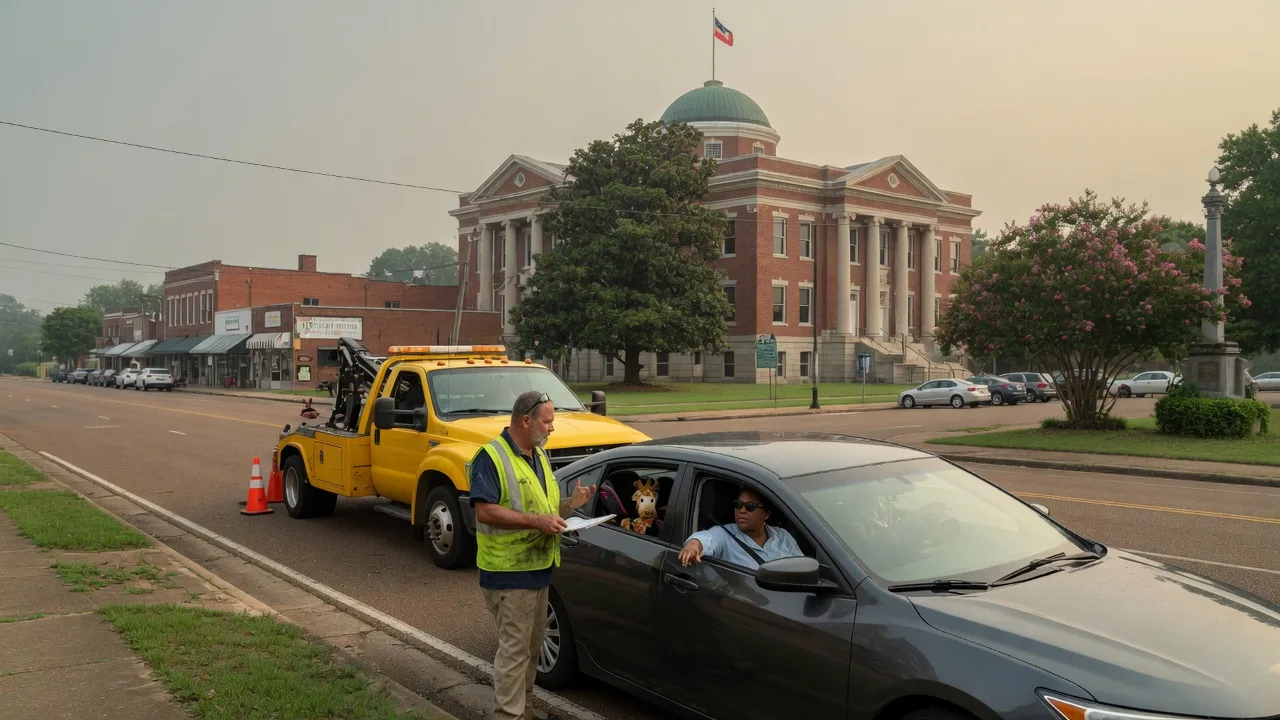
A breakdown in Hernando calls for a precise pickup plan. Hernando towing starts with your location, the car’s condition, and where it needs to go. Those details help the operator prepare for the right move.
Share the exact Hernando road or lot
Start with the place where the car stopped. “Hernando” alone leaves too much ground to search. Give the road name, direction of travel, and the nearest visible landmark.
On I-55, say which direction you were traveling. Share any exit, ramp, bridge, or sign you can read safely. Don’t cross traffic or leave a protected position to inspect a marker. A phone location pin can help when nearby signs aren’t visible.
Commerce Street needs different details. Tell the operator whether you’re near the town square, farther from the center, or inside a business lot. If the car is parked behind a building, name the entrance that reaches it. A storefront name helps only when it’s visible from the correct driveway.
Inside a parking lot, describe the car’s position. Include the row, nearby entrance, and any access barrier. Mention a gate, narrow lane, parking structure, curb, or blocked approach. The operator needs to know whether towing equipment can reach the car directly.
Share the vehicle’s color, make, model, and plate when available. Tell the operator if you’ll remain with it. If someone else has the keys, explain that before the job is assigned.
For a disabled car that can’t leave under its own power, request emergency towing. Quick Tow Memphis takes the job details and matches you with a local operator. That operator performs the tow and contracts with you directly.
Name the Mississippi pickup, not the Memphis shop
Say clearly that the pickup is in Hernando, Mississippi. The destination may be in Memphis, but the tow begins in DeSoto County. Mississippi controls a tow originating there, not Tennessee.
That distinction matters when a caller gives only a shop name. A Memphis destination doesn’t turn the pickup into a Tennessee job. The operator first needs the Mississippi location, then the destination across the state line.
Current Mississippi requirements for a consensual Hernando breakdown tow couldn’t be confirmed from the approved material for this page. Ask the dispatched operator which Mississippi rules and paperwork apply. For a legal question, confirm the current requirement with the Mississippi authority responsible for the pickup location.
Don’t use Memphis impound procedures for a voluntary Hernando tow. Those procedures concern different agencies and another state. This guide also doesn’t assume that a DeSoto County tow follows Memphis pricing or operating rules.
If the trip ends outside Hernando, say that during the first call. A longer cross-border move may call for long-distance towing. Give the complete destination address, not only the city or business name.
Other DeSoto County locations need their own pickup details. A breakdown in Olive Branch isn’t a Hernando call with another label. The same applies to a Southaven breakdown. Those cities have different streets, approaches, and destinations.
Describe what the car does now
Tell the operator what happened without trying to diagnose it. Plain observations are more useful than a guess. Say whether the engine runs, the car rolls, or the steering responds.
Describe any warning lights you noticed before stopping. Mention smoke, leaking fluid, collision damage, a flat tire, or a wheel sitting at an unusual angle. Don’t touch leaking fluid or enter moving traffic for a closer look.
The car’s current position matters just as much. Explain whether it’s fully parked, partly in a lane, on a shoulder, against a curb, or down an embankment. A car that needs recovery from mud or a ditch isn’t positioned like one sitting in a paved lot.
Tell the operator whether the transmission can shift into neutral. Mention whether the parking brake releases and whether the keys are present. If the wheels won’t turn, say so. Don’t force controls or attempt a roadside repair where traffic makes that unsafe.
Vehicle details also shape the towing plan. Give the model year and trim when you know them. State whether the car has front-wheel drive, rear-wheel drive, or all-wheel drive only if you’re certain. The owner’s manual contains the towing or emergency-transport instructions for that exact vehicle.
Also mention low ground clearance, collision damage, or modifications. Those conditions may change how the operator loads the car. Recreational towing instructions aren’t a substitute for the disabled-vehicle guidance in the manual.
Explain I-55 or Commerce Street access
Access determines how the operator approaches the car. An I-55 shoulder and a Commerce Street parking lot present different working spaces. Describe the setting before the operator heads toward you.
For I-55, share the travel direction and the side where the car stopped. Tell the operator whether you’re on the main roadway, an entrance ramp, or an exit ramp. A location pin helps, but it shouldn’t replace a spoken description.
Don’t describe an interstate stop as “near Hernando” when you can see more. Read a nearby sign from inside the car if that’s the safer position. Report any barrier, narrow shoulder, or traffic obstruction that affects access. Leave vehicle movement and roadside recovery to the responding operator.
On Commerce Street, specify whether the car is along the street or inside a lot. Near the town square, describe the side of the square and the nearest accessible entrance. Don’t assume the operator will approach from the same direction you did.
Private lots can add practical access issues. Mention locked gates, posted entry instructions, loading areas, or vehicles blocking the direct path. If a property representative controls the gate, contact that person before the operator arrives when possible.
These details aren’t minor. They help distinguish a straightforward paved pickup from a job needing a different approach. They also reduce the chance that the operator reaches the wrong side of the property.
Confirm the destination before dispatch
Choose the destination before the tow begins whenever possible. Give its full address and confirm that it’s the correct entrance. A repair shop may have separate customer, service, and after-hours access points.
Confirm that the destination expects the vehicle. Ask the shop or property contact where the operator should leave it and how keys should be handled. Don’t assume an address alone means the vehicle can be accepted.
If you haven’t chosen a shop, say so. The operator needs an actual destination before moving the car. A temporary location can create another tow later, so decide where the vehicle should remain before agreeing to the job.
Ask for the full total with mileage included before dispatch. Distance, vehicle size, time of day, truck type, and hookup difficulty can change the amount. Ask what circumstances could change the written total.
Quick Tow Memphis can put the total in writing before dispatch. You can also request an itemized invoice and the related paperwork. There’s no membership or annual fee for using the referral line.
Review the pickup and destination together. Say “Hernando, Mississippi” for the starting point, then repeat the full destination address. If the route crosses into Tennessee, make that clear. The Mississippi origin remains central even when the vehicle ends its trip in Memphis.
When to call us
Call when the car can’t move safely, needs professional loading, or must travel from Hernando to another destination. The line takes calls around the clock and routes your call to the operator covering your zone. Call us at (901) 557-8700.