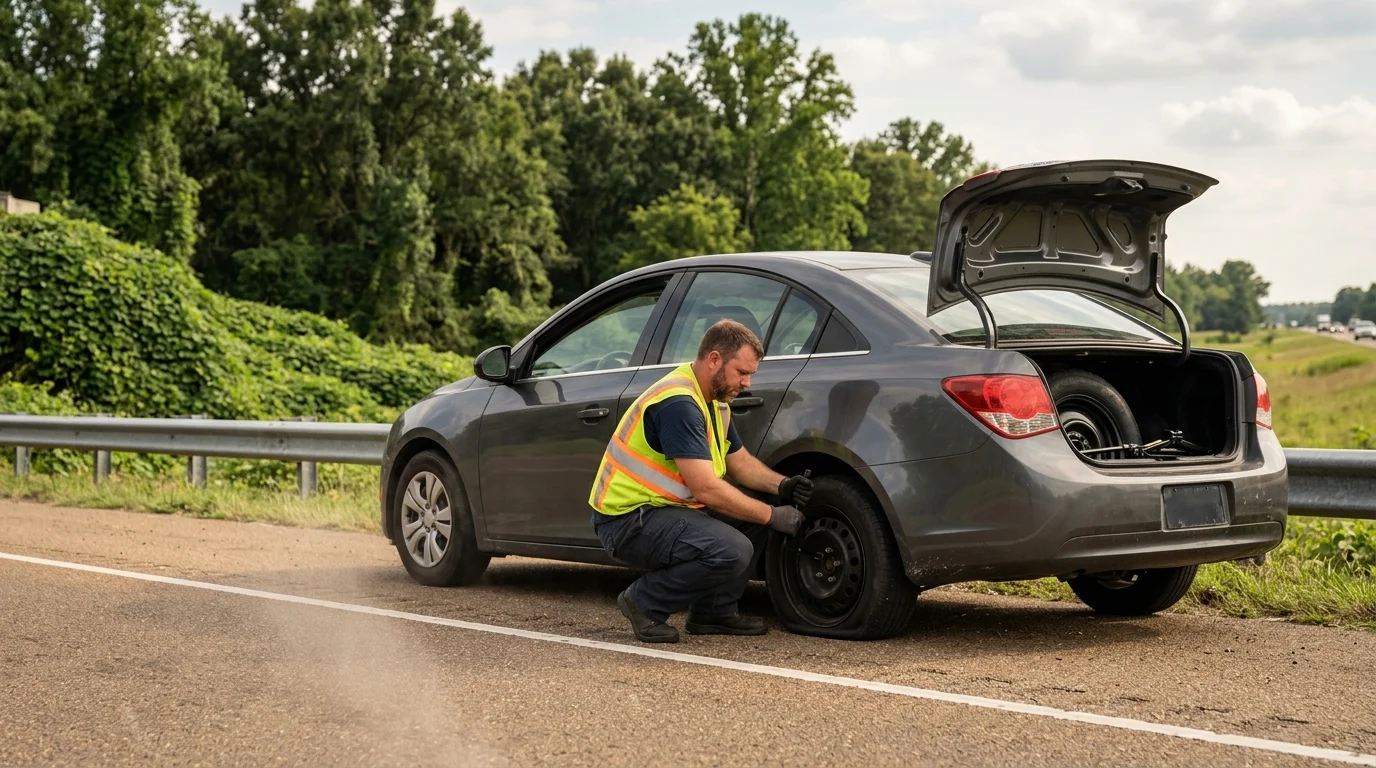
A Memphis flat usually ends one of three ways. A spare goes on, the tire gets evaluated for repair, or the car gets towed. The right flat tire service in Memphis depends on the tire, your equipment, and where the car stopped.
Flat tire service in Memphis has three outcomes
A usable spare is often the simplest outcome. It must be present, accessible, and suitable for the car. The vehicle’s manual and the spare’s label provide its specific instructions. Those directions matter more than general roadside advice.
Repair is the second possible outcome. A plug shouldn’t be promised from a phone description. The tire needs an in-person inspection before anyone decides whether repair is appropriate. Describe the visible damage, but leave the final decision to the person examining it.
Look for details that help the operator prepare. Note whether the tire lost air gradually or after an impact. Mention any visible cut, object, wheel damage, or unusual position. You don’t need to diagnose the problem yourself.
A tow is the practical third path. It may be needed when there’s no usable spare, the required tools are missing, or roadside work doesn’t fit the location. It also makes sense when the tire needs a shop inspection before the car moves again.
The flat tire service page explains how the referral line connects drivers with local operators. Tell the recorded line which outcome appears likely, but don’t worry about choosing perfectly. Clear details let the operator arrive prepared for the actual situation.
Don’t keep driving merely to turn a flat into a more convenient call. Instead, report where the car sits and what you can see. The operator can then discuss a tire change or towing plan with you.
The spare situation most drivers discover too late
The trunk may hold a spare, a repair kit, neither, or equipment you’ve never opened. Finding out after a flat adds another decision to an already stressful stop.
Start by checking what’s physically present. Don’t assume a covered compartment contains a tire. Some storage wells hold tools or cargo instead. If you find a spare, read its label and check the vehicle manual before treating it as usable.
A complete description should cover more than the tire itself. Look for the jack, lug tool, and any key used for locking wheel hardware. Tell the operator when one of those pieces is missing. Also mention whether luggage or equipment blocks access to the spare compartment.
Don’t call a spare ready based only on its appearance. Say how long it has been stored if you know. Report visible damage or anything else that concerns you. The responding operator can evaluate what’s available once on scene.
If the car carries a repair kit, describe it without promising it solves the problem. Its instructions and the tire’s condition will determine whether it applies. A kit isn’t the same thing as a replacement tire.
When the spare situation remains uncertain, roadside assistance can begin with an on-scene assessment. The call should still include a possible tow destination. That avoids starting the planning process again if the spare or repair option doesn’t work.
A quick trunk check before a longer trip can prevent confusion later. Confirm what the manufacturer supplied and where each tool is stored. Keep the manual accessible instead of buried beneath a full cargo area.
Where you are standing changes the answer
A flat beside a Midtown curb presents different access than one along I-240. A grocery lot in East Memphis differs from a narrow interstate shoulder. The tire may be identical, but the service plan can change with the setting.
In Midtown, give the nearest cross street and the side of the road. In East Memphis, name the shopping center entrance or nearby storefront. Around Cordova and Bartlett, include the municipality instead of relying only on a familiar street name. Those details help prevent confusion during the match.
The river crossings require especially precise location information. The Hernando de Soto Bridge carries I-40. The Memphis & Arkansas Bridge carries I-55. Report the interstate, travel direction, and whether you’ve reached the bridge or remain on an approach.
Our guide to breaking down on the Memphis bridges covers those crossings in more detail. Don’t describe your location as simply “the Memphis bridge.” The route number separates two very different approaches.
The same principle applies along Lamar Avenue, which carries US-78 and SR-4. Give the direction of travel and the nearest recognizable intersection. Avoid assuming the operator will identify your lane from a business name alone.
Metro Memphis also crosses state lines. A tow beginning in Southaven falls under Mississippi law. One beginning in West Memphis or Marion falls under Arkansas law. Tennessee towing rules shouldn’t be carried across either border.
Tell the referral line where the car physically sits, not where your trip began. Include the city, state, road, direction, and nearby landmark. Exact geography helps the operator assess whether a tire change fits the location or a tow is the better plan.
The free patrol that changes a flat tire, and its hours
The TDOT HELP program operates free patrols on covered Tennessee interstates around Memphis seven days a week. Urban hours vary by day. Rural HELP covers I-269 from the Mississippi state line to Exit 19 from 6:00 a.m. to 10:30 p.m. daily, with on-call overnight support for major incidents. During service hours, dial 511 and follow the Motorist Assistance prompts. Assistance is not guaranteed.
The listed Memphis routes are I-40, including the Hernando de Soto Bridge, and I-55 from state line to state line. Coverage also includes the full I-240 loop and SR-385, known as Bill Morris Parkway.
TDOT lists four HELP services: flat changes, fuel delivery, minor mechanical help, and clearing blocking vehicles. That list doesn’t confirm that the patrol supplies a tire or spare. Check your trunk and report what your vehicle carries.
HELP serves a specific highway role. It doesn’t tow a vehicle to a repair shop, home, or storage lot. Anything beyond lane clearance requires a private tow.
That distinction can settle the spare, repair, or tow decision. A flat change may fit HELP’s listed work when the car has what’s needed. A tire requiring shop attention needs another plan. So does a car that must leave the highway for a chosen destination.
TDOT SmartWay provides live Tennessee traffic, camera, and incident information. Check it when you can do so without dividing your attention from the immediate situation. It can help you describe congestion or a reported incident near your location.
When HELP can’t complete the needed move, emergency towing connects the next part of the trip. Give the operator your highway, direction, nearest exit, and intended destination. Don’t expect HELP’s service list to include work that TDOT doesn’t publish.
What to say on the call so one trip fixes it
Begin with location. Give the city and state, road name or interstate, travel direction, and nearest exit or cross street. Mention whether the car is in a lot, at a curb, on an approach, or beside a travel lane.
Next, identify the vehicle. Share its year, make, model, and general size. Say which tire is flat. Report visible wheel damage, an embedded object, or signs that more than one tire is affected.
Then explain the spare situation plainly. Say whether you found a spare, jack, lug tool, and wheel-lock key. If you haven’t checked, say that instead of guessing. Mention any cargo that prevents access to the storage compartment.
Tell the referral line what you need after the tire decision. If repair requires a shop, provide the destination or ask to discuss an appropriate towing plan. If you don’t yet have a destination, say so early.
Price questions should cover the complete move. Distance, vehicle size, time of day, truck type, and hookup difficulty can affect the total. Ask for the full total with mileage included before agreeing. Also ask what circumstances could change it.
Ask the matched operator for the total in writing before you agree. You can also request an itemized invoice, written authorization, and related paperwork. The referral is pay-per-call, with no membership or annual fee.
A useful call sounds specific, not technical. You don’t need to name the tire failure or select the truck. You need to describe the car, equipment, damage, location, and desired destination accurately. That gives the matched operator a clear picture before taking the job.
When to call us
Call when there’s no usable spare, the tire can’t be handled where the car sits, or a shop needs to inspect it before the car moves. Quick Tow Memphis takes your details and matches you with a local towing operator, and the line takes calls around the clock. Call us at (901) 557-8700.