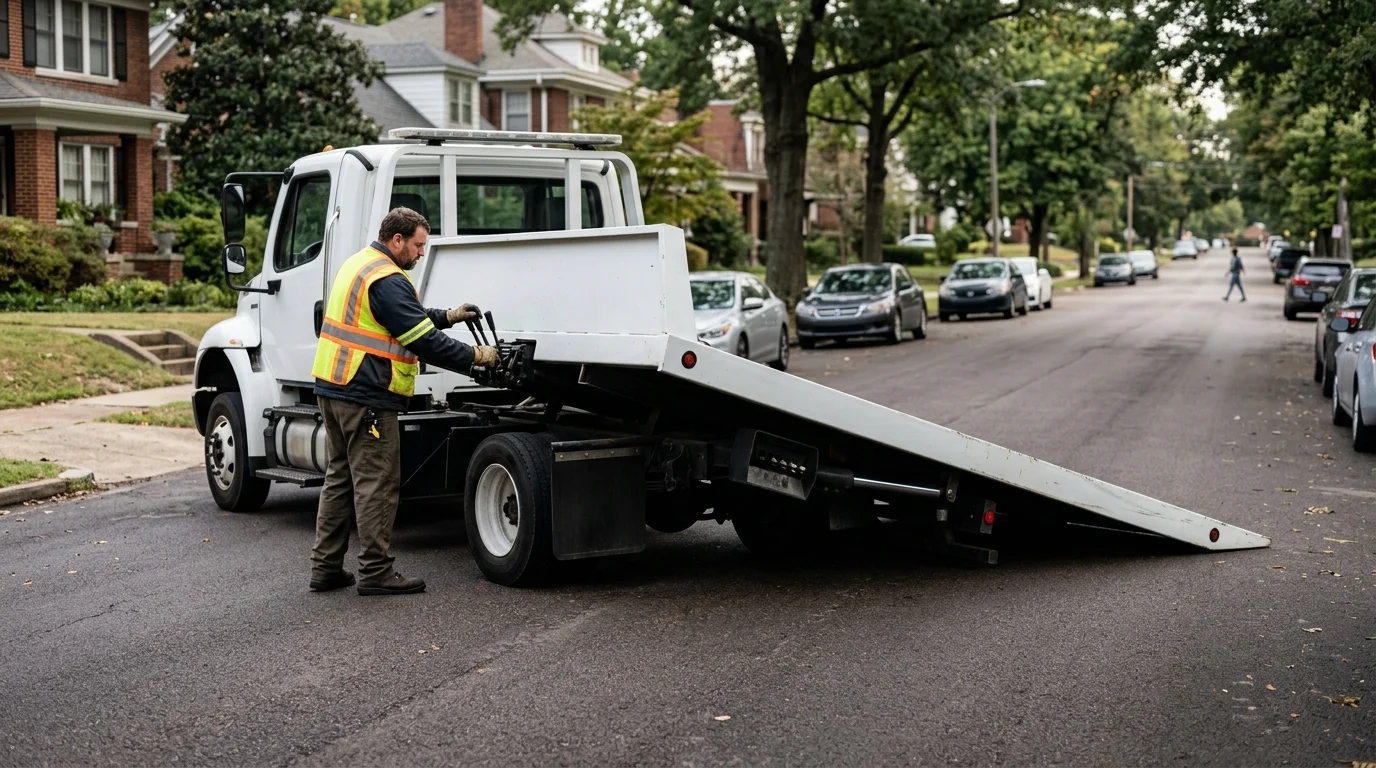
Choosing between a flatbed and wheel lift starts with your vehicle, not a blanket rule. Check the owner’s manual, describe the car’s condition, and let the operator confirm the correct setup. The main difference to verify is whether the whole vehicle rides on a carrier deck or one end stays raised during transport.
The mechanical difference in one paragraph
When the matched operator uses the word flatbed, ask whether all four wheels will rest on the carrier deck. When a wheel lift is proposed, ask which axle will be raised and whether any wheels will remain on the road. Those answers explain the mechanical difference without treating either truck name as a safety guarantee. A flatbed towing operator in Memphis may need to consider the loading approach, the car’s condition, and the available working space. For a wheel-lift towing job, ask how the operator plans to position the vehicle and whether added equipment is needed. The right answer can change between a disabled sedan in Midtown and a damaged vehicle beside I-240. It can also change after the operator sees the car. Share the exact pickup position before you agree, especially near a narrow shoulder, parking structure, gate, or busy loading area. Then ask the operator to compare the proposed setup with the towing instructions in your manual. That short conversation is more useful than assuming every flatbed works the same way or that every wheel lift creates the same conditions. Truck type is also one factor that can affect the total. Ask for the full amount with mileage included before agreeing, and ask what could change it.
How does drivetrain change the towing setup?
Drivetrain determines which wheels deliver power and which wheels may be allowed to roll during a wheel-lift tow. Find the towing, roadside assistance, or emergency transport section in your owner’s manual. Then give the operator the exact year, make, model, trim, and drivetrain before equipment is selected.
| Vehicle layout | Which wheels are driven | What a wheel-lift plan must address |
|---|---|---|
| Front-wheel drive | The front axle is driven. | When the manual permits this method, the front end comes off the road while the rear wheels roll. |
| Rear-wheel drive | The rear axle is driven. | When the manual permits this method, the rear end comes off the road while the front wheels roll. |
| All-wheel drive or four-wheel drive | Both axles can receive power. | A wheel lift alone leaves one axle on the road, so the operator must check the manual before choosing a carrier or a wheel-lift setup with wheel dollies. |
| Hybrid | The driven wheels depend on the vehicle’s specific layout. | The operator needs the exact model and the manual’s transport instructions, not just the hybrid badge. |
| Battery-electric | The driven wheels depend on the motor layout. | Model-specific loading and transport instructions control whether any wheels may roll. |
Wheel dollies are the option that supports the wheels not held by the wheel lift. This can keep the remaining road wheels off the pavement. Dollies are one setup for the operator to evaluate, not a promise about what equipment the matched operator will use.
A 4x4 pickup needs one more detail: the transmission position doesn’t establish what the transfer case allows. Report what the transfer-case selector or dashboard shows. Check the manual for separate transfer-case towing instructions, and don’t change a mode from an online procedure written for another model or year.
Hybrid badges also don’t identify the driven axle. Tell the operator whether the vehicle can select neutral, what the instrument panel shows, and whether any drivetrain warning is visible. Don’t assume shutting off the hybrid system means its wheels may roll during transport.
Battery-electric vehicles need the same model-specific approach. Some manuals describe a transport setting or a particular loading procedure. Our guide to EV and Tesla flatbed towing explains what to check before the operator arrives. The owner’s manual remains the controlling reference for the specific vehicle.
If you don’t know the drivetrain, say that plainly. Don’t choose a method from the badge, body shape, or what worked for another car. The operator needs the drivetrain, current vehicle condition, and manufacturer instructions before making the final equipment decision.
How do clearance, modifications, and visible damage change loading?
Low clearance changes the loading angle and the points that could contact the ground or equipment. Tell the recorded line about a lowered suspension, low front lip, splitter, side skirt, body kit, running board, oversized tire, or low-hanging exhaust. Name any ride-height modification, including adjustable or air suspension, without changing its setting unless the manual or operator directs you.
A lowered car can have trouble at more than the first ramp edge. Report a steep driveway, curb, crowned road, parking-deck transition, or sharp change in slope around the pickup point. Send a side-profile photo that shows the space below the front, center, and rear of the car. Ask how the operator’s proposed loading position accounts for the vehicle’s front overhang and other low points.
Don’t test clearance by driving a disabled car onto boards or improvised ramps. Give the operator photos of the vehicle and its approach path instead. The operator can evaluate the loading angle, available working space, and whether the planned setup needs different positioning or loading accessories.
Visible corner damage changes what the operator must inspect before movement. Report these cues without naming a failed part:
- One corner sits noticeably lower than the other three
- A component or loose piece hangs below the body near a wheel
- A wheel looks tilted compared with the wheel on the other side
- A wheel appears pushed back in its wheel opening
Also report any wheel that looks bent, missing, or unable to roll. Mention loose bodywork, leaking fluid, deployed airbags, steering that doesn’t respond normally, or anything dragging beneath the car. These observations don’t diagnose the problem or select the towing method by themselves.
Use plain descriptions. “The front passenger wheel points inward” gives more information than “the axle is broken.” If you don’t know what failed, don’t diagnose it. Send clear photos if the matched operator requests them. Include the front, rear, both sides, wheels, and the space around the vehicle.
The pickup surface also belongs in the description. Tell the recorded line whether the car is in a garage, parking deck, driveway, roadside shoulder, loading area, or soft ground. Mention overhead clearance, a locked gate, tight turns, or vehicles blocking access. Ask the operator whether those conditions affect the proposed equipment or loading plan.
Neither truck name promises damage-free movement in every situation. Ask what contact points the operator plans to use and what must happen before loading. If the vehicle was damaged in a crash, don’t move parts, turn wheels, or change settings unless the operator directs you.
What the operator asks before choosing
Good preparation starts with a complete vehicle description. Have the following details ready:
- The exact year, make, model, and trim
- The drivetrain listed in the manual or vehicle information
- Whether the car starts, rolls, steers, and shifts as expected
- Any visible wheel, tire, suspension, steering, or body damage
- Any modifications that change height, clearance, or wheel size
- The pickup location, destination, and access limits
- The towing instructions shown in the owner’s manual
Be precise about the Memphis location. The Hernando de Soto Bridge carries I-40. The Memphis and Arkansas Bridge carries I-55. If you’re near a river crossing, name the bridge and interstate rather than saying only “the bridge.” On Lamar Avenue, identify that you’re on US-78 and share a nearby cross street or landmark.
TDOT’s HELP program patrols covered Tennessee interstates around Memphis during published urban hours that vary by day. Rural HELP also covers I-269 from the Mississippi state line to Exit 19 from 6:00 a.m. to 10:30 p.m. daily, with on-call overnight support for major incidents. During service hours, dial 511 and follow the Motorist Assistance prompts. Assistance is not guaranteed. HELP may clear a blocking vehicle, but a move to your chosen shop, home, or storage lot requires a private tow.
Pickup state matters too. Tennessee rules shouldn’t be applied to a tow beginning in Southaven, Mississippi, or West Memphis, Arkansas. Tell the recorded line which side of the state line holds the vehicle.
The line takes calls 24/7. We gather the details and match callers with local operators. The operator performs the work and contracts with the customer directly.
What you should tell the matched operator about your car
Start with the problem, then describe the vehicle. A useful opening sounds like this: “My car won’t move, it’s all-wheel drive, and the manual gives specific towing instructions.” Add the year, make, model, exact location, and intended destination.
Next, describe what changed. Tell the recorded line whether the car stopped running, was involved in a collision, has a flat tire, or displays a warning message. Stick to what you can see or hear. You don’t need to identify the failed part.
Read the manual before the operator arrives when circumstances allow. Search its index for towing, roadside assistance, emergency transport, neutral, or transport mode. Keep the relevant page open. If instructions conflict with something you heard elsewhere, tell the operator before the vehicle moves.
Photograph the car and its surroundings if requested. Capture visible damage, wheel position, modifications, overhead space, gates, and nearby obstacles. Don’t step into an active traffic lane for a photo. If the roadside position feels exposed, report that first and follow instructions from emergency authorities.
Remove uncertainty from the destination as well. Give the full address and say whether it’s a repair shop, home, parking area, or storage location. Confirm that the destination can receive the vehicle. Distance, vehicle size, time of day, truck type, and hookup difficulty can affect the total. Ask for the full total with mileage included before agreeing, and ask what would cause it to change. Ask the matched operator for the total in writing before you agree, plus an itemized invoice. The referral line can remind you to ask.
That’s how to prepare a car for towing without guessing about equipment. Accurate details let the working operator make the final call.
When to call us
When a car can’t move normally or has drivetrain, damage, or clearance concerns, equipment selection belongs to a working towing operator. We’ll gather the details and match you with a local operator who performs the tow and contracts with you directly. Call us at (901) 557-8700.