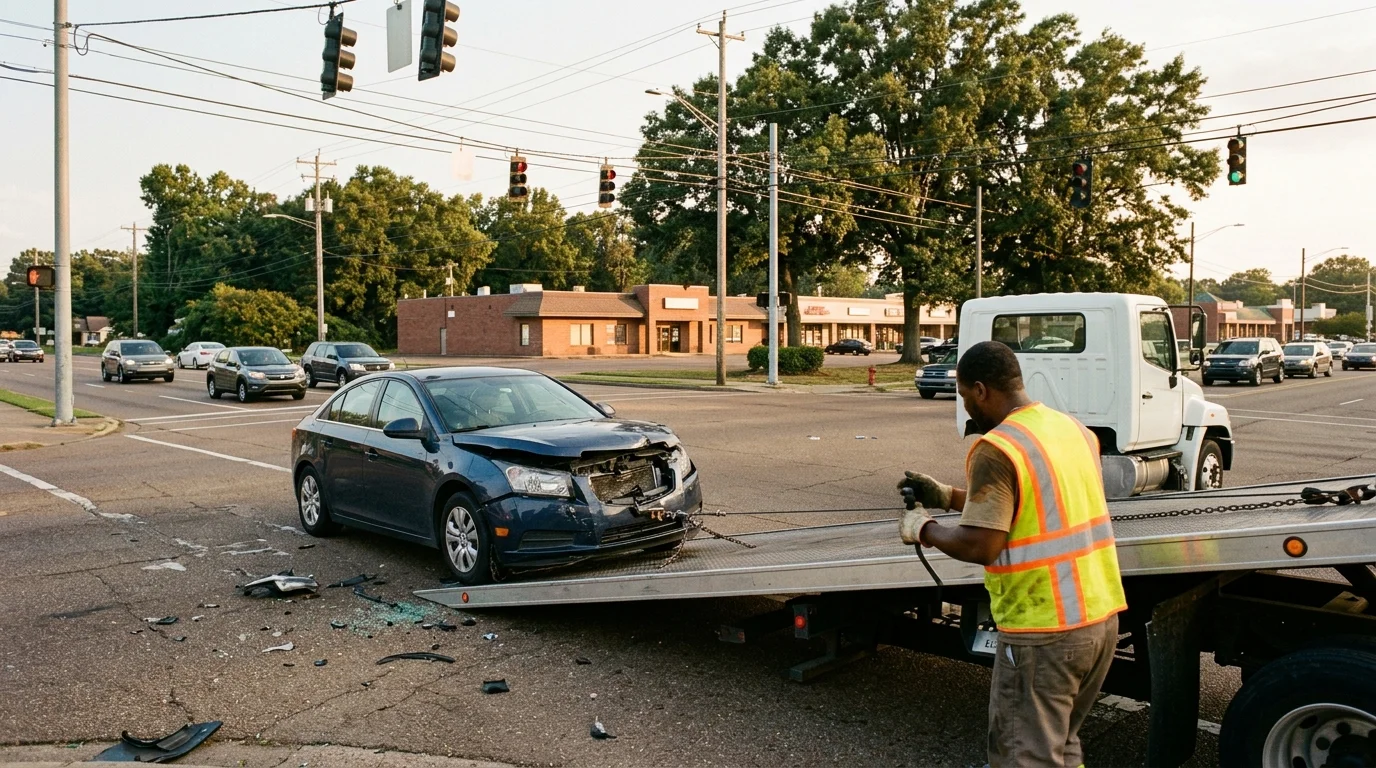
A Memphis crash can leave your damaged car moving before you do. To find your car after an accident tow in Memphis, start by identifying which agency ordered the tow. MPD, Shelby County Sheriff, and HCD tows all process through the city’s Vehicle Storage Lot.
Your car after an accident tow in Memphis: the first hours
You still own the car after a crash. However, you may lose control over when and how it leaves the scene. Traffic conditions, the car’s condition, and the responding officer’s decision can shape what happens next.
Memphis rules generally honor an owner’s choice of towing company. MPD can make a different decision in three situations. The requested company may lack the required city approval. It may be unable to respond within a reasonable time. The damaged vehicle may also present an immediate traffic hazard.
That final exception matters on busy Memphis roads. A disabled car blocking I-240 or Lamar Avenue can’t remain in a travel lane while arrangements develop. The same concern applies near the Hernando de Soto Bridge on I-40 and the Memphis & Arkansas Bridge on I-55.
If the scene allows you to choose, confirm the destination before agreeing. Also ask for the full total with mileage included. Distance, vehicle size, truck type, time of day, and hookup difficulty can affect the operator’s charge. Ask what circumstances could change the total.
Quick Tow Memphis is a referral service. We take your details and match you with a local operator. That operator performs the accident recovery work and contracts with you directly. Our phone line takes calls around the clock, but we don’t publish an arrival promise.
Where it goes when the officer picks the truck
An officer-directed Memphis tow usually starts with one address: the MPD Vehicle Storage Lot at 465 Klinke Avenue, Memphis, Tennessee 38127. The lot processes MPD, Shelby County Sheriff, and Housing and Community Development tows. There isn’t a separate Shelby County impound lot for those vehicles.
Memphis doesn’t provide an online vehicle lookup tool. Call the contact number published on the MPD page before traveling to Klinke Avenue. Have the plate or VIN ready. The lot is open every day, around the clock.
The city lists a $135 impound fee and $30 daily storage. Those are the city’s charges, not Quick Tow Memphis prices. They exclude winching and other additional charges. City storage rates begin 24 hours after impound. The lot accepts cash and credit.
An owner picking up a vehicle needs proof of ownership. That can be the registration, title, or lease. Bring the plate or VIN and valid photo identification. A licensed driver must drive the vehicle away. Otherwise, another tow must be arranged for an added fee.
A non-owner needs more paperwork. The city requires a notarized owner statement naming that person, plus a legible copy of the owner’s photo ID. The person also needs the plate or VIN, vehicle make, and year. Rental vehicles require the rental agreement and matching identification.
Our guide to finding a towed car in Memphis covers that search in more detail.
Location changes the process near state lines. A tow originating in Southaven follows Mississippi law. A pickup in West Memphis or Marion follows Arkansas law. Tennessee towing rules shouldn’t be applied simply because the driver lives in Memphis.
The report that has to reach the agency, and what it contains
When the owner isn’t present, the person towing the vehicle must report it to the law-enforcement agency responsible for the pickup location. That report must be made within one hour.
The report includes the VIN and license plate. It also contains a vehicle description, the pickup location, and the storage location. The resulting record is public. These requirements come from Tennessee’s enacted 2025 towing and vehicle-storage act.
This record creates a trail when a car disappears from the crash scene. Start with the agency that handled the collision. Give it the plate, VIN, vehicle description, and exact pickup location. A cross street can matter, especially around city and county boundaries.
Memphis still relies on the Vehicle Storage Lot’s phone line rather than an online lookup. A statewide vehicle portal has been planned, but its operating status couldn’t be confirmed. Don’t rely on an unverified website or an old Tennessee code reference. The state repealed its former towing chapter and later replaced the first version of its new chapter.
The safest route is direct confirmation. Check with the responsible agency, then confirm the storage location before leaving home. Our guide to Memphis towing rights explains the current local rules without relying on repealed sections.
Getting your things out of it
Memphis rules cover personal property after a vehicle reaches storage. Property and cargo that aren’t physically attached to the vehicle must be released to the owner or a designee upon request. MPD can order otherwise.
That rule may help when medication, identification, work gear, or house keys remain inside. Contact the lot before making the trip. Explain what you need and whether you’re the owner or an authorized designee. Bring identification and the ownership documents available to you.
The city rule doesn’t establish a separate retrieval fee. It also doesn’t create specific personal-property access hours. The Vehicle Storage Lot itself operates every day, around the clock, but confirming access before traveling can prevent a wasted trip.
The rules reviewed for this page don’t confirm a separate legal right to remove belongings at the crash scene before the tow. You can ask the officer and operator whether access is safe and permitted. Don’t describe that request as a guaranteed right.
Avoid removing anything physically attached to the car. The confirmed Memphis rule applies to property and cargo that aren’t attached. If there’s disagreement about an item, ask the storage lot what documentation it requires.
Insurance cards and claim information can also be important after a collision. Towing coverage isn’t required by Tennessee law. It depends on the endorsements in your policy. Check our guide to insurance coverage for towing in Tennessee before assuming the tow or storage bill will be reimbursed.
Holds, and why the yard cannot tell you when they lift
A vehicle connected to a criminal investigation may have an MPD hold. Call the Vehicle Storage Lot to check its current status before attempting pickup. The lot’s official page carries its current contact details.
A hold changes what the owner can do, even when the required pickup documents are ready. Storage staff can confirm whether the vehicle remains held. Don’t make transportation plans until its release status has been confirmed.
Tennessee’s storage rules generally prevent charges for days when a vehicle wasn’t available for release. A law-enforcement hold is an exception to that rule. That makes early status checks important when storage continues.
Once the vehicle is available, inspect what you can before deciding its destination. A damaged car may need to go to a repair facility, another storage location, or a destination chosen with the insurer. Confirm the towing total, including mileage, before approving that move.
For longer storage situations, Tennessee uses a formal notice and reclaim process. Ownership must be verified within three business days. The owner and lienholders must then be notified within three more business days by a nationally recognized overnight carrier, with proof of delivery requested. The reclaim period runs 20 days from the notice date.
Those deadlines don’t tell you when an investigative hold will end. The practical answer must come from the current status given by the Vehicle Storage Lot. Keep notes from each contact, including the date, the status provided, and any documents requested.
When to call us
Once the vehicle is released, moving a damaged or undrivable car belongs to a working towing operator. We can take the pickup and destination details, then match you with a local operator who contracts with you directly. Call us at (901) 557-8700.