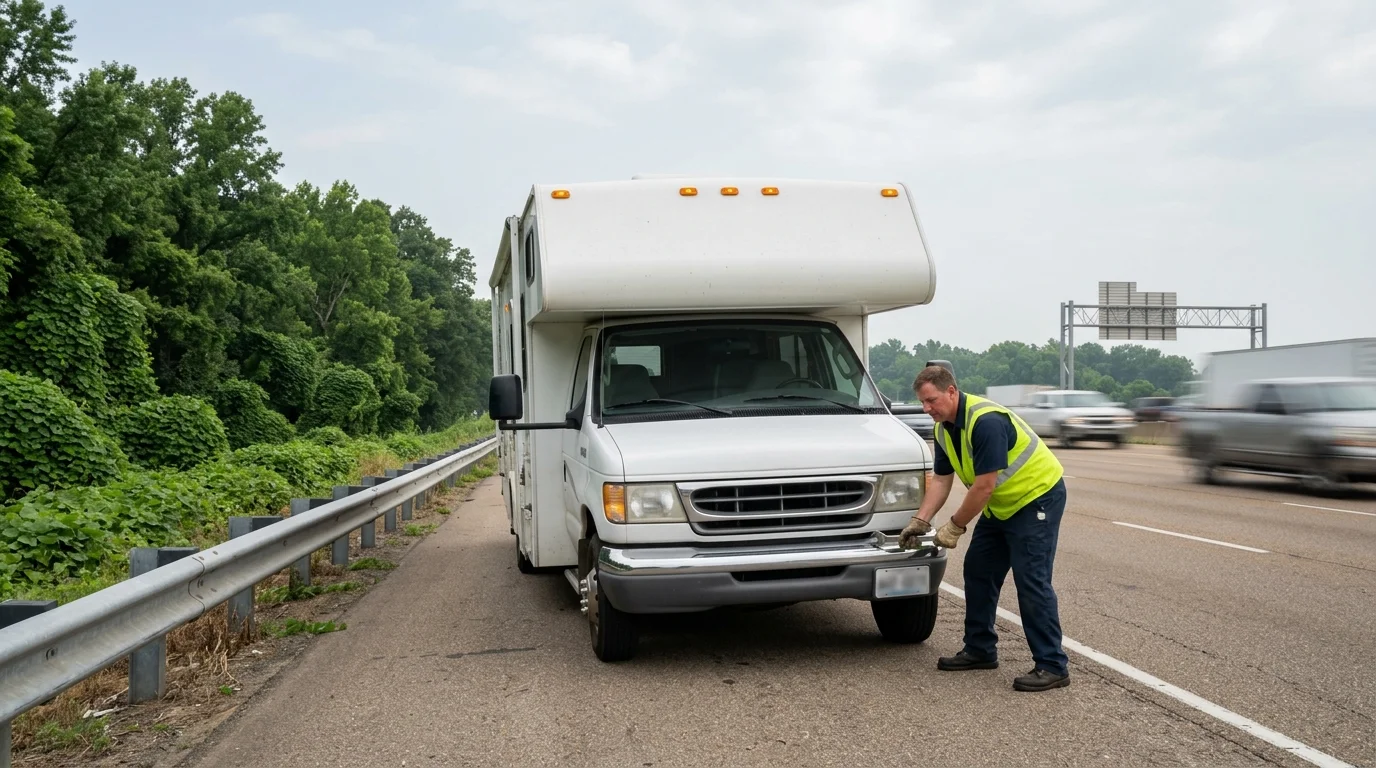
RV towing in Memphis can’t be booked like a standard car tow. The operator needs the rig’s size, condition, and exact location before choosing a truck. Those details matter even more near the interstate ring and river crossings.
RV towing in Memphis: weight and wheelbase pick the truck
Class A, Class B, and Class C labels provide a starting point. They don’t tell an operator everything needed to move the RV. Two coaches in the same class can have different wheelbases, axle layouts, ground clearance, and loaded weight.
Start with the manufacturer, model, model year, and RV type. Share the weight rating from the vehicle label. If you know the current loaded weight, provide that too. Don’t estimate a figure when you can photograph the label instead.
The operator will also need the overall length and height. Report the axle count, wheelbase, drivetrain, and current damage. A missing wheel, locked steering, damaged suspension, or low-hanging bodywork changes the hookup plan. Say whether the RV is pulling a car, boat, or utility trailer.
Photos help clarify details that are hard to describe by phone. Take them only from a protected location away from moving traffic. Useful views include the entire roadside position, each damaged wheel, the front and rear, and the vehicle label.
Our RV and trailer towing service starts with collecting those details. We then match the caller with a local operator suited to the job. Larger coaches or difficult recoveries may require heavy-duty towing equipment.
Price depends on distance, vehicle size, time of day, truck type, and hookup difficulty. Ask for the full total with mileage included before agreeing. Also ask what circumstances could change that total.
Where a Memphis breakdown puts you
The Memphis interstate network concentrates RV traffic around several very different recovery settings. I-40 carries traffic through the northern side of the city and across the Hernando de Soto Bridge. I-55 uses the Memphis & Arkansas Bridge before continuing through southwest Memphis toward Mississippi.
Those crossings aren’t interchangeable. The Hernando de Soto Bridge is the I-40 crossing. The Memphis & Arkansas Bridge carries I-55. A disabled RV near either bridge may face narrow working space, moving traffic, or limited access from the opposite direction. Our guide to breaking down on the Memphis bridges explains that local problem in more detail.
Elsewhere, an I-240 stop near East Memphis differs from an I-40 breakdown near Cordova. Bartlett traffic often approaches through the I-40 and US-64 area. Whitehaven and Southaven trips commonly involve I-55, where a few miles can put the pickup in another state.
Lamar Avenue adds another kind of challenge. It carries US-78 and SR-4 through an active trucking corridor. TDOT’s Memphis Congestion Study describes Lamar as the region’s top congested state road. It also calls the route “a critical, but clogged corridor for Memphis’s trucking industry.”
Overnight traffic matters too. The FedEx Superhub handles approximately 250 flights nightly, most between 10 p.m. and 5 a.m. That shift economy keeps commercial movement active while much of Memphis sleeps.
When calling, give the roadway, direction, nearest exit, and visible landmark. “I-40 near Memphis” isn’t precise enough for planning an RV recovery.
The highway patrol layer, and exactly where it stops
The TDOT HELP program provides patrols on covered Tennessee interstates around Memphis. Urban hours vary by day. Rural HELP also covers I-269 from the Mississippi state line to Exit 19 from 6:00 a.m. to 10:30 p.m. daily, with on-call overnight support for major incidents. During service hours, dial 511 and follow the Motorist Assistance prompts. Assistance is not guaranteed.
Its listed services are specific: flat changes, fuel delivery, minor mechanical help, and clearing blocking vehicles. HELP doesn’t tow an RV to a shop, home, campground, or storage lot. Anything beyond lane clearance requires a private tow.
That distinction matters when an RV has drivetrain, suspension, steering, or collision damage. A patrol may encounter the vehicle and help with a listed roadside problem. It doesn’t replace the towing operator needed for destination transport.
Don’t assume patrol coverage means a truck has already been assigned. Share the precise location when requesting private service. Mention whether HELP, police, or another responder is already at the scene. That helps the operator understand access conditions without promising an arrival time.
Before traveling, TDOT SmartWay can show Tennessee traffic, cameras, and incident information. Check it before entering the interstate ring or approaching a bridge. Conditions may influence which route makes sense, especially when the RV is already showing signs of trouble.
If the coach can’t continue, tell the towing operator where it needs to go. A repair shop, campground, secure parking location, and home address can each create a different route and mileage total.
Getting off the shoulder safely while you wait
Start by describing where the RV sits relative to traffic. A rig fully beyond the shoulder line presents a different scene from one blocking a lane or ramp. Tell the call taker if the RV leans, extends into traffic, or sits close to a guardrail.
No single inside-or-outside rule fits every roadside position. Fire, smoke, leaking fuel, injuries, or an occupied travel lane make the situation an emergency. Call 911 and follow the responder’s instructions.
If you leave the RV, move away from passing traffic. Don’t stand between the vehicle and an active lane. Avoid the area directly ahead of or behind the coach. Keep children, pets, and other passengers together in the safest available location.
Don’t crawl beneath the RV or attempt a roadside recovery yourself. Don’t remove a wheel beside moving traffic. An RV’s size and roadside position can turn a repair attempt into a larger recovery problem.
Keep the hazard lights on if the electrical system permits. Gather the registration, destination address, and vehicle details while you wait. If you can do so without approaching traffic, note the nearest mile marker, exit, cross street, or bridge feature.
Tell the operator which side has damage. Mention whether steering works, the parking brake releases, and the slides are retracted. Report any attached trailer or towed car. If a responder directs traffic or changes the RV’s position, update the call taker.
The goal isn’t to diagnose every failure from the shoulder. It’s to provide enough accurate information for the operator to plan the recovery.
Crossing the state line changes the rules
Metro Memphis crosses Tennessee, Arkansas, and Mississippi. An RV can leave Tennessee during an ordinary trip without leaving the urban area. That creates an important distinction: the state where the tow begins governs the pickup.
An I-40 trip west reaches West Memphis, Arkansas, after crossing the Hernando de Soto Bridge. I-55 crosses the Mississippi River on the Memphis & Arkansas Bridge. The same interstate also runs south from Memphis toward Southaven, Mississippi.
A tow beginning in West Memphis falls under Arkansas rules. A pickup in Southaven or elsewhere in DeSoto County follows Mississippi rules. Tennessee requirements don’t carry across either state line merely because the destination is Memphis.
For Tennessee pickups, the applicable state framework is 2025 MOTION Act, known as the MOTION Act. Don’t assume its rules apply when the disabled RV sits across the river or south of the state line.
Give both the pickup state and destination when requesting service. Include the full route if the trip crosses a state line. Distance, vehicle size, truck type, time of day, and hookup difficulty can all affect the total.
Ask for the full amount with mileage included before you agree. Ask what could change it during the job. Our guide to long-distance towing costs in Memphis explains how to compare that information without relying on an incomplete starting figure.
When to call us
An RV in a travel lane, near a bridge approach, or carrying wheel or drivetrain damage belongs with a working towing operator. We’ll collect the rig and location details, then match you with a local operator equipped for the job. Call us at (901) 557-8700.