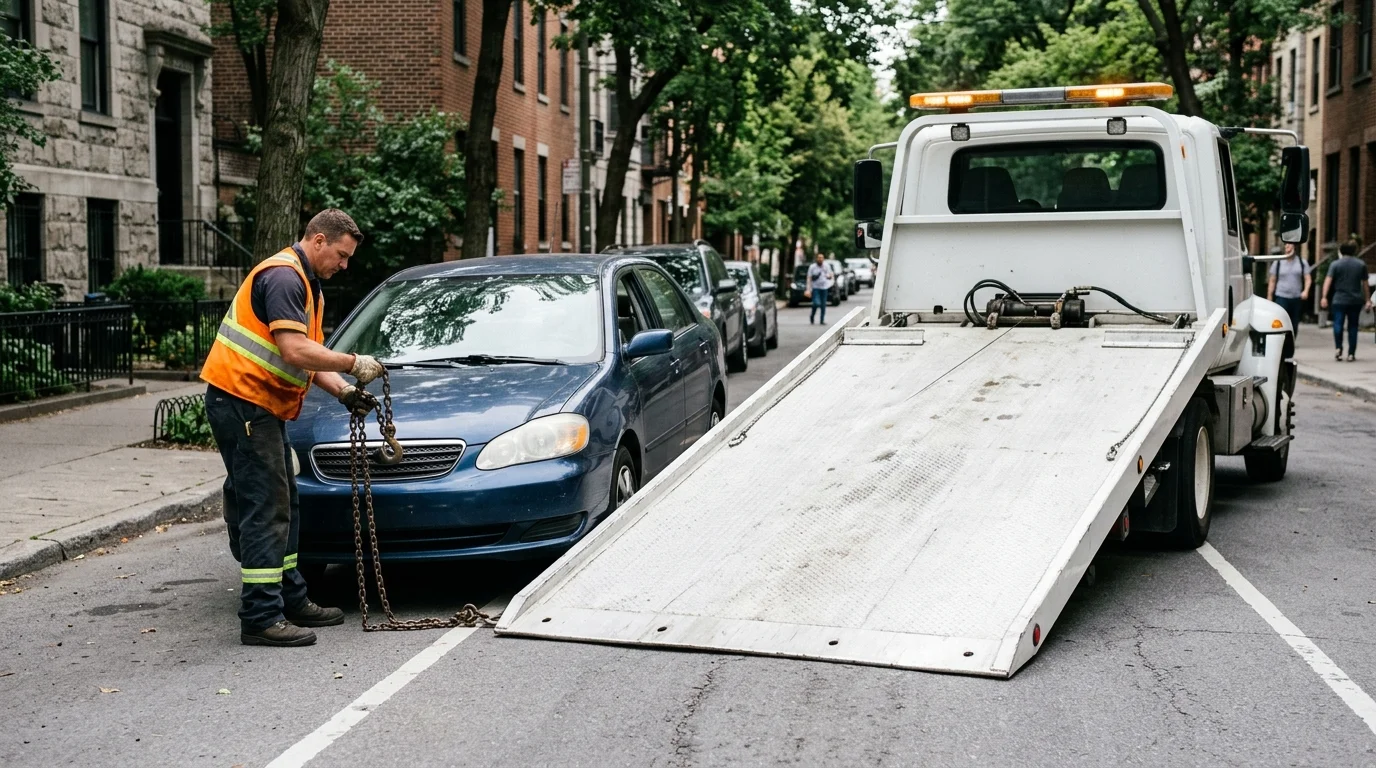
Typing “tow truck flat bed near me” usually means you’ve already chosen a towing method. The next step is giving dispatch enough detail to match your vehicle and location with a suitable operator. A clear description can start before anyone reaches the car.
Name the vehicle and drivetrain
Begin with the vehicle’s year, make, model, and trim. Include whether it’s a car, pickup, SUV, motorcycle, or another vehicle type. Tell dispatch about any aftermarket changes you know about, including a lowered suspension.
Next, name the drivetrain shown in the owner’s manual. It may be front-wheel drive, rear-wheel drive, all-wheel drive, or four-wheel drive. Don’t guess when you’re uncertain. Say that you’re unsure and have the manual available.
Model year matters because towing instructions can change between generations and trims. Two vehicles carrying the same model name may not share the same transport instructions. That’s why “Subaru Outback” isn’t as useful as “2023 Subaru Outback with all-wheel drive.”
Quick Tow Memphis is a referral service. We take your details and match the call with a local towing operator. The operator performs the work and contracts with you directly. Our flatbed towing service page explains that matching process.
Give the exact pickup location too. Name the road, nearest exit, parking area, or building entrance. Specify whether you’re on I-40 near the Hernando de Soto Bridge, I-55 near the Memphis & Arkansas Bridge, the I-240 loop, or Lamar Avenue at US-78.
Mention the state when you’re outside Tennessee. A tow originating in Southaven follows Mississippi law. A pickup in West Memphis follows Arkansas law. That detail shouldn’t wait until the operator is already headed toward the wrong side of the river.
Describe the wheels, steering, and brakes
Tell dispatch what you already know about the wheels. Say which tire is flat, whether a wheel is missing, or whether collision damage reaches the wheel area. Report what you can observe without entering traffic or crawling beneath the vehicle.
Describe the steering next. Say whether the front wheels appear straight or turned. If you already know the steering is locked, include that. Also mention whether the keys are present and whether the parking brake releases. Don’t force a control merely to test it.
These details matter even after you request a flatbed tow. “The car won’t move” leaves several conditions unknown. “The right front tire is flat, the steering is locked left, and the parking brake won’t release” gives the operator a clearer starting point.
Manufacturer instructions show why these details belong in the first call. The official 2024 Honda Civic Sedan manual calls a flatbed the best transport method. It also requires flatbed transport when the parking brake can’t be released. For that specific Civic, Honda describes a front wheel lift with the rear tires on the road as another acceptable setup.
That guidance applies to the listed model year, not every Honda. It also shows why dispatch needs more than the drivetrain alone. Share wheel, steering, and brake conditions, then let the responding operator plan the loading method.
Explain clearance and loading access
A flatbed request also needs a description of the pickup space. Tell dispatch whether the vehicle is in a covered garage, parking deck, gated lot, narrow driveway, alley, curb lane, or roadside area. Mention nearby parked cars, walls, gates, curbs, slopes, and blocked approaches.
The setting can vary sharply across Memphis. A Midtown curbside pickup presents different access from a Cordova driveway. A Hickory Hill apartment lot isn’t the same scene as a vehicle stopped along Lamar Avenue. Give the actual setting instead of naming only the neighborhood.
Describe the direction the vehicle faces and which end is easiest to reach. If a gate requires access from one entrance, say so. If the car sits beneath a ceiling or inside a structure, tell dispatch before an operator is matched. Photos of the vehicle and its surroundings can also show what words miss.
Report anything that reduces ground clearance. That includes a low front edge, visible body damage, or a modified ride height. Don’t assume a requested flatbed automatically fits every vehicle or pickup location.
Manufacturer guidance can be very specific here. Chevrolet’s 2018 Colorado owner’s manual directs flatbed transport for a disabled Colorado. It also tells the professional service to use ramps when needed to reduce the approach angle. That example doesn’t promise the same setup for another model.
Our guide to low-clearance vehicle towing explains what information to gather before requesting transport.
Check the current manufacturer instructions
Open the towing or emergency-transport section for your exact model year and trim. Read its wording to dispatch, or send a clear photo of the relevant page. Don’t replace those instructions with advice written for another year or vehicle.
Pay close attention to references involving the drivetrain, parking brake, drive wheels, or transfer case. Also distinguish disabled-vehicle transport from recreational towing. They aren’t interchangeable sections of an owner’s manual.
Subaru provides a useful model-specific example. Its guides say Symmetrical All-Wheel Drive sends power to all four wheels, improper towing can damage the system, and a flatbed is preferred for the 2020 Legacy and 2023 Outback examples. The official 2023 Outback guide also directs owners to the full manual for more information.
The 2024 Ford F-150 shows why broad rules can mislead. Ford’s recreational-towing instructions separate 4x2 and 4x4 models. The 4x4 procedure allows four-wheel-down towing only through that model’s Neutral Tow feature and its instrument-cluster confirmation. That procedure shouldn’t be applied to another pickup, trim, transfer case, or model year.
Likewise, Chevrolet’s manuals for the 2013 and 2014 Corvette give specific disabled-vehicle instructions involving all four wheels and low clearance. Those examples don’t create a rule for every sports car.
If you’re still choosing between methods, read our flatbed and wheel-lift comparison. Drivers with four driven wheels can also review the all-wheel-drive towing guide before calling.
Confirm the destination and quote
Give dispatch the complete destination before agreeing to the tow. Include the business or property name, street address, and the entrance where the vehicle should arrive. Say whether the destination is a repair shop, body shop, home, or storage facility.
Confirm that the destination can receive the vehicle when it arrives. If access involves a gate, parking structure, or tight driveway, mention that too. A pickup in Memphis with delivery across the Mississippi or Arkansas line should be described as a cross-border trip from the start.
Our published standard light-duty hookup starts at $95. That’s a starting fee, not the full total for every job. Distance, vehicle size, time of day, truck type, and hookup difficulty can move the final amount. The operator sets the total and contracts with you directly.
Ask for the full total with mileage included before agreeing. Ask what circumstances could change it. We put the total in writing before dispatch, and an itemized invoice is part of our process. Service is pay-per-call, with no membership or annual fee.
Before ending the call, repeat the essentials: exact vehicle, drivetrain, wheel condition, steering, parking brake, clearance, pickup access, and destination. Correct anything that changed after the first description. If a collision moved the vehicle or another car now blocks access, tell dispatch before the operator arrives.
When to call us
When the manual calls for flatbed transport, or wheel and clearance problems complicate loading, the work belongs with a towing operator. Quick Tow Memphis can take the details and match your call with an operator covering your zone, and the line takes calls 24/7. Call us at (901) 557-8700.