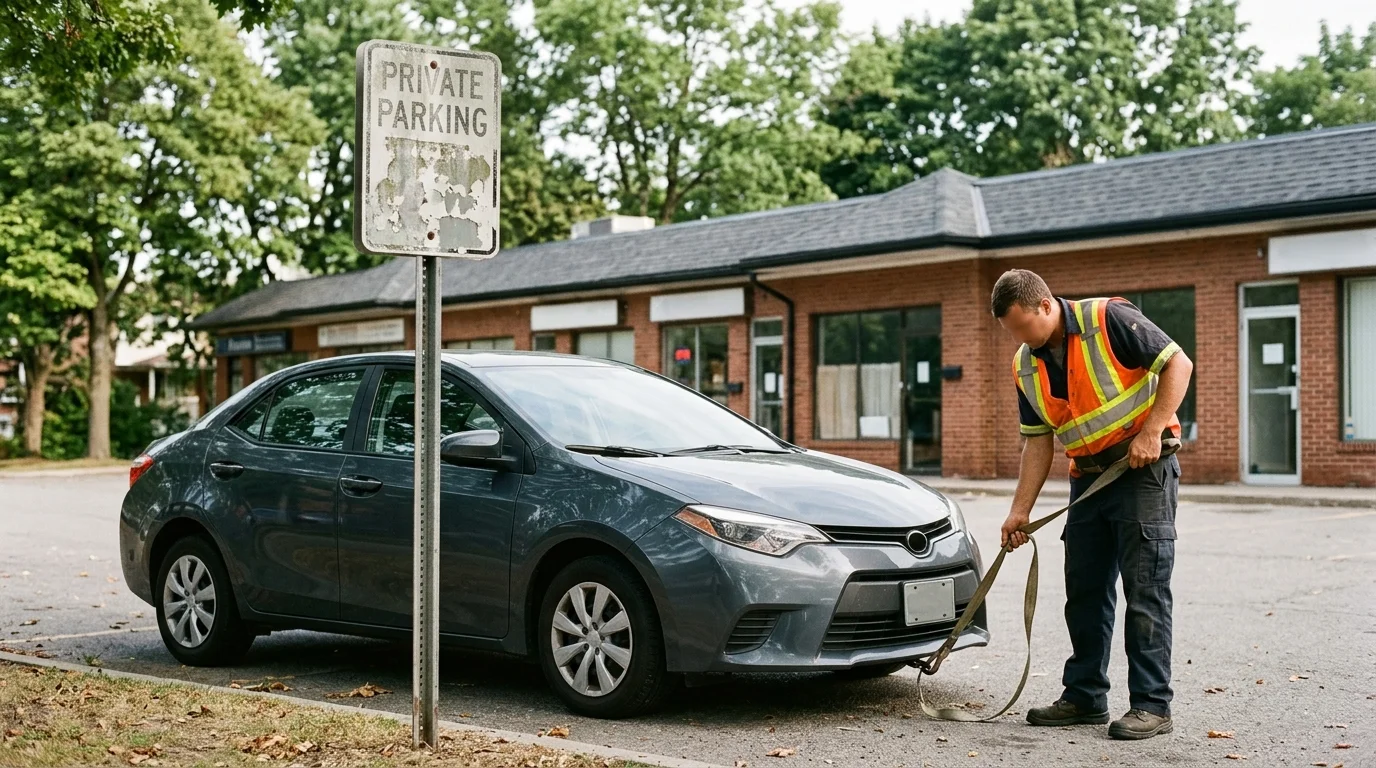
Searching for “tow zones near me” usually means you’re deciding whether a space is safe before walking away. In Memphis, first identify the type of property. Then read and photograph the restriction covering that exact space.
Start with the property and sign in front of you
A tow-away sign gets its meaning from its wording and location. A sign near a driveway might govern one lot. Arrows may point toward only certain spaces. Painted curbs, stall markings, permit labels, and separate entrance signs can add context.
Start with a wide view of the property. Include the parked car, nearby sign, curb, and entrance. Then take a close photo that captures every readable line. Record any towing or storage contact shown on the sign. Don’t rely on memory after leaving.
Next, decide whether you’re beside a public curb or inside private property. A Midtown street space isn’t the same setting as an East Memphis office lot. On Summer Avenue in Berclair, confirm whether the space belongs to a storefront or the public curb. In Cordova, check whether a restriction covers the whole shopping center or one reserved section.
Don’t assume a sign is valid because it looks official. Don’t assume it’s invalid because it looks small or faded. Tennessee doesn’t set one statewide size and wording standard for every ordinary private-lot towing sign. The type of property, posted policy, and authorization behind the tow also matter.
If the wording is unclear, choose another space when possible. That’s usually simpler than trying to resolve an ambiguous restriction after the car is gone.
Separate street restrictions from private lot rules
Public streets and private lots follow different decision paths. A private-property sign doesn’t establish a street restriction. Likewise, a city parking notice doesn’t explain the rules inside a nearby apartment or retail lot.
Current Tennessee towing law generally requires the owner’s express written authorization before a vehicle is towed. The law also provides exceptions. Those include certain posted commercial or public-access lots, vehicles left unattended there for more than 12 hours, hazards, blocked access, illegal parking, authorized removals from property not open to the public, and law-enforcement requests.
Inside Memphis, private-property tows require express written authorization. That paperwork identifies who authorized the removal, the vehicle, the reason, and other available identifying details. The sign is therefore only one part of the towing decision.
Paid commercial lots have a narrower sign rule. Their late-fee notices use red lettering at least 6 inches high on a white background. Those notices appear at each designated exit and must be visible from every parking space. Lots using automatic license-plate readers must place an LPR notice at each designated entrance under the same visibility standard. These rules aren’t a universal template for every trespass or no-parking sign.
Residential rental property follows another rule. A landlord may tow an unauthorized vehicle after 10 days of written notice posted on the vehicle. Immediate removal without that notice is allowed when the vehicle violates the landlord’s posted permit-parking policy. Tennessee doesn’t give that policy sign a statewide size or wording standard.
Our guide to Tennessee private-property towing signs explains these categories in more detail.
Record the location before leaving the vehicle
A useful photo shows more than the closest sign. Capture every entrance you used, the vehicle’s stall, nearby pavement markings, and any arrows. Include enough of the building or street to establish where the photo was taken.
Save parking receipts, app confirmations, visitor permits, or messages from the property. Photograph a temporary permit where it sits inside the vehicle. If a machine is unavailable or a sign is damaged, record that condition before leaving. These records don’t decide whether a tow is lawful, but they preserve what you actually saw.
Write down the property address and the nearest business or intersection. Memphis parking areas can have several entrances facing different roads. A driver entering from Poplar Avenue may see a different approach than someone entering from a side street. Walk back to the other entrances if it’s safe.
If towing begins while the car remains in its original parking location, current Tennessee law provides an on-site release path. The vehicle must be released when the owner or operator pays the release fee. For a vehicle towed without the owner’s written authorization, a release fee above $100 is prohibited.
Ask what amount is being requested and who is collecting it. Keep any receipt or paperwork provided. Once the vehicle leaves its original location, the immediate-release rule no longer describes the situation.
What to do if the car is gone when you return
First, check the full parking area. Some properties may direct traffic toward another section, while a missing car can also have another explanation. Ask the property representative whether a removal was authorized and which towing business took the vehicle.
Look again at every posted sign. Photograph the towing contact, property name, and restrictions before calling. Give the towing business the plate or VIN, vehicle description, pickup location, and approximate time you last saw it.
When an owner isn’t present for a Tennessee tow, the person towing must report the vehicle to the law-enforcement agency with jurisdiction within one hour. The report includes identifying details, the pickup location, and the storage location. That record is public. Contact the agency covering the place where the vehicle was parked.
MPD, Shelby County Sheriff, and Memphis Housing and Community Development tows all process through the MPD Vehicle Storage Lot at 465 Klinke Avenue. The lot has no online lookup tool. Call (901) 636-8200 to check whether the vehicle is there and whether any hold applies.
A private-property tow may go somewhere else. Start with the contact posted at the property and the law-enforcement record. Our Memphis vehicle-location guide covers the retrieval process without turning this sign check into a search for every possible storage yard.
Keep the photos and paperwork if the removal appears inconsistent with the posted restriction. The separate guide to your rights after a Memphis tow explains the city complaint route and the records worth keeping.
Where to verify the rule controlling that location
No single tow-away rule covers every curb, apartment lot, paid garage, and retail space around Memphis. We couldn’t confirm one Memphis-wide size or wording standard for every towing sign. Tennessee also has no statewide dimensioned-sign requirement for ordinary trespass or no-parking private lots.
For a public curb, use the agency named on the sign or notice. Ask which restriction covered that block and time. For a private lot, contact the property owner or manager and the towing or storage business named there. Ask what policy applied to the exact space and who authorized the removal.
A location outside Memphis may involve another local process. Don’t assume City of Memphis wrecker rules control a property in Bartlett. More importantly, a tow originating in Southaven, Mississippi, or West Memphis, Arkansas, falls under that state’s law. Tennessee towing rules shouldn’t be carried across either state line.
When the controlling rule still isn’t clear, keep the question narrow. Identify the space, sign, property type, time, and authority involved. Ask for the current rule or posted policy covering that location. A general internet answer can’t settle facts missing from the property itself.
Quick Tow Memphis doesn’t decide whether a sign or tow is lawful. Property owners arranging an authorized removal can review our private property towing service and gather the vehicle and location details before calling.
When to call us
Call when an authorized vehicle removal belongs with a working towing operator, or when you need your own car moved from private property. Quick Tow Memphis takes the details and connects you with a local operator, who performs the work and contracts with you directly. Call us at (901) 557-8700.