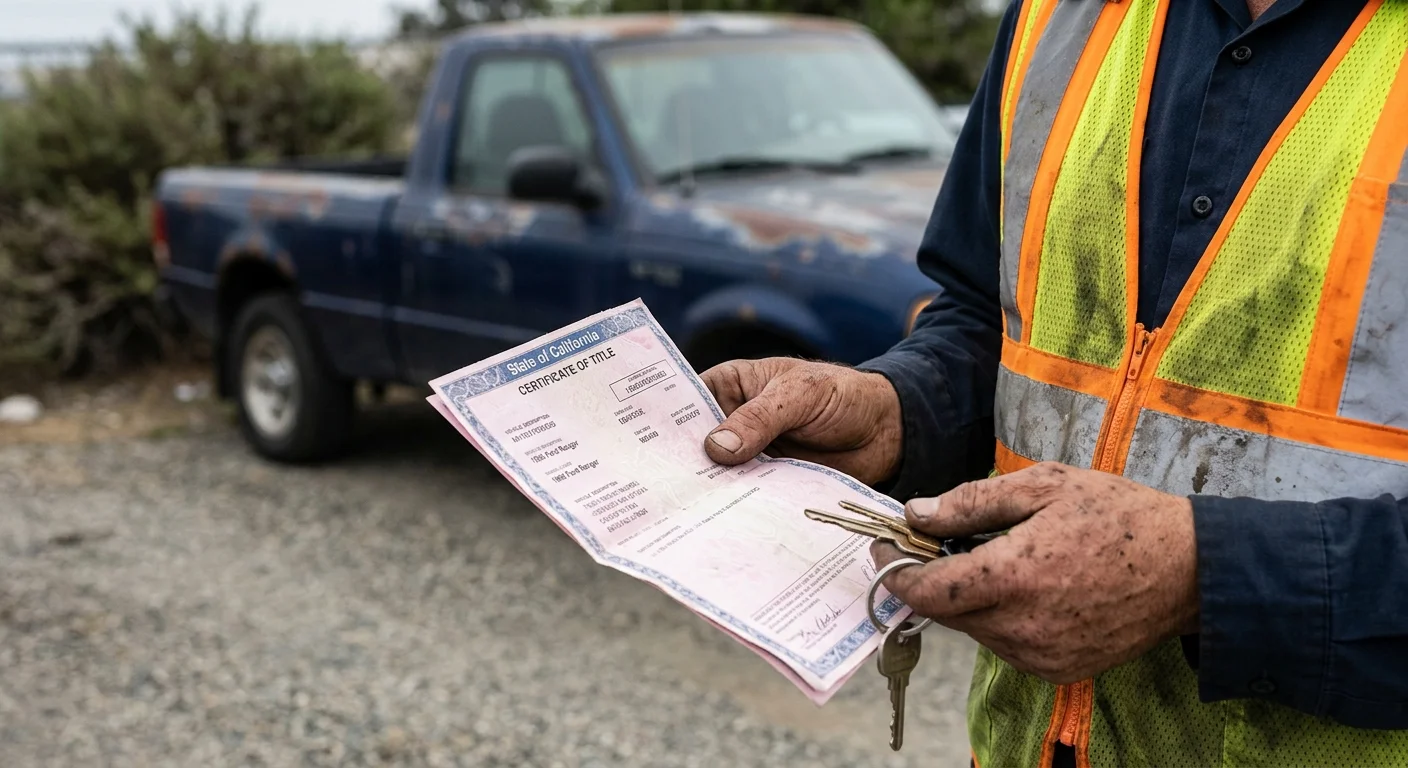
Junking a car in Tennessee comes down to one document: a title signed over correctly. If you still have a clean title, you sign the assignment section on the back, note the sale price and odometer reading, and hand it to whoever is buying the car for scrap or parts. No state filing closes out your ownership beyond that signature. The complications start when the title is missing, the car is too far gone to prove ownership the normal way, or insurance already totaled it. Here’s how Tennessee actually handles each version.
If you still have a clean title
Every Tennessee title has an “Assignment of Title by Registered Owner” section printed on the back. That’s where you formally transfer the car, whether the buyer is a private party, a scrap yard, or a licensed dismantler. Fill in your name, the buyer’s name, the date of sale, the sale price, and the odometer reading if the car is a 2011 model year or newer. That signed, assigned title is the transfer mechanism in Tennessee. Nothing else has to happen at the state level for a normal sale to close.
A bill of sale is a good idea alongside it. The county clerk uses it to calculate the buyer’s sales tax when they register the vehicle, or a scrap buyer may want one for their own paper trail. But it isn’t a substitute for the signed title, and it isn’t a filing you send to the state on its own.
In order, a clean-title sale looks like this:
- Fill out the assignment section on the back of the title with the buyer’s name, sale date, price, and odometer reading if required.
- Write up a bill of sale with both names, the date, and the price.
- Hand the signed title and bill of sale to the buyer when the car changes hands.
- Decide what happens to your plate before you drive away without it.
That’s the whole sequence. There’s no separate release form to mail in afterward and no waiting period before the sale is considered final.
What Tennessee doesn’t require
If you’ve junked a car somewhere else, you might expect a “Notice of Sale” or a “Release of Liability” form, something you file with the state the same day you hand over the keys. Tennessee has no such filing. There’s no state form that formally releases you from liability the moment you sell. The signed title is what does that work. Keep a copy of the signed-over title and your bill of sale for your own records, since that’s your proof the transfer happened on a specific date.
Lost or missing title
A missing title doesn’t stop a legitimate sale, it just adds a step. Apply for a Duplicate Title through your county clerk. The fee is $14 statewide, including here in Shelby County. Apply in person at the main office and you can walk out with it the same day. Mailed requests from a branch office run 5 to 7 business days. You’ll need the multi-purpose application, proof of ownership, a photo ID, and a lien discharge if a lien is still recorded against the car.
Plates don’t go with the car
Tennessee plates stay with the owner, not the vehicle. When you junk a car, you either surrender the plate or transfer it to a replacement vehicle. Transferring a plate costs $1 at the county clerk. Don’t hand your plate over to a scrap buyer as part of the deal. It’s yours to keep or move, not something that transfers with the title.
Selling to a licensed dismantler without a title
If your title is gone for good and the car qualifies, Tennessee has a separate path built for scrap sales. A licensed dismantler, recycler, or scrap metal processor can buy a vehicle 12 years or older, if they’re buying it solely for parts, dismantling, or scrap, without ever seeing a title. Both sides complete a Title Substitution Form instead. The buyer has to hold the vehicle at least 3 business days, including the day of purchase, before dismantling, crushing, or shredding it. They keep your ID, either a thumbprint or a photo ID copy, plus your written certification that you have the legal right to sell the car and that no liens are attached. The buyer then reports the purchase electronically within 24 hours, excluding weekends and holidays, and keeps records for 3 years.
That paperwork exists to stop stolen-car laundering, and Tennessee backs it with real penalties. A false certification or a missed report is a Class A misdemeanor carrying a mandatory minimum $1,000 fine (Tenn. Code Ann. § 55-3-203). Every piece of it, the 3-day hold, the ID copy, the 24-hour report, exists so a scrap sale can’t be used to make a stolen vehicle disappear before anyone notices it’s missing.
This dismantler path is also the reason age matters as much as condition. A 12-year-old rule sounds arbitrary until you think about what it screens for: a car old enough to have realistically depreciated to scrap value, versus a newer vehicle where skipping the title paperwork would be a red flag on its own.
No title, no dismantler eligibility: the police certificate path
Older, clearly inoperable cars without a valid title have one more option. If your vehicle is over 10 years old and has no engine, or is otherwise totally inoperable, and the title is faulty, lost, or destroyed, or the vehicle itself qualifies as abandoned, you can apply to the local police department for a certificate of authority to sell it to a demolisher without a title. The demolisher accepts that certificate in place of the title. It’s a narrow path built for cars that are genuinely done, not a shortcut around a normal sale.
Notice how this path differs from the dismantler exception above it. The dismantler path is a private transaction between you and a licensed buyer, built around a substitution form and a holding period. The police certificate path routes through local law enforcement first, because the title itself is missing or broken in a way a private substitution form can’t fix. If you have any title at all, even a duplicate you could apply for through the county clerk, that’s almost always the faster route than asking police for a certificate.
What happens to the title once the car is demolished
Whoever actually demolishes the vehicle has to surrender the title, or the auction sales receipt if the car came from auction, to the state for cancellation, and keep destruction records. Once that surrender happens, no further ownership transactions can occur on that vehicle. That’s the backstop that keeps a junked VIN from resurfacing on a car that shouldn’t legally exist anymore.
If insurance already totaled it, that’s salvage, not junk
A car insurance writes off after an accident follows a different track than a straightforward junk sale. Tennessee defines a Salvage Vehicle as one where the estimated or actual cost of parts and labor to rebuild it to its pre-accident, legally operable condition exceeds 75% of its retail value (§ 55-3-211(9)(A)). A Non-repairable Vehicle goes a step further: incapable of safe operation, with no resale value except for parts or scrap.
Getting either designation means applying by mail to the Tennessee Department of Revenue’s Vehicle Services Division in Nashville. There’s no cost for a Salvage or Non-Repairable Certificate. Once a vehicle carries either title, it can’t be registered or driven on Tennessee roads again unless it goes through the separate Rebuilt Vehicle process, which runs $75 for an individual owner or $85.50 for a dealer conversion.
Even after a car gets rebuilt and re-registered, its history follows it. Tennessee requires a passenger vehicle’s title to disclose in writing if state records ever show it titled salvage, unrebuildable, parts-only, scrap, junk, nonrepairable, reconstructed, rebuilt, or flood-damaged (§ 55-3-209). That disclosure rule has applied to transfers since October 1, 1996.
That’s worth sitting with if you’re deciding whether to junk a totaled car outright instead of rebuilding it. The Salvage or Non-Repairable path is free to apply for, but it’s also a one-way door in practice: the branding stays on that title for every future owner, disclosed in writing, permanently. If a car is only worth what a dismantler will pay for it in parts, that branding doesn’t cost you anything extra. If you were hoping to rebuild and resell it later, it’s worth knowing upfront that the salvage or non-repairable history never comes off the record.
The felony trap sellers don’t see coming
Here’s the mistake that turns a routine scrap sale into a criminal case. Selling, exchanging, or giving away the title, or the ID, serial number, or plates of a vehicle sold as junk, salvage, or a total loss, is a Class E felony in Tennessee (§ 55-5-127). That’s a serious charge for what usually starts as someone trying to make an extra hundred dollars off a part or a plate. If a car is junk, salvage, or a total loss, its title and its identifying parts stay with that determination. Selling a plate that’s no longer legally effective stays lawful, but that’s a narrow exception, not a loophole to plan around.
The short version
If you only remember one thing from each path, remember this:
- Clean title in hand: sign the assignment section on the back, note the price and odometer, hand it over. No state filing required beyond that.
- Title lost: get a Duplicate Title from the county clerk for $14, same day in person or 5 to 7 business days by mail.
- Plates: they stay with you. Transfer for $1 or surrender them, but don’t hand them to the buyer.
- No title, car is 12+ years old, selling to a licensed dismantler for parts or scrap: a Title Substitution Form replaces the title, with ID, certification, a 3-day hold, and a 24-hour report on the buyer’s side.
- No title, no dismantler deal, car qualifies as abandoned or the title’s destroyed: apply to local police for a certificate of authority to sell to a demolisher.
- Insurance already totaled it: that’s a Salvage or Non-Repairable Certificate through the Tennessee Department of Revenue, free to apply for, by mail only.
- Never: sell the title, ID, serial number, or plates of a junk, salvage, or total-loss vehicle separately from the car itself. That’s a Class E felony, not a gray area.
Do you need the title to scrap a car in Tennessee?
Usually yes, and the clean-title route is the straightforward one. Two paths exist without a title. A licensed dismantler, recycler, or scrap metal processor may buy a vehicle 12 years or older for parts or scrap without seeing the title, provided both sides complete a Title Substitution Form. Separately, an owner whose vehicle is over 10 years old and has no engine, or is otherwise totally inoperable, can apply to the local police department for a certificate of authority to sell it to a demolisher.
When you just need the car gone
Some of these cars aren’t worth the paperwork chase. They’re just taking up space. If the car on your property is not yours to sell, that is abandoned-vehicle removal, not a junk title assignment. Quick Tow Memphis isn’t a licensed dismantler and we don’t process title paperwork. Quick Tow Memphis does not buy cars, pay cash for scrap, or process titles. If you still need a dead or non-running vehicle moved after the title path is handled, the recorded line takes calls 24/7 and matches you with a local operator who contracts with you directly. Call (901) 557-8700. Handle the title the way Tennessee actually requires.