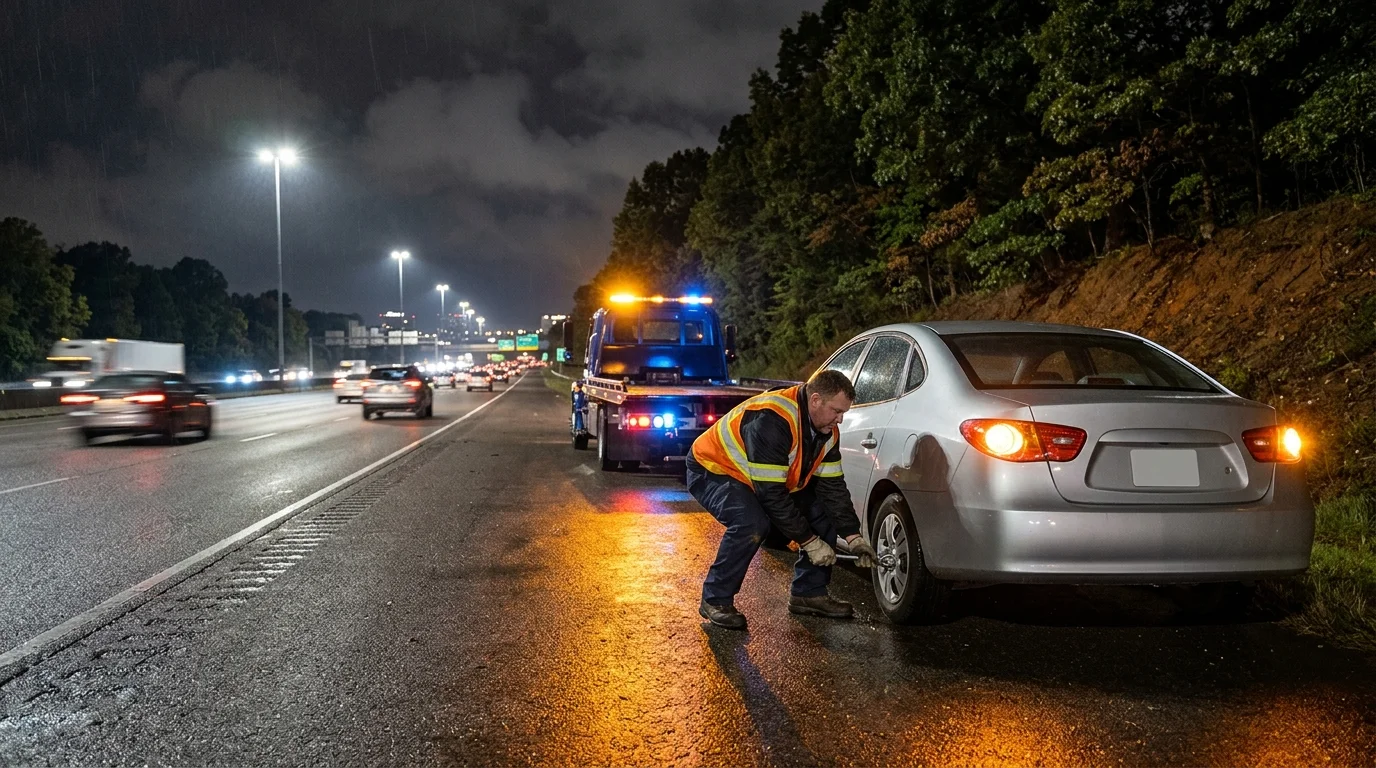
Hazards on, engine dead, and I-240 still moving at 70. That is the overnight call in Memphis: a shoulder on the loop, a dark stretch of I-55, Lamar’s truck lane, or a side street near the airport while the Superhub is in the middle of its sort. Memphis roadside assistance at that hour is a location problem first, then a service problem. Stay in the car, lock the doors, and get the mile marker or the last exit you passed before you start looking for help.
Say where you are on the night loop
The night loop is I-240 all the way around the city. I-40 cuts east-west and carries the Hernando de Soto Bridge over the Mississippi. I-55 runs south toward the state line and carries the Memphis & Arkansas Bridge. SR-385, Bill Morris Parkway, is the south and east belt. Those are the highways that actually go through Memphis. If you are not on one of them, you are on a surface street, and that changes who can even pull in.
Give the interstate, the direction, and the last exit. Perkins, Getwell, Airways, Lamar, Union, and Riverside mean different turnarounds. East Memphis on I-240 near Poplar is not the same stop as Whitehaven on I-55. It is not the same stop as a breakdown on Winchester by the airport. Downtown shoulders are short. The ramps off I-240 onto Union or Madison still stack after midnight. A pin in Cordova or Bartlett is a suburban street, not a freeway gore. Say that out loud so the operator is not hunting the wrong side of the loop.
If you are on a river crossing, treat it as a bridge job, not a generic shoulder. The Hernando de Soto is the I-40 span people call the M Bridge. The Memphis & Arkansas Bridge is I-55. Both carry night freight. If that is where you are sitting, what to do on the Memphis bridges is the specific play, including staying put until a wrecker can stage. Do not walk a tied-arch span in the dark to “get to the other side.”
On the interstates, TDOT SmartWay cameras and 511 can confirm a backup you cannot see from the seat. Check them from the car if you can. Do not walk the shoulder to find a better pad. Do not cross live lanes. If you can ease onto a wider shoulder, an exit gore, or a lit ramp, do that with hazards on. If you cannot, stay buckled where you are.
South of the state line is a different legal stack. A stop in Southaven or elsewhere in DeSoto County is Mississippi, not Tennessee. West Memphis and Marion are Arkansas. Tell the operator which state you are in before anyone rolls. Tennessee rules do not follow you across the river or the DeSoto line.
Decide whether a jump, tire, or tow fits
Roadside assistance Memphis drivers need after dark is a short list. A jump if the car is dead but otherwise sound. A spare and a tire change if the sidewall is down and you have a usable donut. Fuel if the tank is empty and the engine is fine. A lockout if the keys are inside and the car is in park. Anything else is a tow.
The operators we dispatch can handle that list on a private call. They cannot guess from “it won’t start.” Say whether it cranks, clicks, or does nothing. Say whether a tire is shredded or just soft. Say if the car is in a live lane, on a shoulder, in a lot, or on a grass slope. A wheel-lift is a different truck than a flatbed. A car in drive on a grade is a different hook than a car in park on level asphalt. If a quick assist will not move the car, towing is the job.
Do not change a tire on the left shoulder of I-240 at night. Do not pop a hood in a travel lane for a jump. If you are on the interstate, the safe version of roadside assistance is the operator coming to you, not you kneeling next to a donut while trucks pass. If the battery will not take a jump, or the spare is missing, or the car is sitting on a shredded tire, you are already in tow territory.
A tow is the right call when the car cannot roll safely under its own power. Overheating, a broken axle, an airbag light after a hit, a car that died in a gore point: those are emergency towing jobs. Tell the operator where you want the car to go. A 24-hour shop on Getwell is a different drop than a driveway in Cordova or a lot in Bartlett. If you do not have a shop, say so. Do not ask a highway patrol truck to drag you home. That is not what free patrol help is for.
If you already compared membership clubs and pay-per-call options, our best roadside assistance in Memphis guide is the daytime version of this decision. Overnight, the membership card does not change the physics. You still pick jump, tire, fuel, or a wrecker, and you still need a truck that can reach the pin you are on.
What free highway help covers after dark
Tennessee’s free highway program is TDOT HELP. It is a patrol, not a number you call for a truck. In Memphis, HELP runs Monday through Sunday from 6:00 a.m. to 8:30 p.m. The listed routes are I-40 including the Hernando de Soto Bridge, I-55 from state line to state line, the full I-240 loop, and SR-385 / Bill Morris Parkway. That list is exact. Do not assume a HELP truck on every numbered road, and do not assume one on Lamar, Winchester, or an airport service road.
What HELP does on those routes is also a closed list: flat changes, fuel delivery, minor mechanical help, and clearing blocking vehicles. Jump starts are not on that list. HELP does not tow you to a shop, a house, or a lot. Anything past lane clearance is a private tow. Read it on TDOT’s HELP program page if you want the state’s own wording.
After 8:30 p.m., treat highway help as a private call. The patrol window is closed. A 10 p.m. dead battery on I-240 is not a HELP stop. A 2 a.m. flat on I-55 is not a HELP stop. Even inside the window, HELP is not a dispatch service. You may see a truck, or you may not. If you are off the listed interstates, you were never on their map.
Dark is not the same as after hours. In January you can be in the dark at 6:15 p.m. and still inside HELP’s clock. In July, 8:00 p.m. can still be dusk. Use the clock, not the sky. If you are past 8:30 p.m., skip the wait and call a private operator.
How the Superhub area changes access
The FedEx Superhub is why southeast Memphis does not sleep. About 250 flights a night move through that operation, most of them between 10 p.m. and 5 a.m. That is shift-economy traffic: cargo jets, contractors, and the trucks that feed Lamar, Winchester, Democrat, Swinnea, and the airport ramps. It is not a published breakdown count. It is the reason those streets stay busy when Midtown is quiet. Overnight roadside Memphis work around the sort window is a freight problem as much as a car problem.
TDOT’s Memphis Congestion Study calls Lamar Avenue, US-78 / SR-4, the top congested state road in the Memphis region and “a critical, but clogged corridor for Memphis’s trucking industry.” At night that still matters. A disabled car in a Lamar through-lane is sitting in truck traffic. A disabled car on a Superhub-area side street may be legal to park but hard for a wrecker to see. Give the nearest named road, the gate or building if you have one, and whether you are in a lot or on the pavement.
Access is the whole game around the airport. Some lots are gated. Some shoulders on Winchester are narrow. Some ramps off I-240 toward the airport stack with sort-window traffic even when the rest of the city is empty. Tell the operator if a truck needs a gate code, a loading dock, or a surface-lot pin rather than an interstate mile marker. A car on Airways is not the same call as a car on the I-240 shoulder above it.
If you work the sort and you are in a personal car, you still need a destination. A night-shift shop may be closed. Ask whether the operator can hold the car until morning or drop it at a 24-hour lot you name. Do not leave the car in a live lane because the bay opens at 7.
Confirm the quote before anyone rolls
Before anyone rolls, get the total in writing. Distance, vehicle size, time of day, truck type, and how hard the hook is all move the number. A light sedan on a level I-240 shoulder is not a low-clearance car in a ditch off Lamar. Mileage to the drop counts. Ask for the full total with mileage included, and ask what would change it.
Our standard light-duty hookup starts at $95. That is our published floor, not a cap on the operator’s whole job, and not a city rate. Memphis does not publish an on-scene wrecker schedule you can quote from the shoulder. Do not treat a hookup number as the bill for a long haul to a shop in Bartlett.
Quick Tow Memphis is a referral service. We take the details and match you with a local operator. The operator does the work and contracts with you directly. We do not own the wrecker. What we do control is the process: the total in writing before dispatch, an itemized invoice, written authorization and paperwork on request, and pay-per-call with no membership and no annual fee. The line takes calls 24/7. Your call routes to the operator covering your zone.
If the car is already gone, that is an impound question, not a roadside one. MPD, Shelby County Sheriff, and Housing and Community Development tows all process through the city lot at 465 Klinke Avenue. There is no online lookup. The phone is (901) 636-8200. City fees at that lot are an impound fee of $135.00 and storage of $30.00 per day. Confirm those on the MPD Vehicle Storage page before you pay. That is a different night than the one this page is about.
When to call us
Call when the car cannot sit there until morning: a live lane on I-240, a dark pin on I-55, a shredded tire on Lamar, or a no-start on a Superhub-area street after HELP has parked. The operators we dispatch handle the jump, the tire, the fuel, or the tow. Call us at (901) 557-8700.