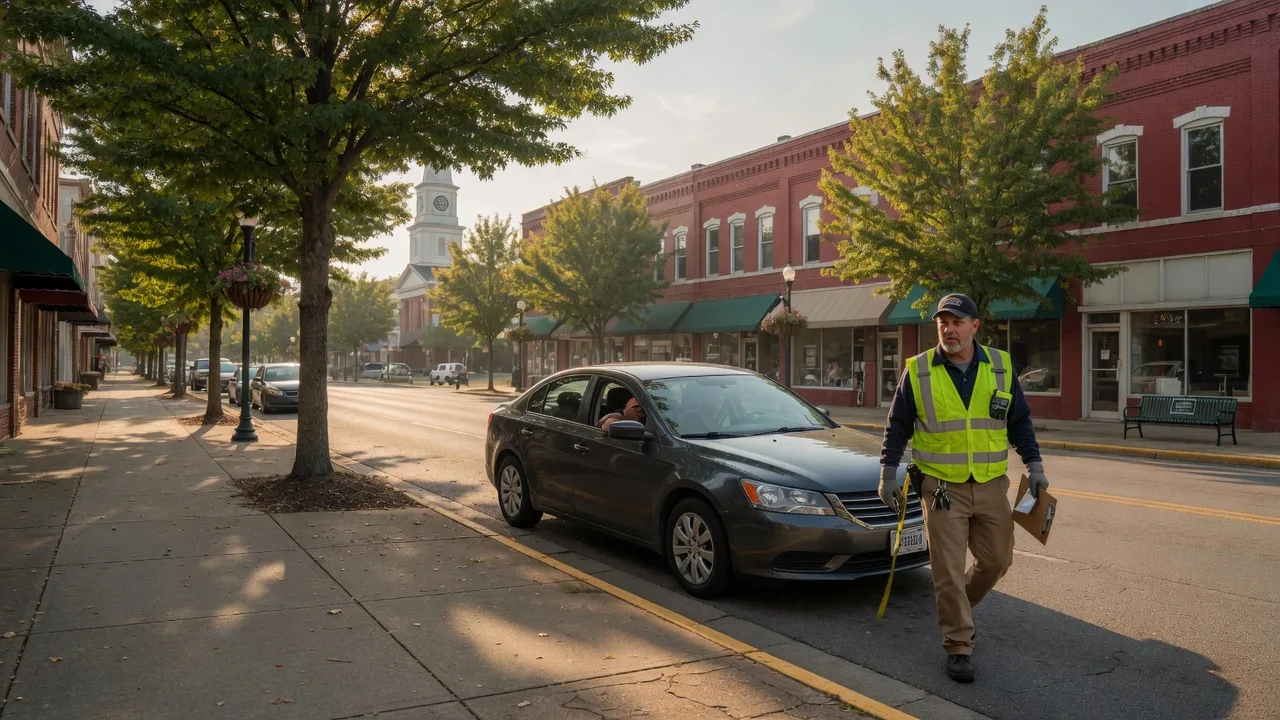
A breakdown in Collierville starts with two decisions: where you are and whether the car needs moving. For Collierville towing, give the operator a precise pickup point, describe what the car does now, and choose the destination before dispatch.
If anyone is hurt or there’s an immediate danger, contact emergency services first. Once that’s handled, the details below will make the towing call clearer.
Share the exact Collierville road or lot
Start with the road name, your direction of travel, and a nearby marker. “Collierville” alone leaves too much ground to search. A pickup on West Poplar Avenue is different from one on Byhalia Road or Collierville-Arlington Road.
If you’re near Collierville Town Square, name the business, public space, or cross street you can see. In a retail lot, share the store name and the side of the building. Add the row, entrance, or curb area if that helps identify the car.
A map pin is useful, but don’t depend on it alone. Tell the operator what surrounds the vehicle. Mention whether it’s in a marked space, beside a building, or near an entrance. Describe the car’s color, make, model, and plate when available.
For a roadside pickup, say whether you’re on the main road, a turn lane, or an adjoining driveway. If you’re near I-269, give the roadway name shown by your map and the nearest confirmed exit or marker. Don’t guess which ramp or direction you used.
Parking-lot procedures vary by property. No verified universal procedure was found for Collierville’s town-square or retail lots. Contact the business or property manager if you’re unsure whether the vehicle can remain there while help is arranged.
Describe what the car does now
The operator needs the current condition, not only what happened earlier. Say whether the engine starts, the car moves, and the steering responds. Mention any warning shown on the dashboard, using the exact wording when possible.
Explain what happened just before the car stopped. It may have lost power, made a new sound, overheated, or refused to restart. Don’t diagnose the cause unless you already know it. A clear description is more useful than a guess.
Tell the operator about visible damage, a flat tire, leaking fluid, or wheels sitting at an unusual angle. If the vehicle left the pavement or became stuck, don’t describe the request as a basic tow. Explain where every wheel is sitting and what surrounds the vehicle.
Share the exact year, make, model, and trim when you have them. Also mention whether the vehicle is front-wheel drive, rear-wheel drive, all-wheel drive, or four-wheel drive. If you don’t know, say so. The towing or emergency-transport section of the owner’s manual can help confirm model-specific instructions.
Tell the operator if the parking brake won’t release, the steering is locked, or the keys are unavailable. These details help the operator evaluate the required transport setup before accepting the job.
Decide whether roadside help or a tow fits
Roadside help may fit when the vehicle can remain where it is and the problem might be handled without transporting it. A tow fits when the car can’t be driven to the chosen destination or when moving it under its own power isn’t appropriate.
Start with our roadside assistance service if you need an operator to assess a problem that may not require transport. Describe the symptoms before dispatch. That gives the operator a chance to determine whether roadside work matches the request.
Choose emergency towing when the car needs to leave the breakdown location. Have both the pickup point and destination ready. If you’re uncertain, explain what the car can and can’t do rather than choosing equipment yourself.
Don’t try to move a disabled vehicle from an active roadway position without suitable help. Tell the operator about traffic exposure and the car’s exact position at the start of the call.
Quick Tow Memphis is a referral service. We collect the job details and connect callers with a local operator. The operator performs the work and contracts with the customer directly.
If the breakdown happened west of Collierville, our Germantown breakdown guide covers that area. Drivers farther north can use the separate Bartlett breakdown guide.
Explain Poplar, Byhalia, or I-269 access
The road name shapes the pickup instructions. West Poplar Avenue, Byhalia Road, Collierville-Arlington Road, and I-269 shouldn’t be treated as interchangeable locations.
On West Poplar, give a nearby business or cross street. Confirm your travel direction from your map rather than using “toward Memphis” as the only clue. In the town-square area, describe the block, lot, or side street where the car sits.
On Byhalia Road, name the closest visible business or retail entrance. Large shopping areas may have several access points. Tell the operator which entrance you used and where the vehicle is relative to the storefront.
For Collierville-Arlington Road, share a confirmed cross street or map marker. Avoid relying on a neighborhood name if the car is actually on the road. The operator needs the vehicle’s physical pickup point.
An I-269 request needs the direction of travel and the closest confirmed exit or mile marker. Coverage by a particular roadside patrol on the Collierville segment couldn’t be confirmed from the approved source material. Don’t assume that a patrol does or doesn’t cover your location. You can check TDOT SmartWay for current Tennessee traffic, camera, and incident information.
If your map labels the road differently from a nearby sign, share both labels. That small detail can prevent confusion before dispatch.
Confirm the destination before dispatch
Choose where the vehicle should go before the operator starts the trip. That might be your home, a repair shop, a dealership, or another approved property. Confirm that the destination will accept the vehicle.
If you’re choosing a shop, contact it directly. Ask whether it accepts after-hours drop-offs and where the vehicle should be placed. Those procedures couldn’t be confirmed as a single Collierville-wide rule because each property controls its own lot.
Give the operator the complete destination address. A business name alone may not identify the right entrance. If the shop has separate customer, service, and delivery areas, ask the shop which one should receive a disabled vehicle.
Cost can change with distance, vehicle size, time of day, truck type, and hookup difficulty. Ask for the full total with mileage included before agreeing. Also ask what circumstances could change that total. Quick Tow can put the quoted total in writing before dispatch and provide an itemized invoice.
If you haven’t selected a destination, say that during the first call. Don’t authorize movement to an unknown lot just to finish the request faster. Confirm where the vehicle will be delivered, who will receive it, and whether you need to meet the operator there.
Keep the destination contact information available. If the receiving property changes its instructions, pass that update to the operator before the vehicle leaves Collierville.
When to call us
When the car can’t be made drivable where it sits, moving it belongs to a working towing operator. Our line takes calls 24/7 and routes your request to the operator covering your zone. Call us at (901) 557-8700.