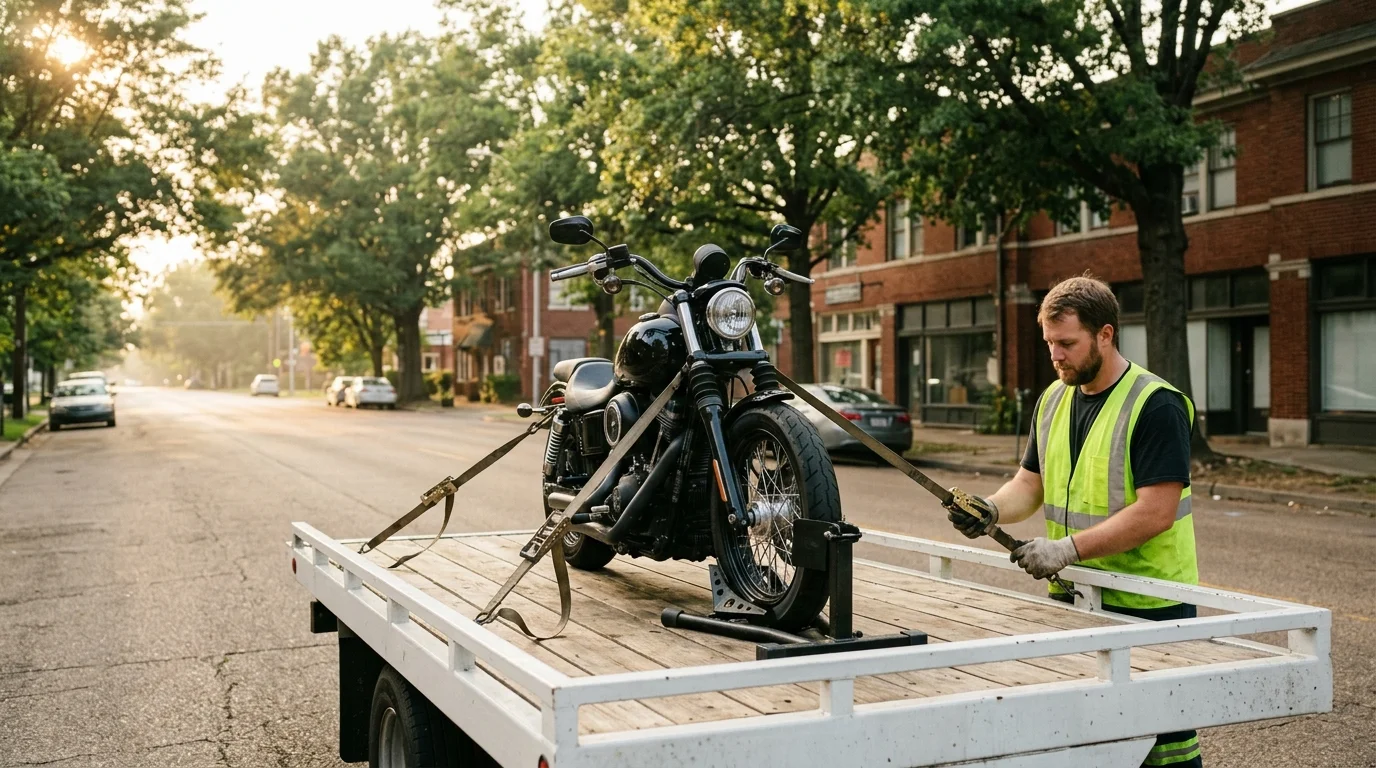
Motorcycle towing in Memphis needs more than an open spot on a truck. Loading, securement, and pickup position all deserve attention. That matters even more beside a busy Memphis corridor or river crossing.
How motorcycle towing in Memphis differs from a car tow
A motorcycle can’t support itself upright once the rider steps away. Its transport setup must control balance as well as forward, backward, and sideways movement. That makes the loading conversation different from a standard car tow.
Start by telling the operator whether the bike still rolls and steers. Mention a locked wheel, damaged front end, broken controls, or a bike resting on its side. Those details help the operator decide how to approach the load. Don’t try to make serious damage sound minor.
Request equipment suited to the bike’s present condition. Our motorcycle towing service connects riders with local operators who can review those details. A flatbed tow gives the operator a full deck for loading and securement. The final equipment choice still depends on the bike, its damage, and the pickup area.
Watch the loading process from a safe position. The bike should remain controlled while moving onto the deck. It shouldn’t be balanced by someone standing in an active traffic lane.
Tell the operator about low bodywork, loose panels, or visible damage. Existing damage can change the loading plan. Photos taken before loading also create a clear record of the bike’s condition.
The destination matters too. A repair shop, home driveway, and secured storage area may offer very different unloading space. Share any gate, slope, narrow entrance, or surface issue during the call. That prevents the unloading end from becoming an afterthought.
Chocks, soft straps and the parts that must never take load
A good setup uses several pieces together. The wheel chock positions the bike. The tie-downs control movement. The flatbed deck provides the transport platform.
Ask the operator how the front wheel will be held. Then ask which parts of the motorcycle will carry the tie-down load. The answer should match the motorcycle manufacturer’s transport instructions. Those instructions matter because frame layouts and approved attachment points can differ.
Soft loops or soft straps help keep metal hardware away from finished surfaces. Still, soft material doesn’t make every attachment point suitable. Mirrors, control levers, brake lines, cables, body panels, and exhaust pieces aren’t substitutes for manufacturer-approved securement points.
Don’t ask for maximum strap tension. More force isn’t automatically a better setup. The operator needs enough control for transport without treating delicate parts as anchors. There’s no universal tension number in this site’s verified information, so confirm the method with the operator and the motorcycle’s own manual.
Before departure, look at the complete setup. Check that loose items have been removed or secured. Confirm that straps aren’t rubbing across sharp edges or painted panels. Ask the operator to explain anything that looks unclear.
A short walk-around takes less effort than dealing with unexplained damage later. Take clear photos of both sides, the controls, and any existing scrape or impact area. Keep those photos with the written tow details and destination information.
The Memphis roads where bikes actually go down
Pickup conditions change across Memphis. A quiet Midtown side street offers more working room than a narrow shoulder beside interstate traffic. Give the exact road, direction of travel, nearest exit, and a visible landmark when you call.
The Hernando de Soto Bridge carries I-40 across the Mississippi River. The Memphis & Arkansas Bridge carries I-55. These are separate crossings on separate interstates. Bridge decks, expansion joints, wind exposure, and limited stopping space can make a disabled bike difficult to reach safely.
Move away from active lanes if you can do so without handling the motorcycle. Don’t walk into traffic to retrieve loose gear. For a breakdown on either crossing, follow the steps in our Memphis bridge breakdown guide.
Lamar Avenue carries US-78 and SR-4. TDOT’s Memphis Congestion Study describes it as the region’s top congested state road and a critical but clogged trucking corridor. A motorcycle pickup there needs an accurate direction and cross street, especially around heavy traffic.
Summer storms create another problem. Water can hide pavement edges and make a low spot difficult to assess. Tell the operator about standing water, mud, soft ground, or storm debris near the bike. Don’t enter moving water to recover it yourself.
The TDOT HELP program runs patrols on covered Tennessee interstates around Memphis. Urban hours vary by day. Rural HELP also covers I-269 from the Mississippi state line to Exit 19 from 6:00 a.m. to 10:30 p.m. daily, with on-call overnight support for major incidents. During service hours, dial 511 and follow the Motorist Assistance prompts. Assistance is not guaranteed. HELP may clear a blocking vehicle, but it does not tow a bike to your chosen shop, home, or storage lot.
Check TDOT SmartWay for current cameras, incidents, and traffic conditions. That can help you describe the scene without making another trip toward traffic.
Getting a dropped bike upright before it moves
A dropped motorcycle isn’t automatically ready to roll onto a flatbed. Its position, surrounding traffic, ground surface, and visible damage all affect the next step.
On a highway shoulder, leave the lifting decision to the responding operator. Traffic exposure can turn a simple upright attempt into a second incident. Get yourself beyond the traffic side of the bike when there’s a safe route there.
Describe which side is down. Mention whether the bike is against a curb, barrier, ditch edge, or parked vehicle. Tell the operator if the wheels are on pavement while another part rests in mud or grass. Photos can clarify the position, but don’t step into a live lane to take them.
Don’t pull the motorcycle by its mirrors, controls, cables, or bodywork. Don’t start disassembling damaged parts beside the road. An operator can assess how to control the bike before changing its position.
Once the scene is workable, the operator should plan the upright movement and loading as one process. Raising the bike without controlling what happens next can leave it unstable. Ask where it will be supported immediately after it comes upright.
Tell the operator if you see leaking fluid, broken controls, loose parts, or a wheel that won’t turn. Don’t restart the motorcycle just to test it. Its condition may require controlled loading rather than riding or pushing.
For a bike below an embankment, trapped near a barrier, or resting in storm runoff, request recovery help. Those situations belong to a working towing operator, not a roadside lifting attempt.
What to ask for when you make the call
Start with your exact location and travel direction. Then give the destination, bike condition, and whether it rolls or steers. Mention nearby traffic, water, mud, gates, parking structures, or tight access.
Ask these questions before you agree:
- What equipment will the operator use for this motorcycle?
- How will the bike be controlled during loading?
- Which securement points will carry the load?
- Does the plan account for the visible damage?
- Can the operator access both pickup and destination?
- What is the full total, including mileage?
- What circumstances could change that total?
Tow cost can move with distance, vehicle size, time of day, truck type, and hookup difficulty. Our guide to Memphis towing costs explains how to review those factors. Ask for the full total with mileage included before agreeing.
Quick Tow Memphis is a referral service. We take the details and match the caller with a local tow operator. That operator performs the work and contracts with the customer directly.
Ask the matched operator for the quoted total in writing before you agree, plus an itemized invoice and related authorization paperwork. The referral line can remind you to ask. There’s no membership or annual fee for calling the line.
Say whether the pickup is in Tennessee, Mississippi, or Arkansas. A tow beginning in Southaven or West Memphis falls under that state’s rules, not Tennessee’s. The operator needs the correct origin even when the destination is Memphis.
Before the matched operator starts the move, confirm the delivery location and contact person. Keep the written details and your condition photos together. That gives everyone the same record of the requested move.
When to call us
Call when the bike is down, damaged, won’t roll, or can’t be moved without entering traffic. We’ll take the details and connect you with a local operator suited to the job. Call us at (901) 557-8700.