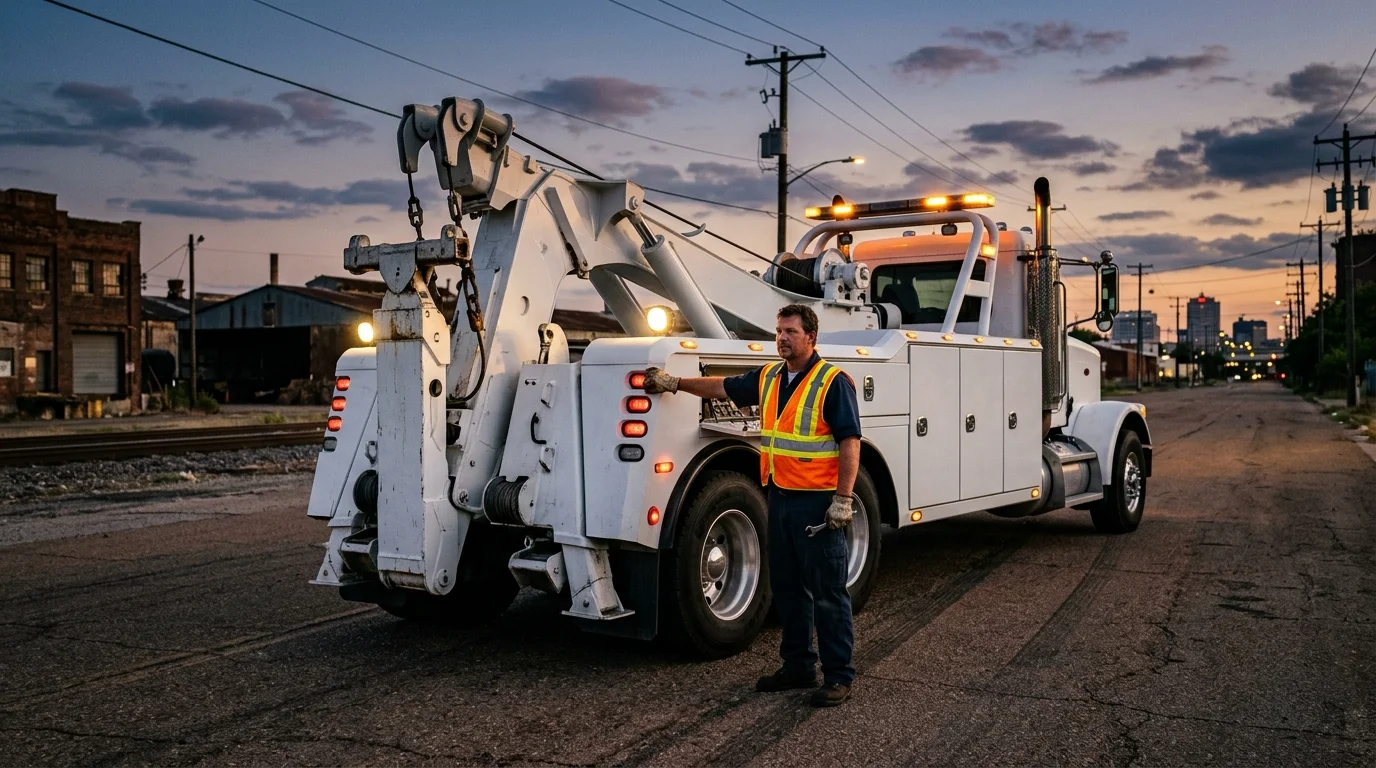
A disabled semi on Lamar Avenue isn’t the same call as a box truck behind a Midtown loading dock. Heavy duty towing in Memphis starts with identifying the vehicle, its load, and the space around it. Those details help the working operator plan the job.
What counts as heavy-duty and what does not
Don’t choose a towing category from the vehicle’s appearance alone. A large pickup, delivery van, box truck, bus, chassis RV, and tractor-trailer can require different setups. The operator needs the actual vehicle details before selecting equipment.
Start with the year, make, model, and body style. If it’s a commercial vehicle, share the stated weight rating shown on its paperwork or identification label. Tell the operator whether the vehicle is empty, loaded, or attached to something else.
For box truck towing in Memphis, body length and cargo status matter. A short empty delivery truck presents a different job than a longer loaded unit. Liftgates, low attachments, damaged wheels, and limited clearance also belong in the description.
For a semi, explain whether the tractor is alone or connected to a trailer. Include the trailer type and whether it carries a load. Don’t assume “semi towing” describes the full job.
Buses and RVs also need precise identification. An RV built on a commercial chassis shouldn’t be booked from its length alone. Send the model information, chassis details, and current condition.
Our heavy-duty towing service connects callers with local operators for these larger jobs. Quick Tow Memphis doesn’t own the wreckers or perform the tow. We take the details and match the caller with an operator who handles the work.
Why weight, axle count and load change the truck needed
Vehicle weight is only one part of the equipment decision. The operator also needs the axle count, load status, configuration, and current condition. Don’t replace those details with a guess about the truck’s size.
A box truck may be empty, partly loaded, or carrying a full shipment. A tractor may be separate from its trailer or still connected. Cargo may also have shifted during a crash or sudden stop. Report what you know and mark everything else as unknown.
Axle details help the operator understand the vehicle’s configuration. Send a clear side photo when it’s safe. A second photo of the vehicle information label can help if the text remains readable.
Tell the operator whether the wheels roll and whether the steering responds. Report flat tires, visible suspension damage, locked brakes, or parts resting on the pavement. These details help distinguish a straightforward tow from a recovery job.
Don’t try to unload cargo or disconnect a trailer beside moving traffic. Give the operator the load information and let the working company decide the approach.
This matters around Memphis’s overnight freight activity. The FedEx Superhub handles approximately 250 flights nightly, with most operating between 10 p.m. and 5 a.m. A commercial vehicle problem near that work cycle still needs complete vehicle and load details, even when the surrounding streets appear quiet.
Access problems that decide the approach in Memphis
Location can change the entire plan. Give the exact road, travel direction, nearby exit, and the vehicle’s position. “On I-40” isn’t enough when the unit could be near East Memphis or approaching the Hernando de Soto Bridge.
Memphis has two major Mississippi River crossings. The Hernando de Soto Bridge carries I-40. The Memphis & Arkansas Bridge carries I-55. Name the correct bridge because each route places the operator on a different approach.
Lamar Avenue carries US-78 and SR-4. TDOT’s Memphis Congestion Study describes it as the region’s most congested state road and a critical but clogged trucking corridor. Report whether the truck is in a traffic lane, driveway, commercial lot, or loading area.
Access inside a property matters too. Mention gates, narrow entrances, low overhead clearance, loading docks, parked vehicles, soft ground, and tight turns. In Midtown, that might mean a confined lot behind a building. In Cordova or East Memphis, it could mean a gated commercial entrance. Describe the actual site instead of relying on the neighborhood name.
The TDOT HELP program patrols covered Tennessee interstates around Memphis during published urban hours that vary by day. Rural HELP also covers I-269 from the Mississippi state line to Exit 19 from 6:00 a.m. to 10:30 p.m. daily, with on-call overnight support for major incidents. During service hours, dial 511 and follow the Motorist Assistance prompts. Assistance is not guaranteed. HELP may clear a blocking vehicle, but work to your chosen shop, home, or storage lot requires a private tow operator.
A pickup in Southaven or West Memphis also crosses a legal boundary. Mississippi law governs a tow originating in Southaven. Arkansas law governs one starting in West Memphis or Marion. Tennessee towing rules shouldn’t be applied across either state line.
What the operator needs to know before you agree
Collect the important details before calling. If you’re managing a fleet, keep them with the vehicle record. If you’re the driver, share only what you can confirm safely.
Provide:
- The exact location, direction of travel, and nearest exit or landmark
- The vehicle’s year, make, model, and body type
- Its stated weight rating and axle count
- Whether it’s empty, loaded, or carrying a shifted load
- Whether a trailer is attached, plus the trailer type
- Whether the wheels roll and the steering responds
- Any visible collision, tire, wheel, suspension, or underbody damage
- Fluids, loose parts, or cargo visible around the vehicle
- Gates, height limits, loading docks, soft ground, or tight access
- The requested destination and any access limits there
Photos can fill gaps that are hard to explain by phone. Take one showing the entire vehicle and another showing the damaged area. Add an access photo when the unit sits behind a gate or beside a loading dock. Don’t enter an active traffic lane to get a better angle.
A collision, rollover, ditch position, or vehicle resting away from the pavement may need accident recovery and winch-out service rather than a basic heavy tow. Tell us about that position at the start. We’ll pass the information to the operator instead of treating it as an ordinary hookup.
Unknown details are acceptable. Say that you can’t confirm them. Accurate uncertainty is more useful than a confident guess about weight, damage, or cargo.
What moves the price on a heavy job
We couldn’t confirm one published Memphis heavy-duty price that applies to every vehicle and situation. The working operator sets the total for the specific job. Ask for the full amount with mileage included before agreeing.
The approved cost drivers are distance, vehicle size, time of day, truck type, and hookup difficulty. A tight loading area can change the hookup work. Collision damage can change the recovery approach. A distant destination adds mileage.
Don’t use a light-duty hookup figure as a heavy-duty benchmark. Semi truck towing in Memphis, box truck towing, bus recovery, and chassis RV work need separate job details. The operator can’t price those calls responsibly from the vehicle name alone.
Before you agree, ask for the total in writing. The written amount should identify the planned service, destination, and included mileage. Ask what conditions could change it. If the operator discovers different vehicle information or added recovery work, request an updated explanation before authorizing that change.
Keep the itemized invoice after the job. Fleet managers may need it for internal records, an insurer, or a vehicle owner. Ask the matched operator for written authorization and related paperwork. The referral line can remind you to ask.
Our guide to tow costs in Memphis explains the broader pricing process. For a heavy call, the best comparison is still a written total based on the actual truck, location, and destination.
When to call us
Call when a disabled semi, box truck, bus, or chassis RV needs a working towing operator, especially after a crash or when access is tight. We’ll take the vehicle and location details, then match you with a local operator who performs the work and contracts with you directly. The line takes calls around the clock: call us at (901) 557-8700.