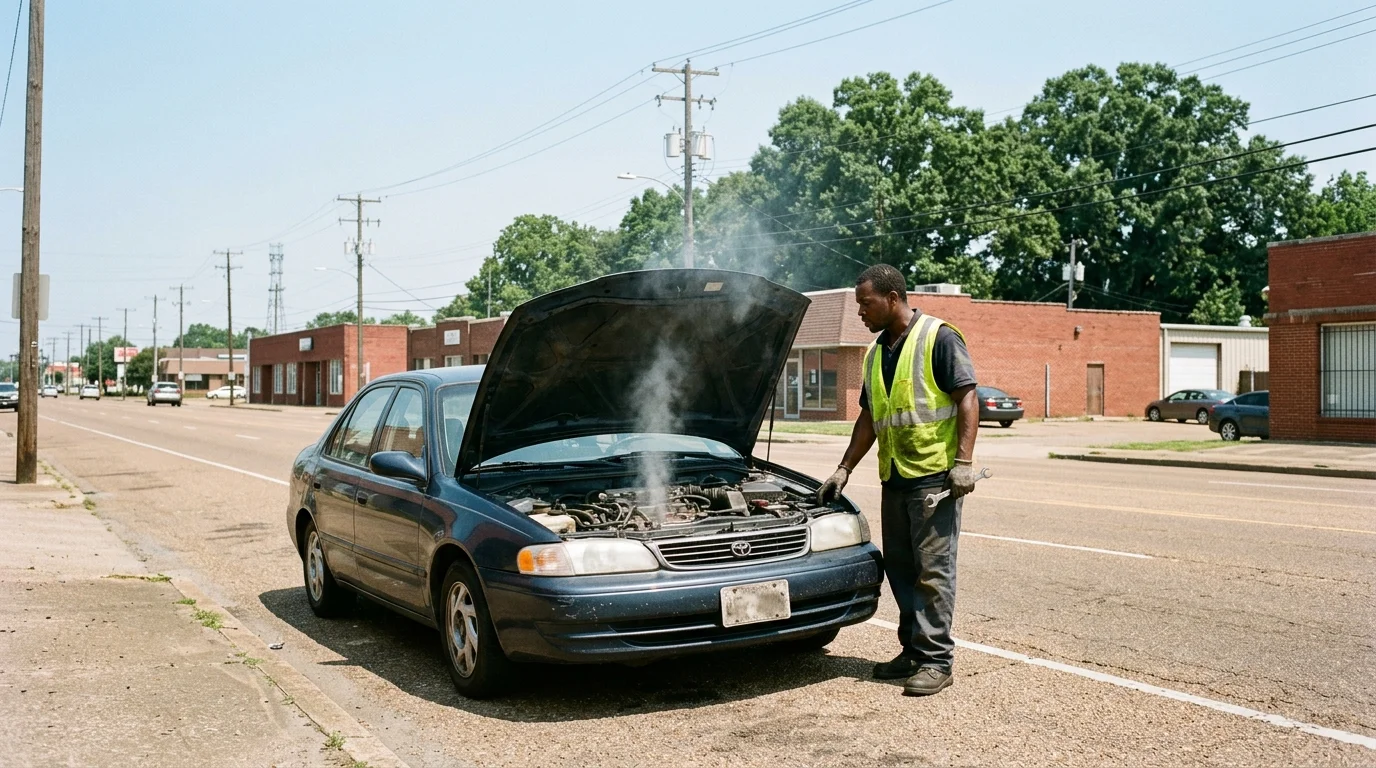
Steam curling from the hood on I-240 changes your priorities fast. A car overheating in Memphis needs a safe stop, not another mile toward home. Leave moving traffic, shut off the engine, and keep the radiator cap closed.
Car overheating in Memphis: the first ninety seconds
A rising temperature gauge, warning light, or steam calls for action. Turn off the air conditioning. Signal early, move toward a safe stopping place, and avoid crossing traffic abruptly.
Your first goal is getting clear of moving vehicles. A parking lot or side street is better than a narrow shoulder. If the car is losing power, don’t force it farther than needed for safety.
Once stopped, shift into park, set the parking brake, and turn off the engine. Switch on the hazard lights. Don’t restart the car just to see whether the warning disappears. That creates more heat before you know what failed.
Stay aware of traffic around the vehicle. Don’t stand between the car and an active lane. If leaving the vehicle would put you closer to traffic, remain buckled inside while arranging help.
The TDOT HELP Program patrols covered Tennessee interstates around Memphis. Urban patrol hours vary by day. Rural HELP covers I-269 from the Mississippi state line to Exit 19 from 6:00 a.m. to 10:30 p.m. daily, with on-call overnight support for major incidents. During service hours, dial 511 and follow the Motorist Assistance prompts. Assistance is not guaranteed.
That service list doesn’t confirm coolant or radiator-water delivery. HELP also doesn’t tow vehicles to a shop, home, or storage lot. A disabled car needing transport requires emergency towing from a private operator.
Before calling, note your road, direction of travel, nearest exit, and visible landmark. Clear location details help the referral line match the situation to an operator with suitable equipment.
Why Memphis summers punish a marginal cooling system
Memphis traffic can expose cooling problems that stayed hidden during easier driving. Long waits reduce the breaks a struggling system gets. Heat rising from the pavement adds to an already demanding trip.
The full I-240 loop brings repeated slowdowns, merges, and pockets of stopped traffic. A car may seem normal while moving, then begin heating during a backup. That pattern doesn’t identify the failed part. It does tell you the warning shouldn’t be dismissed.
Lamar Avenue carries US-78 and SR-4. TDOT’s Memphis Congestion Study describes it as the region’s top congested state road and a clogged corridor for the trucking industry. A breakdown there can place a passenger car beside steady commercial traffic. Choose a safe turnoff instead of stopping in a travel lane whenever the vehicle still moves safely.
The river crossings add another Memphis-specific concern. The Hernando de Soto Bridge carries I-40. The Memphis & Arkansas Bridge carries I-55. If overheating begins on either crossing, your immediate decisions involve traffic position as much as the engine. Our guide to breaking down on the Memphis bridges covers that setting in more detail.
Check TDOT SmartWay before crossing town when possible. Its traffic, camera, and incident information can help you avoid a long backup. That won’t repair a marginal cooling system, but it may keep a known problem away from the hardest traffic conditions.
The cap, and the one rule that never bends
Never open a radiator cap while the engine is hot. Don’t cover it with a rag and twist slowly. Don’t loosen it to “let some pressure out.” Hot liquid and steam can escape suddenly.
Turning off the engine doesn’t make the cap safe right away. Leave it closed while the system cools. Keep your hands away from escaping steam, moving components, and any fluid collecting beneath the car.
Once everything is fully cool, follow the vehicle owner’s manual. Cooling-system layouts differ. Some cars use a separate reservoir, while others require procedures that aren’t suitable beside a road. Don’t guess about which opening takes fluid.
You can make a visual check without touching hot components. Look for liquid beneath the front of the vehicle, a damaged hose, or anything obviously loose. Don’t crawl under the car. Don’t reach around belts or fans, even after shutdown.
A basic roadside visit may fit when the issue can be assessed safely as minor mechanical help. Our roadside assistance page explains the types of situations that may belong there. Describe the warning light, steam, visible leak, and how the car behaved. That lets the referral line distinguish a possible roadside task from a vehicle that should be loaded.
Avoid pouring cold water over a hot engine. Avoid repeated restarts while waiting. The safest useful action is often leaving the engine off until someone can inspect the problem under controlled conditions.
Limping it versus loading it
Driving an overheating car is a gamble with incomplete information. The warning may disappear after cooling, yet return when traffic slows. A short period of normal operation doesn’t confirm the underlying problem is gone.
If the vehicle is already parked somewhere safe, keep it there. Don’t restart it solely to avoid the inconvenience of a tow. A parking lot gives you time to arrange transport without testing the engine in live traffic.
Loading the car makes sense when steam returns, the warning remains active, fluid is visible underneath, or the engine runs poorly. It’s also the better choice when you can’t determine why the temperature rose. A towing operator can move the vehicle without requiring the engine to keep running.
Only move the car under its own power when that movement is necessary to leave immediate traffic danger. Stop again if the warning returns. Reaching the next exit isn’t proof that the car can safely reach a repair shop across Memphis.
Location changes the decision. On I-40 near the Hernando de Soto Bridge, continuing west takes you into Arkansas. Southbound I-55 eventually crosses into Mississippi. Tennessee towing rules don’t govern a tow originating in West Memphis or Southaven. Tell the referral line exactly where the vehicle sits, including which side of a state line.
Also mention whether the car rolls, steers, and shifts into neutral. Those details help identify the truck type needed. Don’t try to push a disabled vehicle through fast traffic or arrange an improvised pull with another passenger car.
What a tow protects that a tow bill does not cover
A tow prevents the trip from demanding more engine operation. It gives you control over where the car goes next, whether that’s a repair shop, home, or another suitable destination. It can’t reverse heat exposure that already happened.
Towing also isn’t a diagnosis or repair. The operator moves the vehicle. A repair facility determines why it overheated and what work may be needed. Keep those roles separate when deciding what service to request.
Price depends on distance, vehicle size, time of day, truck type, and hookup difficulty. Ask for the full total with mileage included before agreeing. Ask what circumstances could change that amount. Our guide to tow costs in Memphis explains those cost drivers without treating one figure as every operator’s final price.
Quick Tow Memphis is a referral service. We take the vehicle and location details, then match the caller with a local towing operator. That operator performs the work and contracts with the customer directly. Ask the matched operator for the total in writing before you agree.
Tell the recorded line that the car overheated, the vehicle type, pickup position, destination, and whether there’s visible fluid. The matched operator decides the equipment.
Keep any repair estimate separate from the towing charge. A tow protects the car from further driving. It doesn’t include the diagnosis, parts, labor, or a promise about the engine’s condition.
When to call us
If steam returns, the warning stays active, or the car can’t move without heating again, leave the engine off and request a towing operator. Our line takes calls 24/7 and matches callers with local operators. Call us at (901) 557-8700.