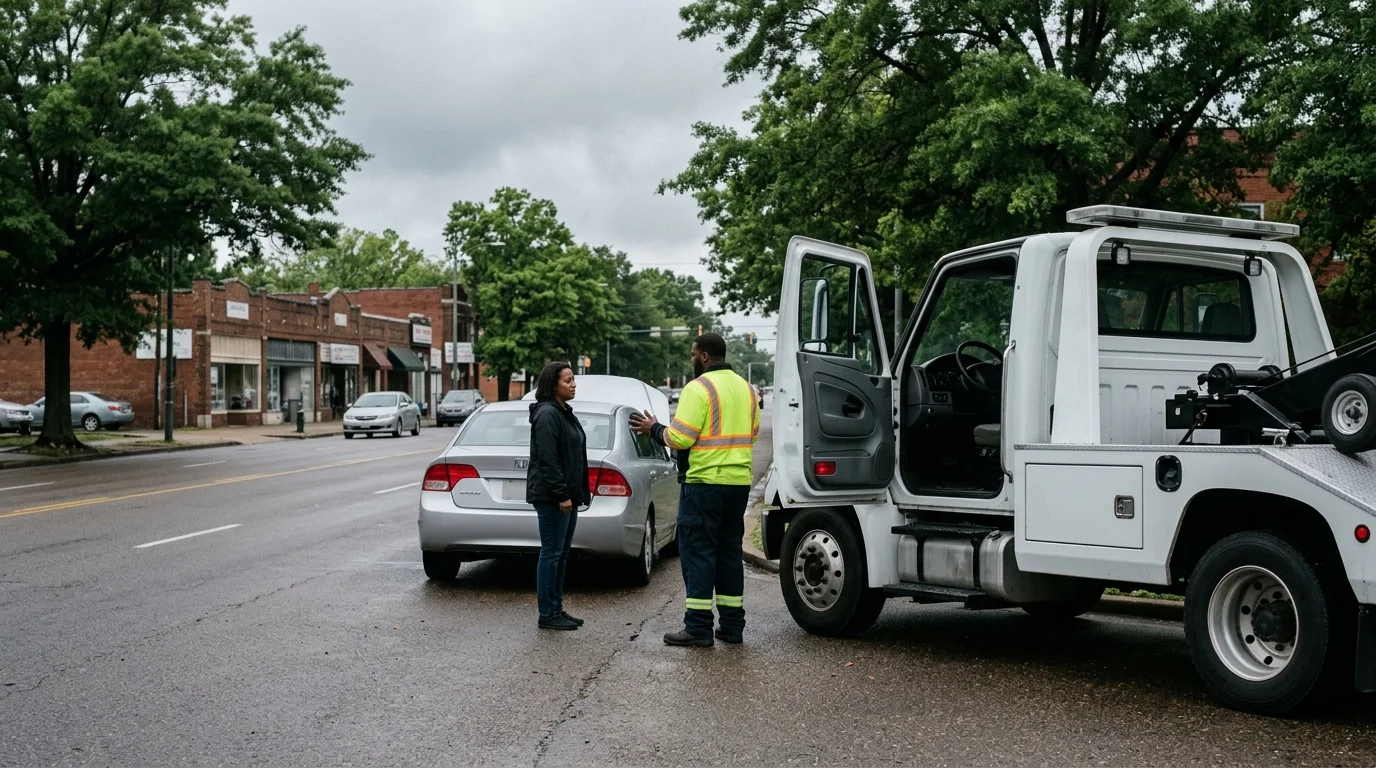
Yes. Can a tow company refuse to tow your car? It can, even when the car plainly needs moving. In Memphis, most refusals involve equipment and access, scene safety, or authority and paperwork. An MPD-controlled tow has an additional local rule protecting your choice of company.
Can a tow company refuse to tow your car in Memphis?
An ordinary towing request starts with a practical decision. The operator must determine whether the available truck can safely reach, load, and move the vehicle. A refusal usually fits one of three groups.
The first is a job mismatch. A light-duty truck may not suit a loaded commercial vehicle. A badly damaged car may need different recovery equipment. A vehicle inside a structure may sit beyond the truck’s safe reach. Those answers concern the job, not the driver.
The second group involves the scene. A vehicle may be positioned in moving traffic, unstable ground, or another unsafe location. Don’t enter a live lane or attempt your own recovery to make the job easier. Give the operator a clear description and let trained personnel decide how to approach it.
The third group concerns permission. A company may decline when the caller can’t show ownership or authority over the vehicle. Private-property work also requires proper authorization. A request from a stranded owner differs from a request to remove someone else’s car.
A refusal doesn’t always mean the answer is final. It may mean that particular operator lacks the right equipment or information. For a breakdown in traffic or another exposed location, start with an emergency towing request and describe the scene before discussing the destination.
Equipment and access often decide the call
The operator needs to understand the whole setup. “My car won’t start” isn’t enough when it has locked wheels, collision damage, or limited overhead clearance. Details that seem minor can change which truck can complete the move.
Give the vehicle’s year, make, model, and current condition. Say whether it’s loaded, whether the wheels roll, and whether the keys are present. Mention visible damage and anything blocking the truck’s approach. If the vehicle is in a garage, loading area, narrow driveway, or behind a gate, explain that before an operator accepts.
Memphis location details matter too. A sedan beside a Midtown curb presents a different setup from a commercial vehicle on Lamar Avenue, which carries US-78/SR-4 and serves heavy trucking. A disabled vehicle near the Hernando de Soto Bridge on I-40 also creates different access concerns than one sitting in a private East Memphis lot.
Vehicle class matters most with buses, commercial trucks, and other large vehicles. Those calls belong with an operator prepared for heavy-duty towing. Starting with the correct service prevents a second refusal after the first truck learns the vehicle is outside its working range.
Ask why the job was declined. “We can’t safely reach it with this truck” gives you something useful for the next call. “We don’t tow that vehicle type” does too. Pass that explanation along instead of beginning again with only the original symptom.
Your choice at a Memphis police scene
Memphis gives vehicle owners meaningful choice during an MPD-controlled tow. City wrecker rules say the owner’s chosen towing company is honored, subject to three exceptions decided by MPD.
MPD may reject that choice when the company isn’t permitted, can’t respond within a reasonable time, or the vehicle creates an immediate traffic hazard. The rule contains no promise that every selected company will accept every job. It explains when MPD can move past the owner’s selection.
That difference matters after a collision. You can name the company you want, but the company must still have suitable equipment and be able to take the call. If the vehicle is blocking traffic, MPD may prioritize clearing the hazard.
Wrecker companies operating inside Memphis must be approved by the Memphis Transportation Commission. Approval for the MPD Wrecker Rotation is a separate matter. A company’s decision to decline your private call isn’t the same as MPD declining your choice at a controlled scene.
Tennessee’s enacted 2025 towing act also addresses authorization. A vehicle generally requires the owner’s express written authorization before towing, unless a listed exception applies. Those exceptions cover certain posted lots, properly authorized private-property removals, and law-enforcement requests. Storage carries its own written-authorization requirement.
Memphis private-property rules require express written authorization identifying who approved the tow, the vehicle, and the reason for removal. If your car was removed without consent, our guide to Memphis towing rights explains the next checks. For an MPD tow that has already happened, use the official Vehicle Storage page to confirm the recovery process.
These Tennessee rules stop at the state line. A pickup beginning in Southaven follows Mississippi law. A tow beginning in West Memphis follows Arkansas law.
Refusals that deserve a closer look
A clear equipment or safety refusal usually gives you a workable next step. Vague pressure, missing paperwork, or shifting explanations deserve more attention.
Be cautious if someone wants a blank authorization signed. The document should match the vehicle, requested move, destination, and person giving permission. Don’t treat an incomplete form as routine.
For a private-property tow, ask who authorized the removal. Memphis rules require written authorization with specific vehicle details and a reason. A company that can’t identify the authorizing party isn’t giving you enough information to understand the tow.
At an MPD scene, ask which local exception applies if your chosen company is rejected. The useful answer should concern permission, reasonable response, or an immediate traffic hazard. You don’t need to argue beside moving traffic. Record the explanation and follow up from a safe place.
Price claims can also reveal a problem. Tennessee doesn’t impose one statewide dollar cap on the tow itself. Don’t rely on someone who claims every Tennessee tow carries the same legal maximum. Ask for the full total with mileage included before agreeing. Also ask what conditions could change that total.
A professional explanation can still be brief. “Wrong truck,” “unsafe access,” or “missing authority” tells you how to proceed. A refusal paired with demands for money, an unclear destination, or paperwork that doesn’t match the request deserves a pause.
Make the next call easier
The second call works better when you lead with the reason for the first refusal. Tell the next provider that the previous truck couldn’t handle the vehicle’s weight, enter the structure, or approach the scene safely. That information helps match the request correctly.
Start with the exact pickup location. On an interstate, give the route, direction of travel, nearest exit, and whether the car blocks a lane. Distinguish the Hernando de Soto Bridge on I-40 from the Memphis & Arkansas Bridge on I-55. Don’t simply say “the bridge.”
Next, describe the vehicle and its condition. Include visible collision damage, locked wheels, missing wheels, a loaded trailer, or limited clearance. Say where the vehicle needs to go and whether you can show ownership or authorization.
Then confirm the financial details. Distance, vehicle size, time of day, truck type, and hookup difficulty can affect the total. Ask for that operator’s full total with mileage included, in writing, before you agree. Ask what could change it. The matched operator performs the work and contracts with you directly.
Sometimes a tow isn’t the right service. A flat tire, fuel problem, or minor mechanical issue may call for roadside help instead. Our guide to roadside assistance in Memphis can help you separate those situations from jobs that require a tow.
Don’t conceal difficult access or vehicle damage to secure a yes. An operator who accepts the wrong description may still decline after seeing the scene. Accurate details give the next call its best chance.
When to call us
When the car can’t move safely or needs recovery equipment, the work belongs with a towing operator. The recorded line takes calls 24/7 and matches you with a local operator. Call us at (901) 557-8700.